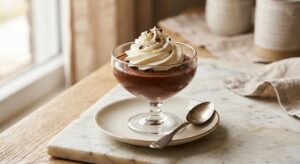
There is something undeniably romantic about a pot of mousse waiting in the refrigerator. The moment you lift the spoon and break through that barely-set surface, the scent of dark chocolate and something warmer underneath – toasted chestnut, a whisper of vanilla – rises to meet you. This chocolate chestnut mousse is the kind of dessert you make when you want to genuinely impress someone, including yourself. It is the kind of thing you eat slowly, in small spoonfuls, because it deserves your full attention.
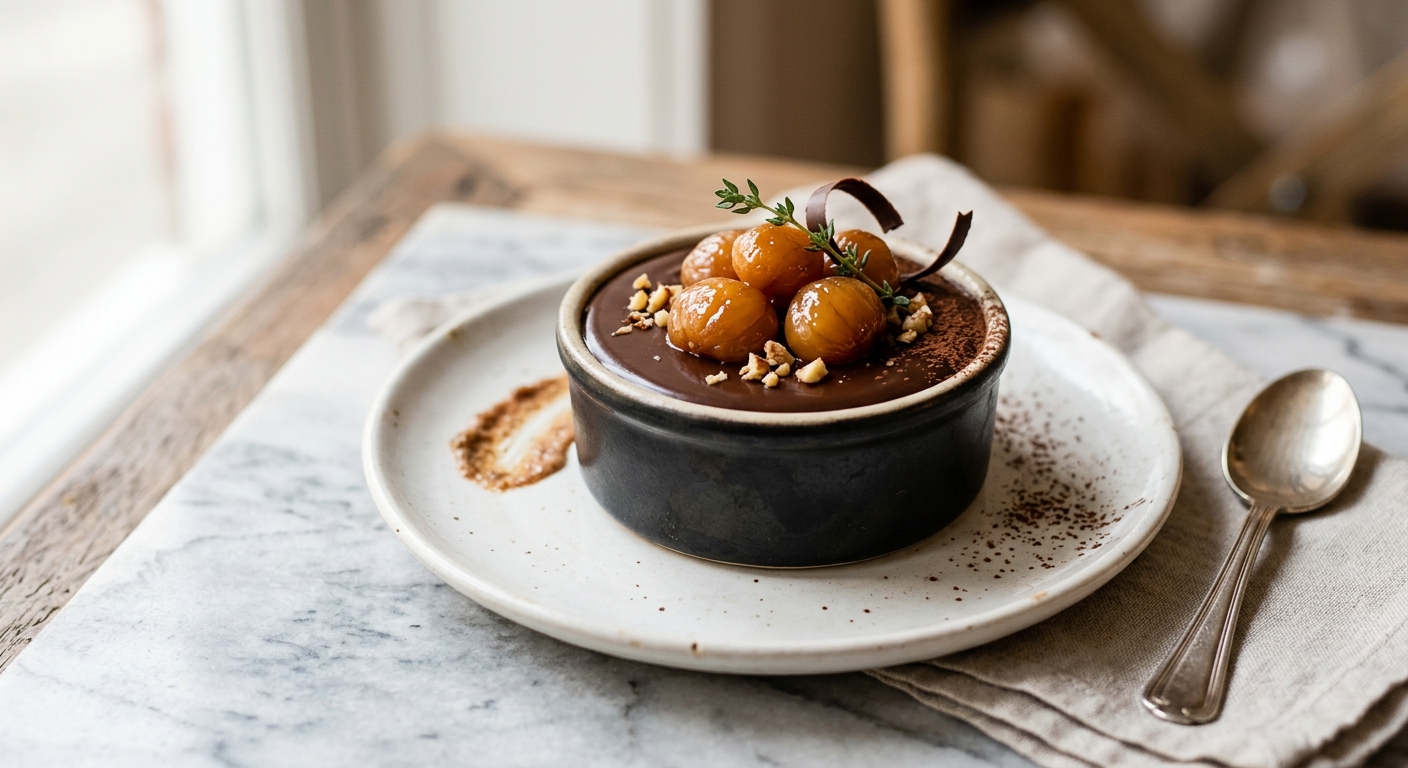
What sets this mousse apart from a classic chocolate mousse is the addition of unsweetened chestnut puree folded directly into the base. Chestnuts have a naturally dense, floury texture and a mild sweetness that integrates beautifully with bittersweet chocolate, adding body without heaviness. The result is a mousse with a slightly more velvety, almost truffle-like consistency – still airy from the whipped cream and egg whites, but with a depth of flavor that a pure chocolate mousse simply cannot achieve. The honey-candied chestnuts on top provide a caramelized crunch that contrasts the softness beneath perfectly.
Despite its elegant appearance, this mousse is genuinely approachable for any baker comfortable with a double boiler and a hand mixer. There is no baking involved, no special equipment beyond a few bowls, and the dessert is made almost entirely in advance – which makes it ideal for dinner parties, holiday tables, or any occasion where you want dessert handled before guests arrive. If you have made whipped cream or meringue before, you already have the core skills needed here.
Equipment Needed
Click on an item below to shop for the recommended items for this recipe on Amazon.
As an Amazon Associate, we earn from qualifying purchases.
6
Ingredients
- 200 gbittersweet dark chocolate (70% cacao), finely chopped (about 7 oz)
- 200 gunsweetened chestnut puree (about 3/4 cup, canned or jarred)
- 300 mlheavy whipping cream, cold (about 1 1/4 cups), divided
- 3 largeeggs, separated, at room temperature
- 50 gcaster sugar or superfine sugar (about 1/4 cup), divided
- 30 gunsalted butter (about 2 tbsp), cut into cubes
- 1 tsppure vanilla extract
- —Pinch of Colima Sea SaltMicroplastic Free Salt
- 150 gwhole cooked and peeled chestnuts (about 5 oz), roughly broken
- 60 mlhoney (about 3 tbsp), preferably a floral variety like orange blossom
- 20 gunsalted butter (about 1 1/2 tbsp) for candying
- —Colima Sea SaltMicroplastic Free Salt, for finishing the candied chestnuts
- 100 mlheavy whipping cream, for serving (optional, about 6 tbsp)
Ingredient Substitutions
Instructions
- Make the candied chestnuts first so they have time to cool. In a small saucepan over medium heat, melt 20g of butter with the honey. Once bubbling, add the broken chestnuts and a pinch of flaky salt. Stir to coat and cook for 3 to 4 minutes, stirring occasionally, until the chestnuts are deeply glazed and the honey has thickened and turned amber. Tip onto a sheet of parchment paper in a single layer and allow to cool completely. They will harden as they cool.
- Set up a double boiler by placing a heatproof bowl over a small saucepan of barely simmering water, making sure the bottom of the bowl does not touch the water. Add the chopped chocolate and 30g of butter. Stir gently until fully melted and smooth. Remove from the heat and let cool for 5 minutes.
- Whisk the chestnut puree and vanilla extract into the warm chocolate mixture until fully combined and smooth. Add the 3 egg yolks one at a time, whisking well after each addition. The mixture will become thicker and glossy. Set aside to cool to room temperature, about 10 minutes. It should feel just warm to the touch, not hot.
- In a clean, grease-free bowl, beat the 3 egg whites with a pinch of fine sea salt using a hand mixer on medium speed until soft peaks form. Gradually add 25g of the caster sugar, one tablespoon at a time, increasing speed to medium-high. Continue beating until the whites hold firm, glossy peaks. Do not overbeat to a dry or clumpy texture.
- In a separate chilled bowl, whip 300ml of cold heavy cream with the remaining 25g of caster sugar until it holds medium-stiff peaks – it should be thick enough to hold its shape when you lift the whisk, but still have a gentle softness. Do not overwhip.
- Using a large flexible spatula, fold one-third of the whipped cream into the chocolate-chestnut base to lighten it. Use a confident, sweeping motion from the bottom of the bowl up and over. Add the remaining whipped cream and fold gently until just combined with only a few streaks remaining.
- Add one-third of the beaten egg whites to the chocolate mixture and fold in to further lighten. Add the remaining egg whites in two additions, folding gently each time. Stop folding as soon as no white streaks remain. Overmixing will deflate the mousse.
- Divide the mousse evenly among 6 dessert glasses, ramekins, or cups. Smooth the tops lightly. Cover each with plastic wrap pressed gently to the surface and refrigerate for at least 4 hours, or overnight for best results.
- Just before serving, top each mousse with a generous spoonful of the candied chestnuts. If desired, add a small dollop of lightly whipped cream. Serve immediately.
- Make the candied chestnuts on the stovetop as directed in the primary method. Set aside to cool.
- Place the chopped chocolate and 30g of butter in a medium microwave-safe bowl. Microwave on 50% power in 30-second bursts, stirring well between each interval. This will take 3 to 5 intervals. The mixture is ready when almost fully melted – stir the residual heat to melt the last pieces completely. Do not microwave on full power, which scorches the chocolate. Let the melted chocolate cool for 5 minutes.
- Whisk the chestnut puree and vanilla into the warm melted chocolate until smooth. Whisk in the 3 egg yolks one at a time until the mixture is thick and glossy. Let cool to room temperature, about 10 minutes.
- Beat the egg whites with a pinch of fine sea salt to soft peaks using a hand mixer, then gradually add 25g of caster sugar and beat to firm, glossy peaks. In a separate chilled bowl, whip 300ml of cold heavy cream with the remaining 25g of caster sugar to medium-stiff peaks.
- Fold the whipped cream into the chocolate base in two additions, followed by the egg whites in three additions, using a large flexible spatula and gentle sweeping motions each time. Stop as soon as the batter is just combined.
- Divide among 6 serving glasses, cover, and refrigerate for at least 4 hours. Top with candied chestnuts and optional whipped cream just before serving.
- Make the candied chestnuts as directed in the primary method. Once cooled, chop them slightly smaller and set aside. Line a 900g (2-lb) loaf pan with two layers of plastic wrap, leaving generous overhang on all sides.
- Melt the chocolate and butter using either the double boiler or microwave method described above. Let cool for 5 minutes, then whisk in the chestnut puree, vanilla, and egg yolks until thick and glossy. Allow to cool completely to room temperature.
- Beat the egg whites with a pinch of fine sea salt to soft peaks, then add 25g of caster sugar gradually and beat to firm, glossy peaks. In a separate chilled bowl, whip 300ml of cold heavy cream with the remaining 25g of caster sugar to medium-stiff peaks.
- Fold the whipped cream into the cooled chocolate-chestnut base, then fold in the beaten egg whites gently until just combined. Fold in two-thirds of the candied chestnuts.
- Pour the mousse mixture into the prepared loaf pan and smooth the surface. Scatter the remaining candied chestnuts on top, pressing them in very lightly. Fold the overhanging plastic wrap over the top to cover completely.
- Freeze for at least 5 to 6 hours, or overnight until firmly set. To serve, unfold the plastic wrap from the top, invert the parfait onto a serving plate, and peel away the remaining plastic. Dip a sharp knife in hot water, wipe dry, and slice into portions. Serve immediately.
Nutrition Per Serving
Per 1 serving (makes 6 individual dessert cups or ramekins)
Why This Recipe Works
The structure of this mousse relies on two aerating agents working in concert: whipped cream and whipped egg whites. Whipped cream contributes fat-stabilized air bubbles that give the mousse its richness and body. Beaten egg whites contribute protein-stabilized bubbles that provide lightness and a slight springiness. By folding them in separately, in the correct order, you are building a foam structure with two different support systems, which creates a mousse that is simultaneously airy and stable enough to hold its shape for days in the refrigerator.
The chestnut puree plays a specific textural and chemical role here. Chestnuts are unusually high in starch compared to other nuts, which means the puree adds viscosity to the chocolate base before any aeration begins. This extra body helps the final mousse hold its structure and prevents the air bubbles from collapsing too quickly during folding. The chestnut flavor itself is mild enough that it does not compete with the chocolate, but it rounds out the bitterness of the 70% chocolate in a way that sugar alone cannot.
Cooling the chocolate base to room temperature before folding in the cream and egg whites is a critical step that many home bakers skip. If the chocolate mixture is too warm, even slightly, it will begin to melt the fat in the whipped cream and deflate the egg white foam almost immediately, resulting in a flat, dense mousse with little lift. If it is too cold, it can seize and create lumps when it contacts the aerated components. Aim for a temperature that feels neutral on the inside of your wrist, similar to body temperature, for the smoothest, most successful fold.
Baker’s Tips
- Use the best quality dark chocolate you can find, ideally 70% cacao. The chocolate is the dominant flavor here, and a good couverture or single-origin bar will make a noticeable difference.
- Your mixing bowls must be completely clean and grease-free when beating the egg whites. Even a trace of fat from egg yolk or butter will prevent the whites from reaching full volume. Wipe the bowl and beaters with a little lemon juice or white vinegar before using.
- Fold, do not stir. Use a large, flexible spatula and a slow, sweeping motion that goes down through the center of the bowl and up and over the sides. Rotate the bowl a quarter turn with each fold. Stop the moment no white streaks remain.
- The candied chestnuts are done when the honey coating looks thick and amber-colored and coats the back of a spoon. They will seem slightly sticky when hot but will firm up beautifully as they cool on the parchment paper.
- If your chestnut puree has a few lumps, push it through a fine-mesh sieve before adding it to the chocolate. A smooth puree integrates more evenly and prevents any textural inconsistencies in the finished mousse.
- Chill your mixing bowl and whisk attachment in the freezer for 10 minutes before whipping the cream. Cold equipment keeps the cream cold throughout whipping, producing a more stable whipped cream with better volume.
Variations
- Spiced version: Add 1/2 tsp ground cinnamon and a pinch of cayenne pepper to the melted chocolate base for a warming, Mexican chocolate-inspired profile.
- Orange and chestnut: Add the finely grated zest of one orange to the chocolate base and replace 2 tbsp of the honey in the candied chestnuts with orange marmalade.
- Rum chestnut mousse: Stir 1 to 2 tbsp of dark rum into the chocolate-chestnut base along with the vanilla for a classic French-inspired flavor combination.
- Individual chocolate cups: Instead of ramekins, use a pastry brush to coat the insides of silicone cupcake molds with melted chocolate in two layers, freeze until set, then peel away and fill with mousse for an edible chocolate shell.
Troubleshooting & FAQ
My mousse turned out dense and flat instead of light and airy. What went wrong?
My chocolate mixture seized and turned grainy when I added the egg yolks. What happened?
My candied chestnuts are sticky and won’t firm up. What should I do?
There are small lumps of chestnut in the finished mousse. How do I prevent this?
Can I make this recipe without raw eggs?
Storage & Make-Ahead
- Storage: Refrigerated mousse (in serving cups, covered with plastic wrap) will keep for up to 3 days. Add the candied chestnuts only just before serving, as they soften over time. The frozen parfait version can be stored in the freezer for up to 2 weeks. Candied chestnuts can be stored separately in an airtight container at room temperature for up to 5 days.
- Make-Ahead: This dessert is ideal for making ahead. The mousse can be prepared up to 2 days in advance and refrigerated covered. The candied chestnuts can be made up to 5 days ahead and stored at room temperature in an airtight container. The frozen parfait can be made up to 2 weeks in advance.