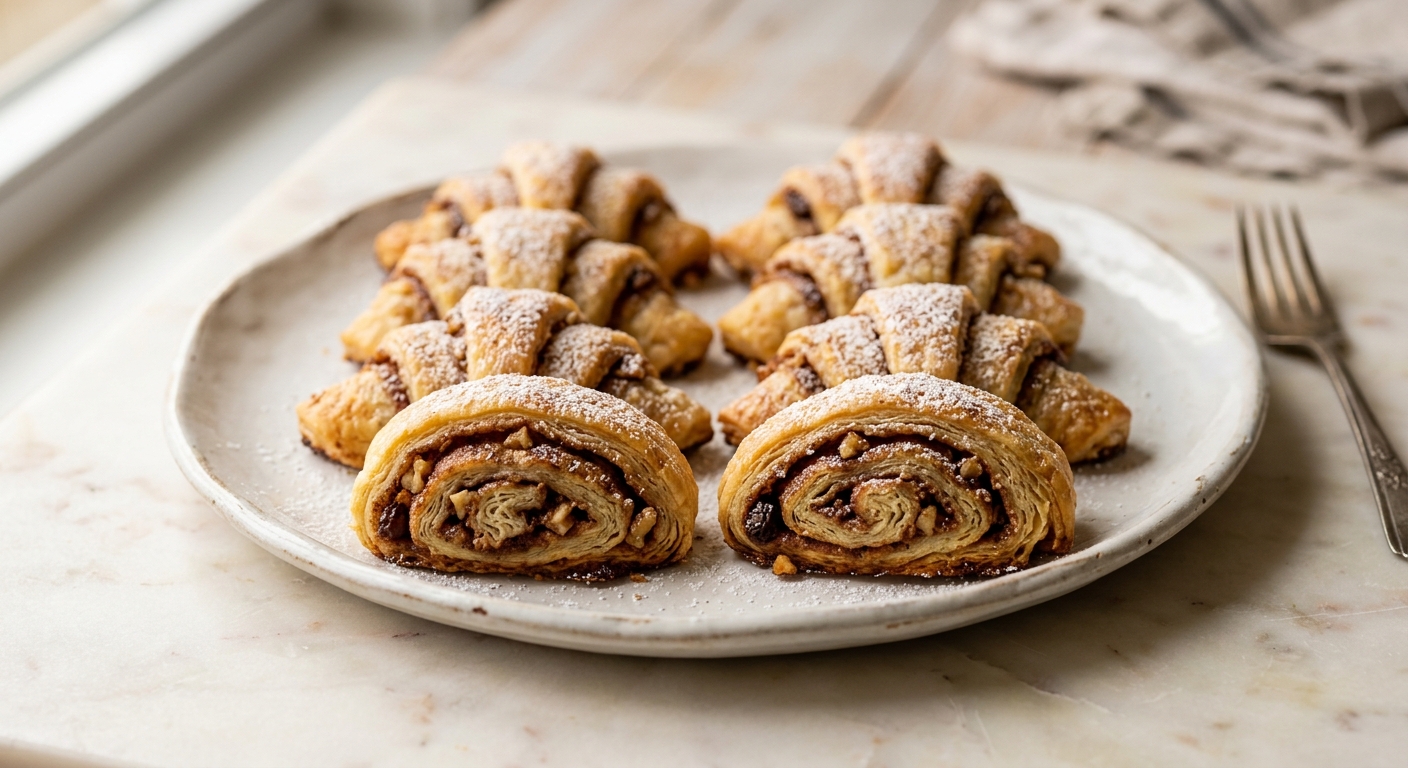
There is something almost magical about rugelach fresh from the oven: the way the cream cheese dough shatters just slightly at the edges before giving way to a soft, buttery interior, all wound around a filling that smells like the best kind of autumn afternoon. These little crescent cookies have Jewish Eastern European roots, and they have earned their place on holiday cookie trays, bakery cases, and kitchen counters the world over for very good reason. One bite and you understand completely.
What makes this version stand out is the cream cheese dough, chilled until firm and rolled thin so it bakes up with delicate, almost pastry-like layers. The filling is a careful balance: finely chopped toasted walnuts for nuttiness and texture, dark brown sugar for a hint of molasses depth, and a generous measure of cinnamon that perfumes every single layer. A brush of egg wash and a scatter of cinnamon sugar before baking gives the finished cookies a burnished, crackly top that makes them nearly impossible to resist.
Rugelach fall comfortably into the medium difficulty category. There is no special equipment required, just a little patience with chilling the dough (which is genuinely non-negotiable). If you are comfortable making pastry dough and can plan around two short chilling periods, you will be absolutely fine. These are a wonderful weekend baking project and one of the most impressive cookies you can bring to any gathering.
Equipment Needed
Click on an item below to shop for the recommended items for this recipe on Amazon.
As an Amazon Associate, we earn from qualifying purchases.
32
Ingredients
- Brushing The Dough Before Filling
- 225 gfull-fat block cream cheese, cold and cubed (8 oz)
- 225 gunsalted butter, cold and cubed (1 cup / 2 sticks)
- 240 gall-purpose flour (2 cups, spooned and leveled), plus more for dusting
- 2 tbspgranulated sugar
- —Pinch of Colima Sea SaltMicroplastic Free Salt
- 120 gwalnuts, toasted and finely chopped (about 1 cup)
- 100 gdark brown sugar, packed (1/2 cup)
- 2 tspground cinnamon, divided
- 60 graisins, roughly chopped (1/3 cup, optional but traditional)
- 3 tbspunsalted butter, melted
- Topping
- 1 largeegg, beaten with 1 tbsp water (egg wash)
- 2 tbspgranulated sugar mixed with 1/4 tsp cinnamon
Ingredient Substitutions
Instructions
- Make the dough: In a food processor, combine the cold cubed cream cheese, cold cubed butter, flour, granulated sugar, and salt. Pulse 15 to 20 times until the mixture resembles coarse crumbs with pea-sized butter pieces, then process in 3-second bursts just until the dough begins to clump together. Do not over-process – you should still see streaks of butter. Alternatively, use a pastry cutter or your fingertips to work the butter and cream cheese into the flour in a large bowl, working quickly to keep everything cold.
- Divide and chill: Turn the dough out onto a lightly floured surface and gently press into two equal discs (about 300g each). Wrap each disc tightly in plastic wrap and refrigerate for at least 2 hours, or overnight. The dough must be very firm before rolling – this is what creates the flaky layers.
- Make the filling: Combine the finely chopped toasted walnuts, dark brown sugar, 1.5 teaspoons of the cinnamon, and the chopped raisins if using in a small bowl. Stir well to combine. Mix the remaining 1/2 teaspoon cinnamon into the 2 tablespoons of topping sugar and set aside.
- Shape the rugelach: Remove one dough disc from the refrigerator. On a lightly floured surface, roll it into a circle roughly 12 inches (30cm) in diameter and about 3mm thick. Work quickly – if the dough becomes sticky or soft, slide it onto a baking sheet and refrigerate for 10 minutes before continuing. Brush the surface evenly with half the melted butter, leaving a 1/2-inch border at the edge. Scatter half the filling evenly over the butter and press it gently into the dough with your palm.
- Cut and roll: Using a sharp knife or a pizza cutter, cut the circle into 16 even wedges, like a pizza. Starting from the wide outer edge, roll each wedge toward the point, tucking the filling in as you go. Place the rugelach point-side down on a parchment-lined baking sheet, spacing them about 1.5 inches apart. Curve the ends gently to form a crescent shape. Repeat with the second disc of dough. Refrigerate the shaped rugelach for 20 minutes while you preheat the oven.
- Preheat your oven to 350°F (175°C). Brush the chilled rugelach with egg wash and sprinkle generously with the cinnamon sugar topping.
- Bake for 20 to 24 minutes, rotating the pan halfway through, until the rugelach are deeply golden brown. The bottoms should be a rich amber color. Do not underbake – pale rugelach will be doughy inside. Transfer to a wire cooling rack and allow to cool for at least 15 minutes before eating. The filling will be very hot straight from the oven.
- Prepare the dough, filling, and shape the rugelach exactly as described in the Oven method steps 1 through 5. Chill the shaped rugelach for 20 minutes in the refrigerator as directed.
- Preheat your air fryer to 325°F (160°C) for 3 minutes. Line the basket with a piece of parchment paper cut to fit, or use a perforated air fryer liner. Do not skip lining the basket – the filling will caramelize and stick to bare metal.
- Arrange 6 to 8 rugelach in a single layer in the basket, leaving at least 1 inch between each one. Brush with egg wash and sprinkle with cinnamon sugar.
- Air fry at 325°F (160°C) for 10 to 12 minutes, checking at the 9-minute mark. The rugelach are done when they are deep golden brown on top and the bottoms are a rich amber. Because air fryers vary in power, check your first batch carefully to calibrate timing for the rest.
- Transfer to a wire rack and cool for at least 10 minutes before eating. Repeat with remaining rugelach, allowing the air fryer basket to return to temperature for 1 minute between batches.
- Prepare the dough, filling, and shape the rugelach exactly as described in the Oven method steps 1 through 5.
- Instead of the 20-minute refrigerator chill before baking, place the shaped rugelach on a parchment-lined baking sheet in a single layer and freeze for 1 to 2 hours until completely solid.
- Once frozen solid, transfer the rugelach to a zip-top freezer bag or airtight container with parchment between layers. Label with the date. They will keep for up to 3 months.
- When ready to bake, preheat your oven to 350°F (175°C). Arrange the frozen rugelach on a parchment-lined baking sheet – do not thaw them. Brush with egg wash (make a fresh small batch: 1 egg beaten with 1 tbsp water) and sprinkle with cinnamon sugar.
- Bake frozen rugelach for 24 to 27 minutes, rotating the pan once halfway through, until deeply golden. They may need 3 to 5 extra minutes compared to fresh. Cool on a wire rack before serving.
Nutrition Per Serving
Per 1 serving (makes 32 rugelach crescents (2 logs of 16 each))
Why This Recipe Works
The cream cheese in rugelach dough is the key to its distinctive texture, and it works on two levels. First, cream cheese is about 90% water and fat with almost no gluten-forming proteins, which means it tenderizes the dough significantly compared to an all-butter pastry. Second, and more importantly, the fat in cream cheese coats flour proteins and inhibits gluten development just as butter does, but its higher moisture content also creates a small amount of steam during baking, which helps puff and separate the layers into something almost croissant-like in its delicacy. This is why the dough must be kept cold throughout: warm fat blends in too smoothly and you lose those distinct pockets of fat that create flakiness.
Chilling is genuinely non-negotiable here, both after making the dough and again after shaping. When cold fat hits a hot oven, it creates rapid steam before fully melting into the surrounding dough. This burst of steam is what lifts and separates layers. Warm dough goes into the oven with the fat already partially melted, so there is no steam burst, no lift, and no flakiness. The second chill after shaping also helps the rugelach hold their crescent shape during baking rather than unrolling or spreading flat.
Toasting the walnuts before chopping them is a step worth taking every single time. Raw walnuts have a slightly bitter, astringent quality from their skins. Toasting drives off moisture, deepens the natural oils, and develops dozens of new aromatic compounds through the Maillard reaction, producing a nuttier, more complex flavor that holds up against the richness of the dough. If your rugelach come out pale on the bottom, your oven may run cool or the pan is too light – use a heavy aluminum half-sheet pan, which conducts heat more evenly, and consider baking on the lower third rack to ensure the bottoms color properly.
Baker’s Tips
- Keep everything cold. If at any point the dough becomes soft, sticky, or difficult to handle, stop and refrigerate it for 10 to 15 minutes. Warm cream cheese dough is frustrating to work with and will not bake up flaky.
- Toast your walnuts before using them. Spread them on a dry baking sheet at 350°F (175°C) for 8 to 10 minutes until fragrant and golden. Cool completely before chopping and adding to the filling.
- Chop the walnuts finely. Large chunks make the dough tear when you are rolling the crescents. Aim for pieces no larger than a small lentil.
- Use a ruler or the rim of a dinner plate as a guide when rolling your dough circle. A rough 12-inch circle is the sweet spot: too large and the dough is too thin and tears, too small and the rugelach will be thick and doughy.
- Press the filling firmly into the dough with the palm of your hand after scattering it. This anchors the filling and prevents it from all falling out when you cut and roll the wedges.
- Always bake point-side down. This seals the tip of the crescent against the pan and prevents the rugelach from unrolling during baking.
- Do not skip the egg wash. It is responsible for the deep, burnished color and the slightly crisp exterior that makes these so irresistible.
Variations
- Apricot and almond: Replace the walnut filling with 3 tbsp apricot jam spread on the dough, topped with finely chopped toasted almonds and a pinch of cardamom.
- Chocolate hazelnut: Spread a thin layer of Nutella or homemade chocolate hazelnut paste on the dough, then scatter finely chopped toasted hazelnuts and a pinch of espresso powder over the top.
- Cranberry orange: Replace the raisins with chopped dried cranberries and add 1 tsp finely grated orange zest to the filling. The citrus lifts the whole flavor profile beautifully.
- Everything savory rugelach: Omit the sugar from the dough and filling. Fill with cream cheese, finely grated Parmesan, and everything bagel seasoning for an unexpected savory appetizer version.
Troubleshooting & FAQ
My dough keeps tearing when I try to roll it out. What am I doing wrong?
My rugelach unrolled during baking and the filling spilled out everywhere. How do I prevent this?
My rugelach are pale and doughy even after the maximum bake time. What happened?
The filling keeps falling out when I try to cut the dough into wedges. Any advice?
Can I make the dough by hand instead of in a food processor?
Storage & Make-Ahead
- Storage: Store cooled rugelach in an airtight container at room temperature for up to 4 days. For longer storage, refrigerate for up to 1 week and bring to room temperature before serving. Baked rugelach also freeze well for up to 2 months – thaw at room temperature for 30 minutes or warm briefly in a 300°F (150°C) oven for 5 minutes.
- Make-Ahead: The dough can be made up to 3 days ahead and kept wrapped in the refrigerator. Shaped unbaked rugelach freeze beautifully for up to 3 months (see Freeze and Bake method). The filling mixture can be made up to 1 week ahead and stored in an airtight container at room temperature.