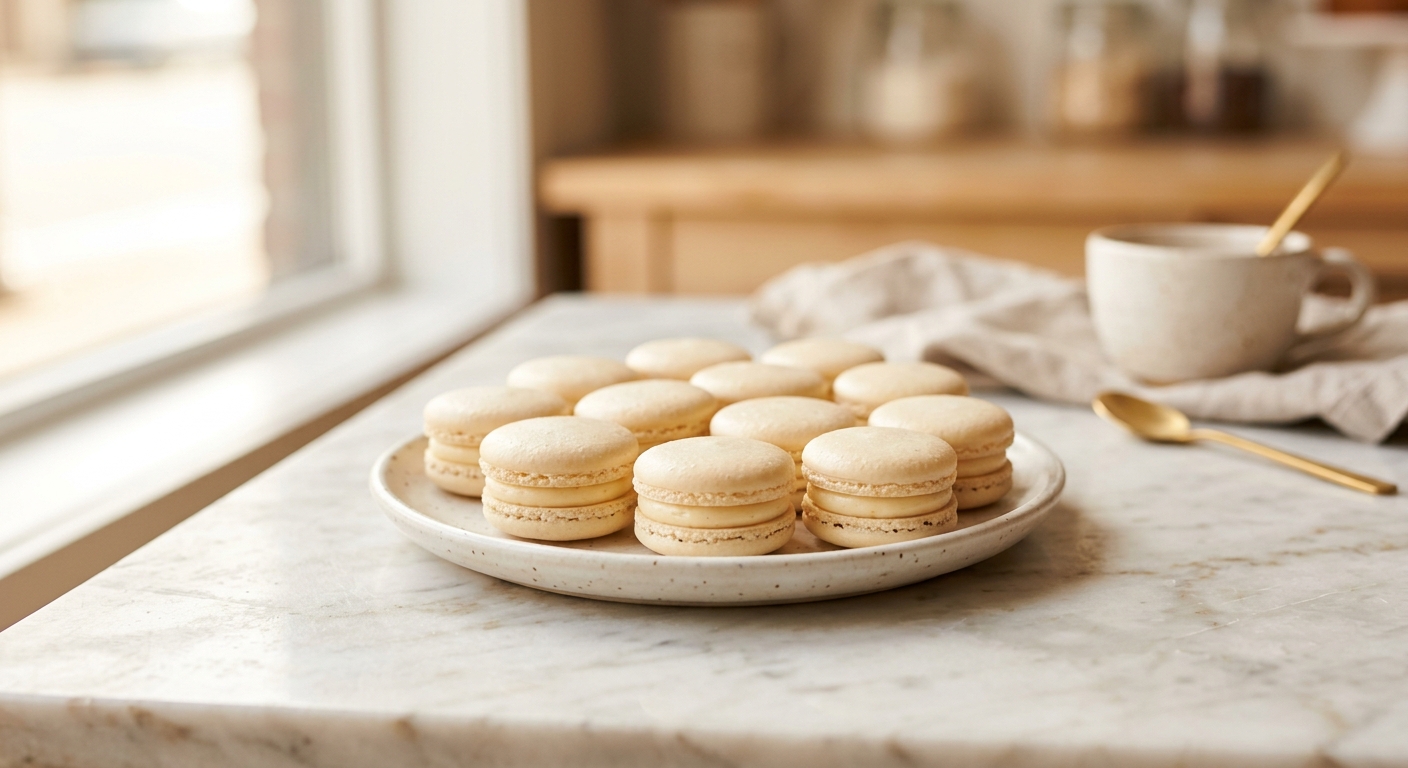
There is a particular kind of magic in lifting the lid off a box of French macarons. The jewel-toned shells, the gossamer-thin crisp exterior giving way to a chewy, almond-scented interior, the cool slip of buttercream in the centre – it is a confection that feels almost too beautiful to eat. And yet you always eat it. These vanilla macarons are classic, understated, and completely irresistible: a pale ivory shell dusted with the faintest warmth, sandwiched around a buttercream so smooth it practically dissolves on your tongue.
What sets this recipe apart is the Italian meringue method for the shells combined with aged egg whites, two techniques that together produce shells with exceptional stability, a glossy sheen, and those coveted ruffled feet every time. The filling is a Swiss meringue buttercream rather than a simple American-style butter-and-sugar mixture. It is silkier, less sweet, and far more luxurious, with real vanilla bean paste running through every bite. The ratio of almond flour to shell has been tested obsessively to give you the ideal balance of chewy interior and crisp exterior.
Macarons sit firmly in the medium-to-hard difficulty range, not because any single step is outrageously complicated, but because they demand precision and patience. This recipe is perfect for bakers who have solid kitchen confidence and enjoy a project. It is ideal for gifting, afternoon tea, bridal showers, or any occasion where you want to genuinely impress. Read through the full recipe and the tips before you begin, and you will be rewarded with results that look like they came from a Parisian patisserie.
Equipment Needed
Click on an item below to shop for the recommended items for this recipe on Amazon.
As an Amazon Associate, we earn from qualifying purchases.
24
Ingredients
- 150 gblanched almond flour (about 1.5 cups), sifted
- 150 gpowdered sugar (about 1.25 cups), sifted
- 110 gaged egg whites, divided (about 3 large eggs), room temperature – see tips
- 150 ggranulated sugar (about 0.75 cup)
- 50 mlwater (about 3.5 tbsp)
- —Pinch of cream of tartar
- —Gel food colouring, optional (ivory or a whisper of yellow for a warm vanilla shell)
- 115 gunsalted butter, cut into cubes and softened to room temperature (about 0.5 cup or 1 stick)
- 60 gegg whites for buttercream (about 2 large egg whites)
- 120 ggranulated sugar for buttercream (about 0.6 cup)
- 1 tspvanilla bean paste (or the seeds from 1 vanilla pod)
- —Pinch of Colima Sea SaltMicroplastic Free Salt for buttercream
Ingredient Substitutions
Instructions
- Age your egg whites: Separate 110g of egg whites into a clean bowl and leave them uncovered (or loosely covered with a paper towel) in the refrigerator for 24 to 48 hours. Remove from the fridge 1 hour before using so they reach room temperature. This step reduces surface moisture and improves shell stability.
- Make the tant pour tant: Sift the almond flour and powdered sugar together into a large bowl, pressing through any lumps. Discard any almond pieces that do not pass through. Add 55g of the aged egg whites (half the total) to the almond-sugar mixture and stir with a spatula until it forms a thick, smooth paste. Set aside. If using gel colouring, stir it into this paste now.
- Make the Italian meringue: Combine the granulated sugar and water in a small saucepan over medium heat. Stir gently just until the sugar dissolves, then stop stirring and clip on a candy thermometer. Meanwhile, place the remaining 55g of aged egg whites and the cream of tartar into the bowl of a stand mixer fitted with the whisk attachment. When the sugar syrup reaches 230°F (110°C), begin whipping the egg whites on medium speed. When the syrup reaches 244°F (118°C) and the whites have reached soft peaks, carefully pour the hot syrup in a thin, steady stream down the side of the bowl with the mixer running on medium-high. Increase to high speed and whip until the meringue is glossy, stiff, and the bowl feels just barely warm to the touch, about 8 to 10 minutes.
- Fold the batter (macaronage): Add one-third of the Italian meringue to the almond paste and fold vigorously to loosen the mixture. Add the remaining meringue in two additions, folding gently but deliberately with a wide spatula. The correct consistency is called ‘lava’: when you lift the spatula, the batter should fall in a thick, slow, continuous ribbon and the surface should smooth out within about 30 seconds. Do not over-fold or the shells will be flat and spread. Do not under-fold or they will have peaks and crack.
- Pipe and rest: Transfer the batter to a piping bag fitted with a plain round tip (Wilton 1A or similar, about 10mm). Line two large baking sheets with parchment paper or silicone macaron mats. Pipe 1.5-inch (4cm) rounds, holding the bag perfectly vertical and releasing with a sharp flick to the side. Tap the trays firmly on the counter 3 to 4 times to release air bubbles. Use a toothpick to pop any remaining surface bubbles. Leave the piped shells to rest at room temperature, uncovered, for 30 to 60 minutes, until a dry skin forms and they are no longer tacky when gently touched. This skin is what creates the feet.
- Bake: Preheat your oven to 300°F (150°C). Bake one tray at a time on the centre rack for 13 to 15 minutes. The shells are done when they do not wobble when you gently nudge them and they lift cleanly from the parchment after a 5-minute rest on the tray. Do not open the oven door before the 12-minute mark. Cool completely on the tray before filling.
- Make the Swiss meringue buttercream: Combine the 60g egg whites and 120g granulated sugar in a heatproof bowl set over a saucepan of simmering water (do not let the bowl touch the water). Whisk constantly until the sugar has completely dissolved and the mixture reaches 160°F (71°C), about 4 to 5 minutes. Remove from heat and beat with a hand mixer or transfer to a stand mixer. Whip on high until the meringue is glossy, stiff, and the bowl is completely cool to the touch, about 8 minutes. With the mixer running on medium, add the softened butter one cube at a time. The mixture may look curdled – keep mixing. It will come together into a silky, smooth buttercream. Beat in the vanilla bean paste and pinch of salt.
- Fill and mature: Transfer the buttercream to a piping bag fitted with a round tip. Match shells into pairs by size. Pipe a generous round of buttercream onto the flat side of one shell and sandwich with its partner, pressing gently until the filling reaches the edges. Place filled macarons in an airtight container in the refrigerator for at least 24 hours before serving. This maturation period is essential: the shells absorb moisture from the filling and transform from crisp to that ideal chewy texture.
- Prepare the macaron batter exactly as described in steps 1 through 4 of the oven method, including the Italian meringue, tant pour tant paste, and macaronage folding technique.
- Pipe shells onto a piece of parchment paper cut to fit the base of your air fryer basket. Pipe rounds of about 1.5 inches (4cm) in diameter, leaving at least 1 inch of space between each. Do not use a silicone mat in the air fryer, as the airflow needs to circulate beneath the parchment. Tap the parchment sheet gently on a flat surface to release bubbles.
- Rest the piped shells: Allow the shells to rest uncovered at room temperature for 30 to 45 minutes until a firm skin forms on the surface and they are completely dry to a gentle touch. Resting time may be shorter than in the oven method because air fryer kitchens often have good ventilation.
- Preheat the air fryer to 275°F (135°C) for 3 minutes. Carefully lower the parchment with the piped shells into the basket. Bake for 11 to 12 minutes without opening the drawer. The shells are ready when they have visible feet, a set top, and do not wobble. They should release cleanly from the parchment after resting 5 minutes in the basket with the heat off.
- Cool completely before filling. Prepare the Swiss meringue buttercream as described in step 7 of the oven method, fill, sandwich, and refrigerate for 24 hours before serving. Note that air fryer batches are small, so plan to run 4 to 6 rounds of baking for a full batch of 48 shells.
Nutrition Per Serving
Per 1 serving (makes approximately 24 filled macarons (48 shells))
Why This Recipe Works
French macaron shells are essentially a meringue-based batter, and everything about this recipe is designed to control moisture and create the right protein structure. Aging the egg whites reduces their water content, which means the meringue whips to a more stable foam and the finished shells are less prone to cracking or being hollow. The Italian meringue method (cooking the sugar syrup to 244°F before adding it to the whites) creates a much more heat-stable meringue than the French method (simply whipping raw whites with sugar). This stability gives you a wider window of correct macaronage consistency and more reliable feet, which form when the outer skin traps expanding steam during baking.
The macaronage step itself is the heart of macaron-making. You are intentionally deflating the meringue to the correct degree by folding. Under-folded batter retains too much air, causing the shells to crack and peak. Over-folded batter loses too much structure, resulting in flat, spreading shells with no feet and a dense, gummy interior. The ‘lava flow’ test is your most reliable guide: a slow, continuous ribbon that folds back into the surface within 30 seconds. The resting period before baking allows a dry skin to form on the shell surface. When the oven heat hits, steam from the still-moist interior can only escape from the base, pushing the batter outward to create the signature ruffle, or ‘pied.’
For the Swiss meringue buttercream, heating the egg whites and sugar together to 160°F (71°C) serves two purposes: it pasteurises the egg whites for food safety, and it fully dissolves the sugar, resulting in a buttercream with an exceptionally smooth, non-grainy texture. If your buttercream looks broken or soupy after adding the butter, do not panic. A soupy texture means the butter was too warm – refrigerate the bowl for 10 minutes and re-whip. A curdled or lumpy texture means the butter was too cold – gently warm the outside of the bowl with your hands or a warm towel and keep mixing. Both situations resolve with patience and temperature correction.
Baker’s Tips
- The single most important step is sifting. Sift the almond flour and powdered sugar together at least twice, and discard any coarse almond pieces that do not pass through. Lumpy tant pour tant leads to lumpy shells.
- Use a kitchen scale for every single ingredient in this recipe. Volume measurements are not precise enough for macarons. Grams only.
- Humidity is the enemy of macaron shells. Do not attempt macarons on a rainy or very humid day unless you have a dehumidifier running. Excess moisture prevents the skin from forming properly.
- Use gel food colouring, never liquid. Liquid colouring adds moisture to the batter and disrupts the balance. Gel gives vibrant colour with just a tiny amount.
- Always bake one test tray before committing to the rest. Every oven behaves differently. Your first tray will tell you if you need to adjust temperature or time.
- If your shells have no feet, the skin did not form fully before baking. Extend resting time. If they crack, the oven temperature is too high or the skin did not form. If they are hollow, the batter was over-folded or oven temperature was too high.
- Let filled macarons mature in the refrigerator for a full 24 hours before serving. This is not optional if you want that classic chewy, yielding texture. Freshly filled shells are crisp throughout and lack the ideal contrast of textures.
Variations
- Lemon Curd Filling: Replace the vanilla buttercream with homemade lemon curd mixed with a small amount of whipped butter for a tangy, bright alternative.
- Chocolate Shells: Replace 15g of the powdered sugar with 15g of high-quality sifted cocoa powder and fill with a dark chocolate ganache (100g dark chocolate melted with 80ml heavy cream).
- Strawberry Buttercream: Add 2 tablespoons of freeze-dried strawberry powder to the finished vanilla Swiss meringue buttercream for a deeply fruity, naturally coloured pink filling.
- Salted Caramel Filling: Fill with a thick, cooled salted caramel sauce instead of buttercream for a gooey, indulgent version. Store these in the fridge and consume within 3 days.
- Earl Grey Shells: Grind 1 tsp of loose Earl Grey tea to a fine powder and sift into the tant pour tant with the almond flour for a subtly floral, bergamot-scented shell.
Troubleshooting & FAQ
My macaron shells cracked on top. What went wrong?
My shells have no feet at all. What happened?
My shells are hollow inside. How do I fix this?
My Swiss meringue buttercream looks broken or soupy. Is it ruined?
My finished macarons are still crisp and not chewy after filling. What did I do wrong?
Storage & Make-Ahead
- Storage: Store filled macarons in a single layer in an airtight container in the refrigerator for up to 5 days. Remove from the fridge 20 to 30 minutes before serving to allow the shells to soften to their ideal chewy texture. Unfilled shells can be stored in an airtight container at room temperature for up to 2 days. Filled macarons freeze beautifully: arrange in a single layer in an airtight container and freeze for up to 2 months. Thaw overnight in the refrigerator, still in the container, to prevent condensation.
- Make-Ahead: Macaron shells can be baked up to 2 days ahead and stored unfilled in an airtight container at room temperature. The Swiss meringue buttercream can be made up to 3 days ahead and refrigerated; re-whip at room temperature for 5 minutes before using. Filled macarons actually improve after 24 hours in the fridge as the shells mature, making this an ideal make-ahead treat for parties and gifting.