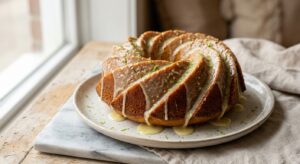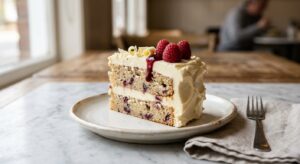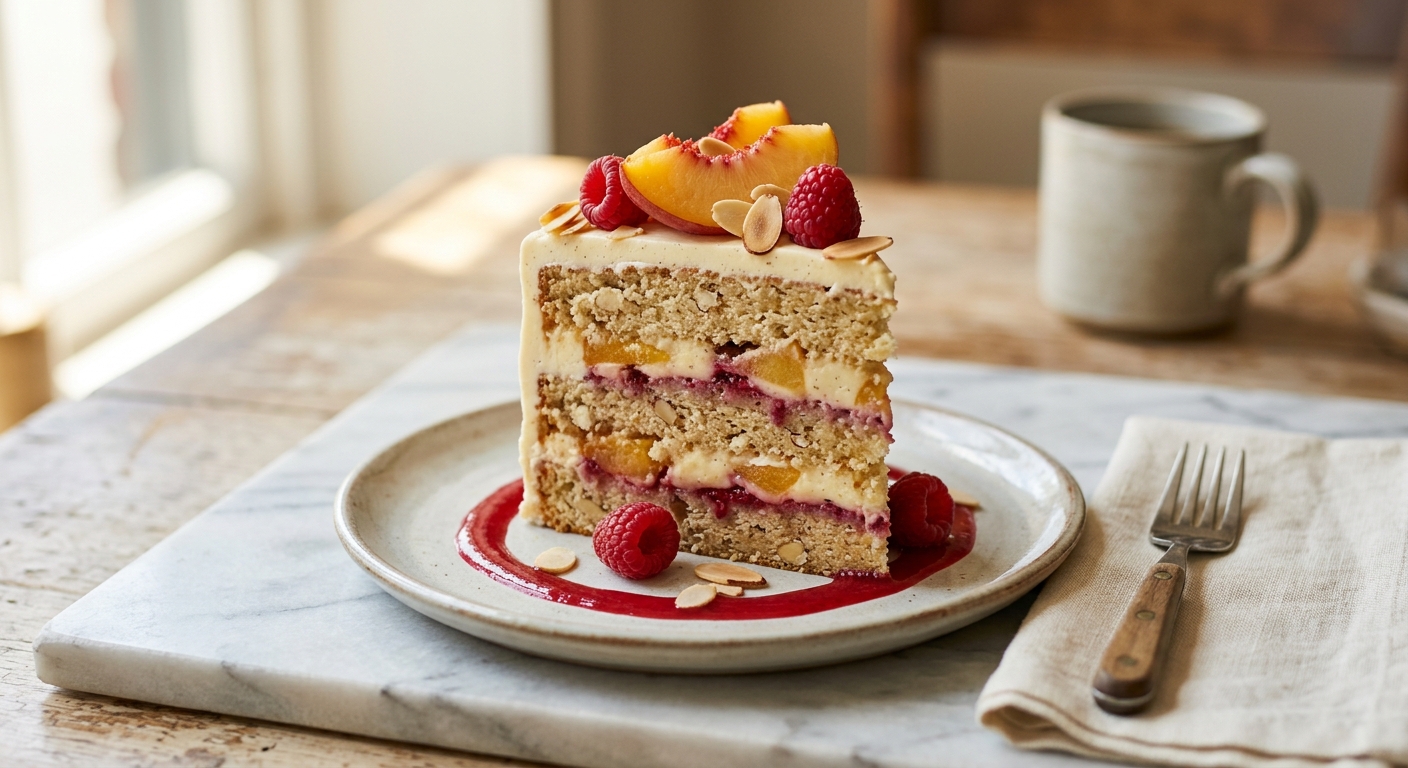
There is something undeniably romantic about Peach Melba. Created in the 1890s by the legendary Auguste Escoffier at the Savoy Hotel in London, in honour of the Australian soprano Dame Nellie Melba, the original dessert was breathtakingly simple: a perfectly poached peach, a scoop of vanilla ice cream, and a ribbon of fresh raspberry sauce. That combination of soft stone fruit, cool cream, and sharp berry has never gone out of fashion, and this cake is a love letter to every one of those flavours.
What sets this version apart is the almond sponge. By replacing a portion of the all-purpose flour with finely ground blanched almonds, you get layers that are noticeably more tender and moist than a standard Victoria sponge, with a subtle nuttiness that complements the peaches beautifully. The filling is a lightly cooked fresh peach compote that holds its shape between the layers, paired with a mascarpone whipped cream that is rich but not heavy. The raspberry coulis is made with nothing but raspberries and a little sugar, cooked briefly to concentrate the flavour, then strained until it is glossy and jewel-bright. Poured over the finished cake just before serving, it runs down the sides in the most glorious way.
This is a medium-difficulty bake that is absolutely within reach of a confident home baker. If you can make a simple sponge cake, you can make this. The components come together in a logical order, and most of the work can be spread across two days. It is the kind of cake you would bring to a summer birthday, a bridal shower, or any occasion where you want the table to go a little quiet when the cake comes out.
Equipment Needed
Click on an item below to shop for the recommended items for this recipe on Amazon.
As an Amazon Associate, we earn from qualifying purchases.
12
Ingredients
- Peach Compote)
- 280 gall-purpose flour (about 2 1/4 cups, spooned and leveled)
- 100 gblanched almond flour (about 1 cup, lightly packed)
- 2.5 tspbaking powder
- 0.5 tspbaking soda
- 0.5 tspColima Sea SaltMicroplastic Free Salt
- 1 tsppure almond extract
- 1 tsppure vanilla extract
- 300 gunsalted butter, at room temperature (about 1 1/3 cups / 2 2/3 sticks)
- 300 gcaster sugar or superfine sugar (about 1 1/2 cups)
- 4 largeeggs, at room temperature
- 240 mlbuttermilk, at room temperature (about 1 cup)
- 700 gfresh ripe peaches (about 4 to 5 medium peaches)
- 60 gcaster sugar (about 1/4 cup
- Mascarpone Cream)
- 1 tbspfresh lemon juice
- 1 tspcornstarch (cornflour)
- 500 gmascarpone cheese, cold (about 2 cups plus 2 tbsp)
- 360 mlheavy whipping cream, cold (about 1 1/2 cups)
- 80 gicing sugar (powdered sugar, sifted, about 2/3 cup
- Mascarpone Cream
- 1 tsppure vanilla extract
- Coulis)
- 450 gfresh or frozen raspberries (about 3 1/2 cups
- 80 gcaster sugar (about 1/3 cup
- Coulis
- 1 tbspfresh lemon juice
- Decoration)
- 30 gtoasted flaked almonds (about 1/4 cup
- —Fresh raspberries and peach slices, to decorate
Ingredient Substitutions
Instructions
- Preheat your oven to 350°F (175°C) with a rack in the centre position. Grease three 9-inch (23cm) round cake pans, line the bottoms with parchment paper circles, then lightly flour the sides, tapping out any excess.
- Make the peach compote first so it has time to cool. Peel, pit, and dice the fresh peaches into 1cm chunks. Combine with 60g caster sugar, 1 tbsp lemon juice, and 1 tsp cornstarch in a small saucepan over medium heat. Cook, stirring occasionally, for 8 to 10 minutes until the peaches are soft but still hold their shape and the juices have thickened to a jammy glaze. Transfer to a bowl, press a piece of plastic wrap directly against the surface, and refrigerate until completely cold, at least 1 hour.
- Make the almond sponge. Whisk together the all-purpose flour, almond flour, baking powder, baking soda, and salt in a medium bowl. Set aside. In the bowl of a stand mixer fitted with the paddle attachment, beat the room-temperature butter and 300g caster sugar on medium-high speed for 4 to 5 minutes until very pale, fluffy, and almost doubled in volume. Scrape down the sides of the bowl well.
- Add the eggs one at a time, beating for 30 seconds after each addition before adding the next. If the mixture looks like it is beginning to curdle, add one tablespoon of the flour mixture and continue. Beat in the almond extract and vanilla extract. Reduce the mixer to its lowest speed and add the flour mixture in three additions, alternating with the buttermilk in two additions (flour, buttermilk, flour, buttermilk, flour). Mix just until no streaks of flour remain. Do not overmix.
- Divide the batter evenly among the three prepared pans. A kitchen scale is the most reliable way to do this. Each pan should hold about 530g of batter. Smooth the tops with a small offset spatula. Bake for 25 to 28 minutes, rotating the pans halfway through if your oven has hot spots. The cakes are done when the tops are golden, the edges pull slightly from the pan, and a toothpick inserted into the centre comes out with just a few moist crumbs. Do not overbake.
- Let the cakes cool in their pans on a wire rack for 15 minutes, then turn them out, peel off the parchment, and allow them to cool completely right-side up on the rack, at least 1 hour. Do not attempt to assemble with warm layers.
- Make the raspberry coulis. Combine the raspberries, 80g caster sugar, and 1 tbsp lemon juice in a medium saucepan. Cook over medium heat, stirring, for 8 to 10 minutes until the raspberries have completely broken down and the mixture is thick and bubbling. Pass the coulis through a fine-mesh sieve, pressing firmly with the back of a spoon to extract all the liquid. Discard the seeds. Taste and adjust sweetness. Allow to cool to room temperature, then refrigerate. The coulis will thicken further as it cools.
- Make the mascarpone cream. Place the cold mascarpone, cold heavy cream, sifted icing sugar, and vanilla extract together in a large bowl or the bowl of a stand mixer fitted with the whisk attachment. Beat on medium speed until the mixture just holds firm, glossy peaks. Take care not to overbeat as mascarpone can become grainy and stiff very quickly. Refrigerate until needed.
- Assemble the cake on a cake board or serving plate. Place the first sponge layer on the board. Spread about one-third of the mascarpone cream over the top, leaving a 1cm border at the edge. Spoon half of the cold peach compote over the cream and gently press it in. Place the second sponge layer on top and repeat with another third of the cream and the remaining compote. Place the final sponge layer on top, bottom-side up for a flat surface. Use the remaining mascarpone cream to cover the top and sides in a relaxed, textured style. Scatter toasted flaked almonds around the top edge and decorate with a few fresh raspberries and peach slices.
- Refrigerate the assembled cake for at least 30 minutes to let the layers settle and the cream firm up before serving. Just before serving, pour the raspberry coulis into a small jug and let guests pour it at the table, or drizzle it dramatically over the cake yourself.
- Preheat your oven to 350°F (175°C). Grease a 9×13-inch (23x33cm) metal baking pan generously with butter and line the base and long sides with a parchment sling, leaving an overhang for easy removal.
- Prepare the batter exactly as described in the oven method steps 3 and 4. Pour all of the batter into the prepared pan and spread it evenly with an offset spatula. The batter will fill the pan to about half its depth, which is correct.
- Bake for 35 to 40 minutes until the top is deep golden, the cake springs back when lightly pressed in the centre, and a toothpick comes out with just a few moist crumbs. Cool in the pan on a wire rack for 20 minutes, then use the parchment overhang to lift the cake out onto the rack to cool completely.
- Prepare the peach compote and raspberry coulis as described in the main method. Prepare a half-batch of the mascarpone cream (use 250g mascarpone, 180ml heavy cream, 40g icing sugar, and 0.5 tsp vanilla) as you only need enough to top, not fill.
- Once the cake is completely cool, spread the mascarpone cream over the entire surface in generous swoops. Spoon the peach compote over the cream, distributing it evenly. Scatter toasted flaked almonds and fresh raspberries over the top. Drizzle about half the raspberry coulis over everything and serve the remainder alongside. Slice into squares directly in the pan.
- Preheat your oven to 350°F (175°C). Line two standard 12-cup muffin tins with paper cupcake liners.
- Prepare the full batter as described in the primary oven method steps 3 and 4. Prepare the peach compote as directed, but dice the peaches into smaller 5mm pieces so they fit neatly inside the cupcakes. Prepare the raspberry coulis as directed.
- Fill each cupcake liner about one-third full with batter. Drop 1 level teaspoon of cold peach compote directly into the centre of the batter in each cup, then cover with more batter until each liner is about two-thirds full. This buries the peach filling inside the cupcake.
- Bake for 20 to 22 minutes until the tops are domed and lightly golden and a toothpick inserted into the sponge (not the filling) comes out clean. Cool in the pans for 5 minutes, then transfer to a wire rack to cool completely.
- Prepare the mascarpone cream as directed. Transfer to a piping bag fitted with a large open star tip. Pipe a generous swirl onto each cooled cupcake. Top each with a single fresh raspberry and 3 to 4 toasted flaked almonds. Drizzle the raspberry coulis over the top with a spoon just before serving, or serve a small bowl of coulis on the side for dipping.
Nutrition Per Serving
Per 1 serving (makes one 9-inch three-layer cake)
Why This Recipe Works
The almond flour in this sponge is not simply a flavour addition, it is doing serious structural work. Almond flour contains a high proportion of fat from the ground nuts, which coats the gluten strands in the wheat flour and physically interrupts their development. The result is a crumb that is noticeably more tender and moist than a standard all-flour sponge. This is the same principle behind the soft crumb in French financiers and frangipane tarts. Using 100g of almond flour while retaining 280g of all-purpose flour gives you the best of both worlds: enough gluten structure to support three layers of filling, and enough almond fat to keep every bite delicate and moist. The buttermilk contributes additional tenderness through its mild acidity, which further relaxes gluten development and reacts with the baking soda to produce a fine, even crumb.
The mascarpone cream is whipped cold and all at once, meaning the mascarpone and heavy cream go into the bowl together rather than the mascarpone being beaten alone first. This is deliberate. Mascarpone has a high butterfat content (around 75%), and beating it on its own for too long causes the fat to break and the cream to become grainy and stiff. By combining it with the liquid heavy cream from the start, you temper this risk: the cream dilutes the mascarpone slightly and the two whip together into a stable, silky mixture that holds peaks without seizing. Stop as soon as you have firm, glossy peaks.
The cornstarch in the peach compote is a small but important detail. Raw peaches release a lot of water as they cook, and without a thickener, the filling would be too wet and would soak into the sponge layers, making the cake soggy within an hour of assembly. The 1 teaspoon of cornstarch combines with the peach juices and thickens them into a light, glossy glaze as the compote cools. If your compote looks thin when hot, do not worry: it will thicken significantly as it refrigerates. If you find it still too loose after chilling, a second brief simmer will fix it.
Baker’s Tips
- Bring the butter, eggs, and buttermilk to room temperature before you begin. Cold butter will not cream properly and cold eggs added to warm creamed butter can cause the mixture to curdle and look broken, which results in a denser, less even crumb.
- Use a kitchen scale to divide your batter equally among the three pans. This is the single most reliable way to ensure all three layers bake in the same amount of time and are the same height for a professional-looking stack.
- Taste your peaches before adding all the sugar. A very ripe, sweet peach in peak summer needs less added sugar than an underripe one. Trust your palate.
- The raspberry coulis should be strained through a fine-mesh sieve, not a coarse one. Raspberry seeds are small enough to slip through a medium sieve and they will make the coulis feel gritty. Press firmly and patiently to extract every drop of juice.
- Do not assemble the cake until every component is cold. Warm sponge layers will melt the mascarpone cream, and warm compote will make the whole thing slide. Patience here is the difference between a beautiful cake and a delicious mess.
- For clean, elegant slices, refrigerate the assembled cake for at least 30 minutes before cutting. Use a long, sharp knife dipped in hot water and wiped dry between every slice.
- If your cakes have domed tops, use a long serrated knife to level them before assembling. A few horizontal passes on a steady surface is all it takes, and the scraps are the baker’s reward.
Variations
- Lavender Peach Melba: Add 1 tsp culinary dried lavender (steeped in the warmed buttermilk for 15 minutes then strained out) to the sponge batter for a floral, Provencal twist.
- White Chocolate Mascarpone Cream: Melt 80g good-quality white chocolate, cool to room temperature, then fold into the mascarpone cream before whipping. This adds a sweet richness that plays beautifully against the tart coulis.
- Mango Melba version: Replace the peaches with an equal weight of fresh ripe mango and use passion fruit pulp stirred through the coulis instead of all raspberries for a tropical variation.
- Gluten-free adaptation: Replace the all-purpose flour with a good-quality 1:1 gluten-free baking flour blend. The almond flour is already gluten-free, so this swap works very well and results in a wonderfully tender crumb.
- Mini celebration cakes: Use six 4-inch (10cm) individual cake rings instead of 9-inch pans. Reduce the bake time to 18 to 22 minutes and assemble individual two-layer cakes for plated dinner party desserts.
Troubleshooting & FAQ
My sponge layers came out dense and didn’t rise well. What went wrong?
My mascarpone cream turned grainy and stiff almost immediately. Can I fix it?
My peach compote is too watery and the filling is sliding out of the layers.
The cake layers are sticking to the pan and tearing when I try to remove them.
My raspberry coulis is very pale pink and lacks flavour. How do I fix it?
Storage & Make-Ahead
- Storage: Store the assembled cake covered in the refrigerator for up to 3 days. The mascarpone cream will firm up nicely in the cold. Bring individual slices to room temperature for 20 minutes before serving for the best flavour and texture. The raspberry coulis keeps refrigerated in a sealed jar for up to 1 week. Unfrosted, cooled sponge layers can be wrapped tightly in plastic wrap and frozen for up to 3 months.
- Make-Ahead: This cake is ideal for making in stages. The sponge layers can be baked up to 2 days ahead, wrapped in plastic wrap, and stored at room temperature or frozen for up to 3 months. The peach compote can be made up to 3 days ahead and refrigerated. The raspberry coulis keeps refrigerated for up to 1 week. The mascarpone cream is best made the day of assembly, as it can weep and loosen if stored overnight. The fully assembled cake can be refrigerated overnight, but add the final decorations and coulis drizzle just before serving.