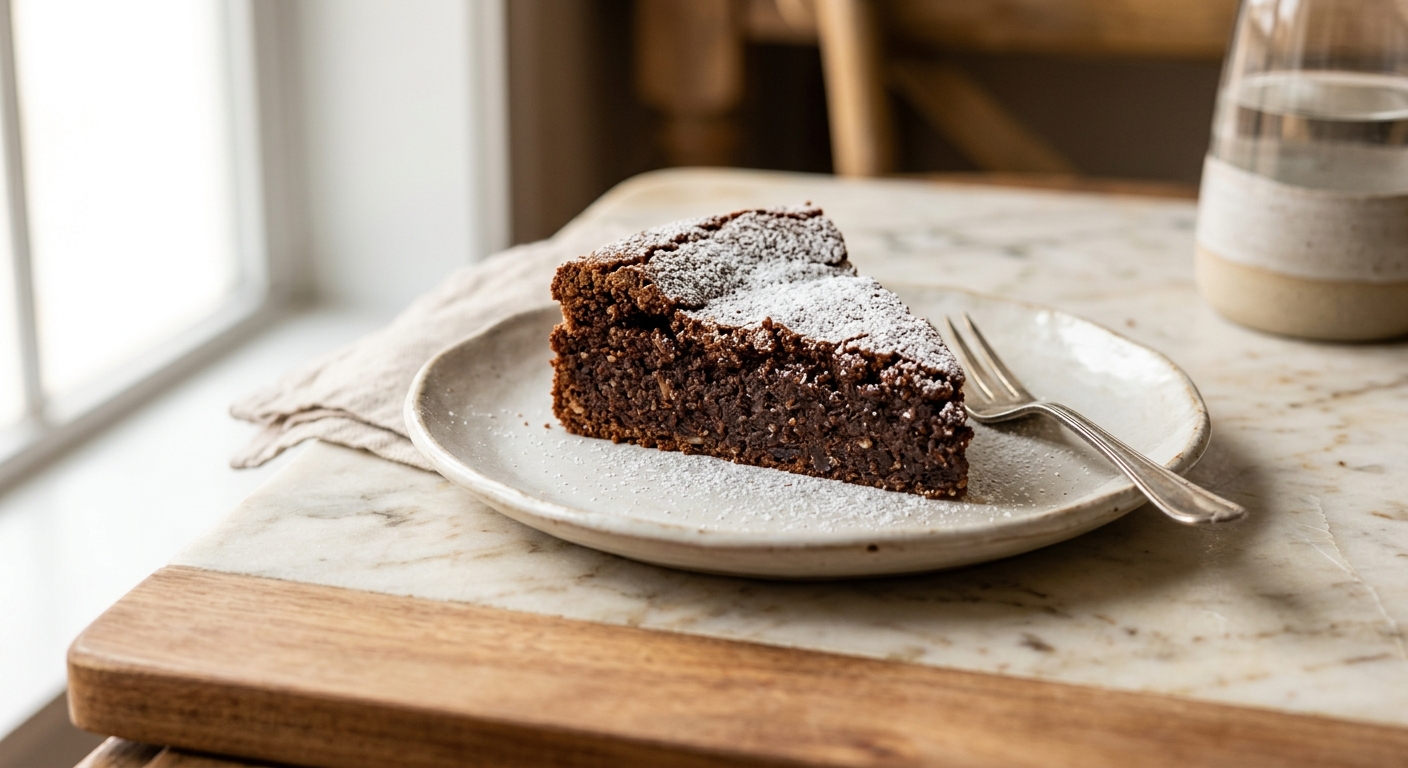
Imagine sitting at a sun-warmed table overlooking the Bay of Naples, a small dark square of cake resting on a white ceramic plate beside a tiny espresso. That is the world of the Torta Caprese. Born on the island of Capri, this cake has one of those charming origin stories involving a forgetful chef who accidentally left flour out of a chocolate cake and, rather than throwing it away, baked it anyway. The result was a revelation: dense and fudgy at the center, with a thin crackled crust on top, and a depth of chocolate and almond flavor that no flour-filled cake could match.
What sets this version apart is the technique of grinding whole blanched almonds yourself rather than reaching for pre-made almond flour. Freshly ground almonds retain more of their natural oils, which contributes a moist, almost creamy texture to the crumb and a nuttier, more complex flavor. We also use a high-quality dark chocolate of at least 70 percent cocoa solids, melted together with real butter, which forms the rich, glossy backbone of the batter. A gentle folding technique keeps the batter light enough to rise beautifully without any chemical leavening, relying entirely on well-beaten eggs for lift.
This recipe sits comfortably in the medium difficulty range. It requires a little care with the egg beating and folding stages, but there is no complicated frosting, no layering, and no temperamental pastry work. It is perfect for intermediate home bakers who want a showstopping dessert without a full day in the kitchen, and it is an absolute gift for anyone baking for guests with gluten sensitivities.
Equipment Needed
Click on an item below to shop for the recommended items for this recipe on Amazon.
As an Amazon Associate, we earn from qualifying purchases.
10
Ingredients
- Dusting
- 200 gdark chocolate, 70% cocoa solids or higher, roughly chopped (about 7 oz)
- 150 gunsalted butter, cubed (about 10 tbsp), plus extra for greasing
- 200 gwhole blanched almonds (about 1.5 cups), or 190g (about 2 cups) almond flour if substituting
- 150 ggranulated sugar (about 3/4 cup), divided
- 4 largeeggs, separated, at room temperature
- 1 tsppure vanilla extract
- 1 tbspdark rum or espresso (optional, but highly recommended)
- 0.5 tspColima Sea SaltMicroplastic Free Salt
- 0.25 tspcream of tartar
- —Powdered sugar
- Dusting The Pan
- —Cocoa powder
Ingredient Substitutions
Instructions
- Preheat your oven to 325°F (165°C). Grease a 9-inch springform pan with butter, then dust it with cocoa powder, tapping out the excess. Line the bottom with a circle of parchment paper. Set aside.
- Place the blanched almonds in a food processor and pulse in short bursts until they reach a fine, sandy meal, about 45 to 60 seconds. Stop before the mixture turns into a paste. Set aside.
- Melt the chopped dark chocolate and cubed butter together in a heatproof bowl set over a saucepan of barely simmering water (a bain-marie), stirring gently until completely smooth. Alternatively, microwave in 30-second bursts, stirring between each. Remove from heat, stir in the vanilla extract and rum or espresso if using, and allow to cool for 8 to 10 minutes.
- Once the chocolate mixture has cooled slightly, whisk in the egg yolks one at a time, followed by 100g (about 1/2 cup) of the granulated sugar and the fine sea salt. Stir in the ground almond meal until fully combined. The batter will be thick.
- In a clean, dry bowl (use your stand mixer or a hand mixer), beat the egg whites with the cream of tartar on medium speed until foamy, about 1 minute. Gradually add the remaining 50g (about 1/4 cup) of sugar, then increase the speed to medium-high and beat until the whites hold firm, glossy peaks, about 3 to 4 minutes. Do not overbeat to dry peaks.
- Add about one-third of the beaten egg whites to the chocolate batter and stir firmly to lighten the mixture. This first addition is sacrificial and helps loosen the dense batter. Add the remaining egg whites in two additions, folding gently with a large flexible spatula in wide, sweeping motions from the bottom of the bowl up and over, rotating the bowl as you go. Stop folding as soon as no white streaks remain.
- Pour the batter into the prepared springform pan and smooth the top gently with an offset spatula. Bake in the center of the preheated oven for 32 to 35 minutes, until the top is set and crackled, the edges have pulled slightly away from the pan, and a toothpick inserted 1 inch from the edge comes out clean. The very center may still feel slightly soft, which is correct.
- Allow the cake to cool completely in the pan on a wire rack, at least 45 minutes. The cake will sink slightly as it cools, which is a hallmark of a proper Torta Caprese, not a mistake. Once cool, release the springform and dust generously with powdered sugar before slicing.
- Prepare a 7-inch springform pan (or the largest pan that fits your air fryer basket) by greasing with butter and dusting with cocoa powder. Line the bottom with parchment. Note that this smaller pan will give a slightly thicker, taller cake.
- Follow steps 2 through 6 of the oven method exactly: grind the almonds, melt the chocolate and butter, combine with yolks and sugar, then fold in the beaten egg whites.
- Pour the batter into the prepared 7-inch pan and smooth the top. Place the pan in the air fryer basket. If your air fryer runs hot, place a small piece of foil loosely over the top of the cake for the first 15 minutes to prevent the surface from over-browning before the center sets.
- Air fry at 300°F (150°C) for 28 to 30 minutes. Check at the 25-minute mark: the top should be set and crackled, and a toothpick inserted 1 inch from the edge should come out clean. The very center should still have a slight wobble when you gently shake the basket.
- Remove carefully using oven mitts and allow to cool completely in the pan on a heatproof surface, at least 40 minutes. Dust with powdered sugar and serve directly from the pan base or transfer carefully to a serving plate.
- Line the bowl of a 6-quart slow cooker with a large sheet of parchment paper, pressing it up the sides with enough overhang to lift the cake out later. Lightly grease the parchment with butter. This step is essential for removal.
- Follow steps 2 through 6 of the oven method: grind the almonds, melt the chocolate and butter, combine with yolks and sugar, and fold in the beaten egg whites.
- Pour the batter into the lined slow cooker and smooth the top. Place a double layer of paper towels across the top of the slow cooker insert before fitting the lid. The paper towels absorb condensation and prevent water droplets from dripping onto the surface of the cake, which would create soggy patches.
- Cook on High for 2 hours to 2 hours 15 minutes. The cake is done when the edges and top are set and no longer shiny, but the very center will remain soft and fudgy. Do not be tempted to cook it until fully firm, as it will continue to set as it cools.
- Turn off the slow cooker and remove the lid. Allow the cake to rest and cool in the cooker for 30 minutes, then use the parchment overhang to carefully lift it out and transfer to a wire rack. Cool for at least another 30 minutes before slicing. Dust with powdered sugar just before serving.
Nutrition Per Serving
Per 1 serving (makes one 9-inch round cake)
Why This Recipe Works
The genius of Torta Caprese lies in what it lacks. Without flour, there is no gluten network to set the structure, which means the cake relies almost entirely on two other mechanisms: the fat-and-chocolate matrix created by melted butter and dark chocolate cooling and re-solidifying as the cake bakes, and the air incorporated into the beaten egg whites. When you fold the whipped whites into the dense chocolate batter, you are introducing thousands of tiny air bubbles that expand in the oven heat and give the cake its lift. That signature crackled crust forms because the surface dries and sets faster than the interior, and the continuing rise of the batter underneath causes the top to fracture beautifully.
Using 70% or higher dark chocolate is not just about flavor intensity. Higher cocoa solid content means more cocoa butter and less sugar in the chocolate itself, which contributes to the firm but fudgy set of the cake’s interior. Lower percentage chocolates contain more sugar and milk solids, which can result in a stickier, less structured crumb. The egg yolks, which go in separately from the whites, contribute emulsifying lecithin that helps keep the butter and chocolate from splitting, as well as richness and color. This is why temperature management matters: adding egg yolks to a too-hot chocolate mixture risks cooking them into scrambled eggs, so always allow the melted chocolate to cool for at least 8 to 10 minutes before adding them.
If your cake comes out flat and greasy rather than risen and tender, the most likely culprit is deflated egg whites. This happens either because the bowl or beaters had a trace of fat or egg yolk on them (fat destroys a meringue), or because the whites were folded in too aggressively. Work gently, and do not skip the step of loosening the batter with the first third of the whites before adding the rest. If the top cracks unevenly or the center is raw while the edges are done, your oven temperature is likely running high. An inexpensive oven thermometer is one of the best investments a home baker can make.
Baker’s Tips
- Separate your eggs while they are cold, as cold egg yolks are less likely to break, but allow the whites to come to room temperature before beating. Room-temperature whites whip to a greater volume more easily.
- Toast the blanched almonds in a dry skillet over medium heat for 3 to 4 minutes before grinding for a noticeably deeper, nuttier flavor. Cool completely before processing.
- When grinding almonds, use short pulses and check frequently. Overprocessing generates heat, which activates the natural oils and turns your nut meal into almond butter.
- Do not rush the cooling process. The cake sets as it cools, and cutting into a warm Torta Caprese will give you a gooey, underdone-looking interior even if it was perfectly baked.
- Use a hot, dry knife to get clean slices. Run your knife under very hot water, wipe dry, and slice. Repeat between cuts.
- The powdered sugar dusting will absorb into the surface within a few hours. If you are making the cake ahead, hold off on dusting until just before you bring it to the table.
- A 9-inch springform pan is strongly recommended here. The cake is delicate when warm and will not survive being turned out of a standard cake pan without the ability to release the sides first.
Variations
- Orange Torta Caprese: Add the finely grated zest of one large orange and 1 tbsp Grand Marnier or Cointreau to the chocolate mixture in place of the rum. The citrus lifts the entire cake.
- Hazelnut and Milk Chocolate: Substitute blanched hazelnuts for the almonds and use 55% milk chocolate instead of dark for a Gianduja-inspired version. Reduce sugar by 25g as milk chocolate is sweeter.
- Espresso and Cardamom: Add 1.5 tsp finely ground espresso powder and 0.5 tsp ground cardamom to the batter with the salt for a spiced, aromatic version that pairs wonderfully with whipped cream.
Troubleshooting & FAQ
My cake did not rise at all and came out flat and dense. What went wrong?
The center of my cake looks completely raw and sunken. Is it ruined?
My chocolate and butter mixture looks greasy and broken. How do I fix it?
The top of my cake is cracked but very unevenly, with one side much higher than the other.
Can I use this recipe to make individual cakes or a smaller version?
Storage & Make-Ahead
- Storage: Store the cooled cake tightly wrapped or in an airtight container at room temperature for up to 2 days, or refrigerate for up to 5 days. The flavor actually deepens and improves on day two. Bring to room temperature for 30 minutes before serving for the best texture. The cake freezes well: wrap individual slices in plastic wrap, then place in a freezer bag for up to 2 months. Thaw overnight in the refrigerator.
- Make-Ahead: This cake is an exceptional make-ahead dessert. Bake it the day before serving, wrap tightly once completely cool, and store at room temperature or in the refrigerator. The flavors meld and deepen beautifully overnight. Dust with powdered sugar only just before serving, as it absorbs into the surface over time.