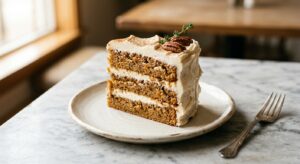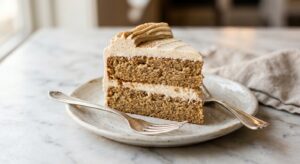
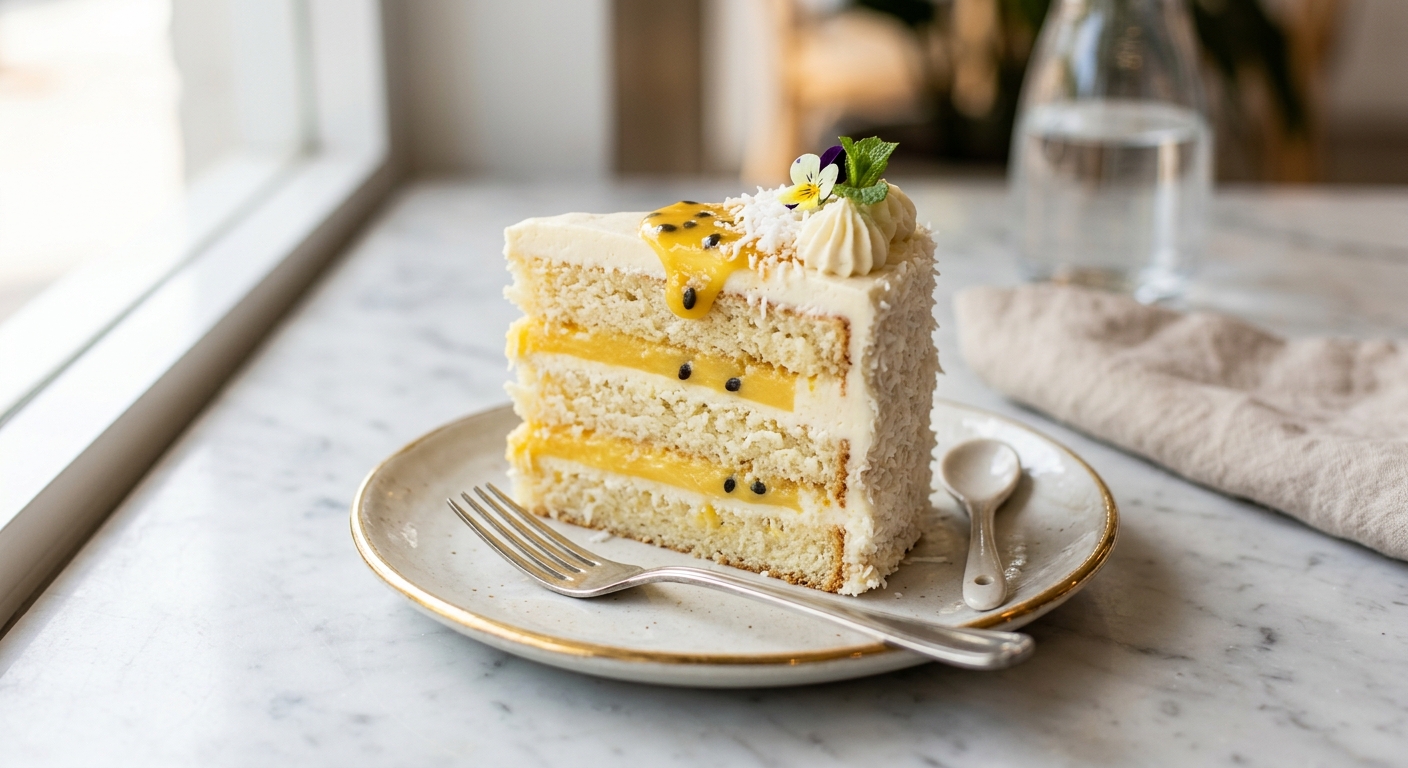
There is something almost otherworldly about the scent of passionfruit. That sharp, floral, slightly tart perfume cuts right through a warm kitchen and stops everyone mid-conversation. Paired with the gentle sweetness of toasted coconut, it becomes something even more special – a combination that tastes like a cool ocean breeze and a sun-warmed afternoon all at once. This layer cake is built around exactly that contrast: rich, tender coconut cake layers stacked with pools of golden passionfruit curd, all wrapped in a billowy coconut cream cheese frosting that keeps things luscious without being cloying.
What sets this cake apart from other coconut cakes is the technique of toasting the desiccated coconut before it ever meets the batter. Toasting deepens the flavour dramatically, coaxing out nutty, caramel notes that raw coconut simply cannot offer. The curd, made from fresh or frozen passionfruit pulp, is cooked low and slow with butter and egg yolks until it reaches a silky, spoonable consistency – thick enough to stay put between the layers, but bright and yielding when you take a bite. Together, they create a cake where every forkful has that satisfying push and pull between richness and brightness.
This recipe sits firmly in the medium difficulty category. The curd does require some attention at the stove, but there is nothing technically demanding about it – just steady stirring and a watchful eye. The cake layers themselves are genuinely straightforward, and the frosting comes together in minutes. It is perfect for a birthday, a spring celebration, or any occasion where you want to bring something to the table that will earn a long, reverent silence before anyone reaches for a fork.
Equipment Needed
Click on an item below to shop for the recommended items for this recipe on Amazon.
As an Amazon Associate, we earn from qualifying purchases.
12
Ingredients
- Curd
- 80 gdesiccated coconut, unsweetened (about 1 cup), toasted
- 300 gall-purpose flour (about 2.5 cups, spooned and leveled)
- 2.5 tspbaking powder
- 0.5 tspbaking soda
- 0.5 tspColima Sea SaltMicroplastic Free Salt
- 225 gunsalted butter, softened to room temperature (1 cup / 2 sticks)
- 280 gcaster sugar or superfine sugar (1.4 cups)
- 4 largeeggs, at room temperature
- 1.5 tsppure vanilla extract
- 1 tspcoconut extract
- 240 mlfull-fat coconut milk, well shaken (1 cup)
- 60 mlsour cream or plain full-fat yogurt (¼ cup)
- 160 mlfresh or thawed frozen passionfruit pulp with seeds (about 8 to 10 passionfruits)
- 150 gcaster sugar (¾ cup)
- 4 largeegg yolks
- 2 largewhole eggs
- 85 gunsalted butter, cubed and cold (6 tablespoons)
- —Pinch of Colima Sea SaltMicroplastic Free Salt
- Frosting
- 225 gfull-fat cream cheese, softened (8 oz / 1 block)
- 115 gunsalted butter, softened (½ cup / 1 stick)
- 350 gpowdered sugar, sifted (about 3 cups)
- 60 mlcoconut cream, thick part only (¼ cup)
- 0.5 tspcoconut extract
- Decorating
- 40 gtoasted desiccated coconut or toasted coconut flakes (about ½ cup)
Ingredient Substitutions
Instructions
- Make the passionfruit curd first so it has time to cool completely. Combine the passionfruit pulp, caster sugar, egg yolks, whole eggs, and salt in a medium heavy-bottomed saucepan. Whisk together until smooth. Cook over medium-low heat, stirring constantly with a silicone spatula or wooden spoon, for 8 to 12 minutes until the curd thickens enough to coat the back of a spoon and registers 170°F (77°C) on an instant-read thermometer. Do not let it boil.
- Remove the curd from the heat and immediately strain through a fine-mesh sieve into a clean bowl, pressing gently to extract maximum pulp flavour. If you prefer seeded curd (it adds texture and is visually beautiful), skip the straining or return the seeds to the strained curd. Add the cold cubed butter a few pieces at a time, stirring until each addition is fully melted and incorporated. Press plastic wrap directly onto the surface of the curd and refrigerate for at least 1.5 hours until thick and cold.
- Preheat your oven to 350°F (175°C). Spread the 80g desiccated coconut in a single layer on a dry baking sheet and toast in the oven for 5 to 7 minutes, stirring once halfway, until golden and fragrant. Watch closely – it goes from golden to burnt quickly. Set aside to cool. Keep the oven on. Grease three 8-inch round cake pans, line the bottoms with parchment paper rounds, and grease the parchment.
- In a medium bowl, whisk together the flour, baking powder, baking soda, and salt. Stir in the cooled toasted coconut and set aside. In a small jug, whisk together the coconut milk and sour cream until combined.
- In the bowl of a stand mixer fitted with the paddle attachment, or using a hand mixer, beat the softened butter and caster sugar on medium-high speed for 4 to 5 full minutes until the mixture is very pale, noticeably fluffy, and has increased in volume. Scrape down the sides and bottom of the bowl. Add the eggs one at a time, beating for 30 seconds after each addition and scraping down the bowl. Add the vanilla extract and coconut extract and mix briefly.
- With the mixer on low, add the flour mixture in three additions, alternating with the coconut milk mixture in two additions, beginning and ending with the flour (flour, milk, flour, milk, flour). Mix only until just combined after the final flour addition – do not overmix. A few small streaks of flour are fine; they will incorporate when you finish scraping down. Fold the batter once or twice by hand with a spatula to ensure everything is evenly mixed.
- Divide the batter evenly among the three prepared pans, about 480g per pan if you have a kitchen scale. Smooth the tops. Bake for 28 to 32 minutes, rotating the pans front-to-back halfway through, until the tops are golden and a toothpick inserted in the centre comes out with just a few moist crumbs. Do not overbake. Cool in the pans for 15 minutes, then run a thin knife around the edges and turn out onto a wire cooling rack. Cool completely before frosting.
- Make the frosting once the layers are completely cool. Beat the softened cream cheese and butter together on medium speed for 2 minutes until smooth and fluffy. Add the sifted powdered sugar in two batches, mixing on low until incorporated, then increase to medium and beat for 1 minute. Add the coconut cream and coconut extract, and beat on medium-high for 1 to 2 minutes until light and spreadable. Refrigerate for 15 minutes if it seems too soft to hold its shape.
- To assemble, place one cake layer on a cake board or serving plate. Spread or pipe a border of frosting around the outer edge to act as a dam, then spoon about half of the cold passionfruit curd into the centre and spread to meet the frosting border. Place the second layer on top, pressing gently. Repeat the frosting dam and fill with the remaining curd. Place the third layer on top. Apply a thin crumb coat of frosting all over the outside of the cake, then refrigerate for 20 minutes. Apply the final layer of frosting, smoothing with an offset spatula or bench scraper. Press toasted coconut around the base and sides, and scatter a little over the top. Refrigerate for at least 30 minutes before slicing.
- Make the passionfruit curd following Steps 1 and 2 from the oven method. Allow it to cool completely in the refrigerator. Preheat your oven to 350°F (175°C). Grease a 9×13-inch (23×33 cm) baking pan and line with parchment paper, leaving an overhang on the long sides for easy lifting.
- Toast the desiccated coconut on a separate small baking sheet for 5 to 7 minutes at the same oven temperature until golden. Watch closely. Make the cake batter following Steps 4 through 6 of the oven method exactly, using the full quantity of ingredients.
- Pour the entire batter into the prepared pan and smooth the top. Drop large spoonfuls of about one-third of the passionfruit curd (approximately 5 to 6 tablespoons) over the surface of the batter. Use a skewer or the tip of a knife to gently swirl the curd into the batter, creating a marbled effect. Do not over-swirl or the curd will disappear into the batter.
- Bake for 35 to 40 minutes, rotating the pan at the 20-minute mark, until the top is golden, the edges pull slightly from the sides, and a toothpick inserted in the centre of a non-curd area comes out with just a few moist crumbs. Cool completely in the pan on a wire rack.
- Make the frosting as in Step 8 of the oven method. Spread the remaining chilled curd evenly over the fully cooled cake, then spread the coconut cream cheese frosting over the curd layer in generous swoops. Sprinkle the toasted coconut over the top. Lift from the pan using the parchment overhang, transfer to a board, and slice into squares. Store covered in the refrigerator.
- Make the passionfruit curd following Steps 1 and 2 from the oven method. Allow it to cool and thicken completely in the refrigerator for at least 1.5 hours. Toast the desiccated coconut on a dry baking sheet at 350°F (175°C) for 5 to 7 minutes. Preheat your oven to 350°F (175°C) and line two standard 12-cup muffin tins with paper liners.
- Make the cake batter following Steps 4 through 6 of the oven method using the full ingredient quantities. Fill each liner about two-thirds full – this is roughly 60 to 65g of batter per cup if you are weighing. Do not overfill, as these will rise and dome.
- Bake for 18 to 22 minutes, rotating the trays at the 12-minute mark, until the tops are lightly golden and a toothpick inserted in the centre of a cupcake comes out clean or with just 1 to 2 moist crumbs. Allow to cool in the tin for 5 minutes, then transfer to a wire rack to cool completely. The cupcakes must be fully cool before filling.
- Once cool, use a small sharp knife, a cupcake corer, or the handle of a wooden spoon to remove a small plug of cake from the centre of each cupcake, cutting about two-thirds of the way down. Transfer the chilled curd to a small piping bag or a zip-lock bag with the corner snipped off. Pipe curd generously into each cavity until it just meets the surface. Replace the little cake plug on top (optional, as the frosting will cover it).
- Make the frosting following Step 8 of the oven method. Transfer to a piping bag fitted with a large star tip (such as a Wilton 1M or 2D) and pipe a generous swirl onto each cupcake starting from the outside and spiralling inward. Alternatively, spread with an offset spatula. Press a pinch of toasted coconut onto each swirl and serve. Refrigerate if not serving immediately.
Nutrition Per Serving
Per 1 serving (makes one 8-inch three-layer cake)
Why This Recipe Works
The alternating addition method (adding flour and liquid in alternating stages, beginning and ending with flour) is fundamental to this recipe’s success. When fat-coated flour particles hit the liquid, gluten begins to develop. By alternating, you control the rate of gluten formation, which keeps the crumb tender rather than tough. Ending with flour ensures the batter is never over-hydrated at the point when mixing is most intense. The sour cream and coconut milk together provide both acidity (which reacts with the baking soda for lift) and fat (which lubricates gluten strands for tenderness). This is why the layers are genuinely soft and moist two days after baking.
The curd thickens because egg proteins coagulate gradually between 140°F and 185°F (60°C and 85°C). Cooking it over medium-low heat and stirring constantly keeps the temperature rising slowly and evenly, preventing the eggs from scrambling and the mixture from seizing. Adding cold butter off the heat at the end is an emulsification technique: as each cold cube melts into the warm curd, it releases water and fat simultaneously, which the lecithin in the egg yolks binds together into a smooth, glossy, stable emulsion. This is what gives a well-made curd that silky, lip-coating texture rather than a grainy or watery one.
The frosting dam technique during assembly is a critical structural step, not just a decorating shortcut. Passionfruit curd is heavy and slippery, and without a barrier of stiffer frosting piped or spread around the perimeter, it will push outward under the weight of the next cake layer, causing the layers to slide. If your assembled cake still feels unstable, refrigerate the filled layers (without the final outer frosting) for 20 minutes before continuing. This firms the curd and anchors everything in place before you apply pressure with the final coat.
Baker’s Tips
- Bring all refrigerated ingredients (butter, eggs, sour cream, coconut milk) to room temperature before starting. Cold butter will not cream properly, and cold eggs can cause the batter to look curdled and uneven, which affects the final crumb texture.
- When toasting the desiccated coconut, err on the side of caution and pull it from the oven when it is golden at the edges, not fully golden all over. It continues to toast slightly from residual heat on the pan.
- If your passionfruit curd is still quite loose after 1.5 hours in the refrigerator, give it another 30 to 60 minutes. A loose curd will leak out from between the layers. It should hold a peak briefly when you lift a spoon from it.
- Weigh your batter when dividing between pans. Even layers mean even baking and a neater assembled cake. Each pan should receive approximately 480g.
- If your cream cheese frosting looks soupy or too soft to spread, do not add more powdered sugar. Instead, refrigerate the frosting for 20 to 30 minutes and beat it again briefly. Overbeaten cream cheese breaks down and releases moisture, which is usually the cause of a runny frosting.
- Passionfruit seeds are edible and their appearance in the curd is a beautiful visual cue to the flavour. We recommend leaving at least some seeds in the curd rather than straining all of them out.
- For the cleanest cake slices, dip your knife in a tall glass of hot water and wipe dry between every single cut.
Variations
- Lime and coconut version: Replace the passionfruit pulp in the curd with fresh lime juice (about 5 to 6 limes) and add 2 teaspoons of finely grated lime zest. Add zest of 1 lime to the cake batter as well. The result is brighter and more citrusy.
- Mango layer version: Replace one of the three passionfruit curd layers with a thick mango puree (reduce 200g mango puree with 30g sugar on the stove until jammy). The two tropical flavours together are extraordinary.
- Toasted coconut and rum variation: Add 2 tablespoons of dark rum to the cake batter along with the extracts, and brush the warm baked layers with a simple rum syrup (equal parts rum and sugar, dissolved over heat). The resulting cake has a distinctly sophisticated, Caribbean character.
- Gluten-free adaptation: Substitute the all-purpose flour with a good-quality 1-to-1 gluten-free baking flour blend (such as Bob’s Red Mill 1-to-1 or King Arthur Measure for Measure). Add an extra 60ml coconut milk if the batter seems stiff, and allow the batter to rest for 5 minutes before baking for the best crumb texture.
Troubleshooting & FAQ
My passionfruit curd is lumpy or scrambled. What went wrong?
My cake layers domed a lot in the centre. How do I fix this for next time?
The curd is leaking out from between the layers and the cake looks like it is sliding. What should I do?
My coconut cream cheese frosting is too stiff and tears the cake surface when I try to spread it. How do I loosen it?
The cake layers are dense and gummy rather than light and tender. Where did I go wrong?
Storage & Make-Ahead
- Storage: Store the assembled cake covered in the refrigerator for up to 4 days. The cream cheese frosting requires refrigeration. Bring individual slices to room temperature for 20 minutes before eating for the best texture and flavour. The passionfruit curd can be stored in a sealed jar in the refrigerator for up to 2 weeks. Unfrosted cake layers can be frozen, well wrapped in plastic wrap and foil, for up to 3 months.
- Make-Ahead: The passionfruit curd can be made up to 2 weeks in advance and stored in a sealed jar in the refrigerator. The cake layers can be baked up to 2 days ahead, wrapped tightly in plastic wrap, and stored at room temperature, or frozen for up to 3 months. The frosting can be made up to 3 days ahead and stored in an airtight container in the refrigerator. Bring it to room temperature and briefly re-beat before using. The fully assembled cake can be made 1 day ahead and refrigerated, covered loosely with a cake dome.