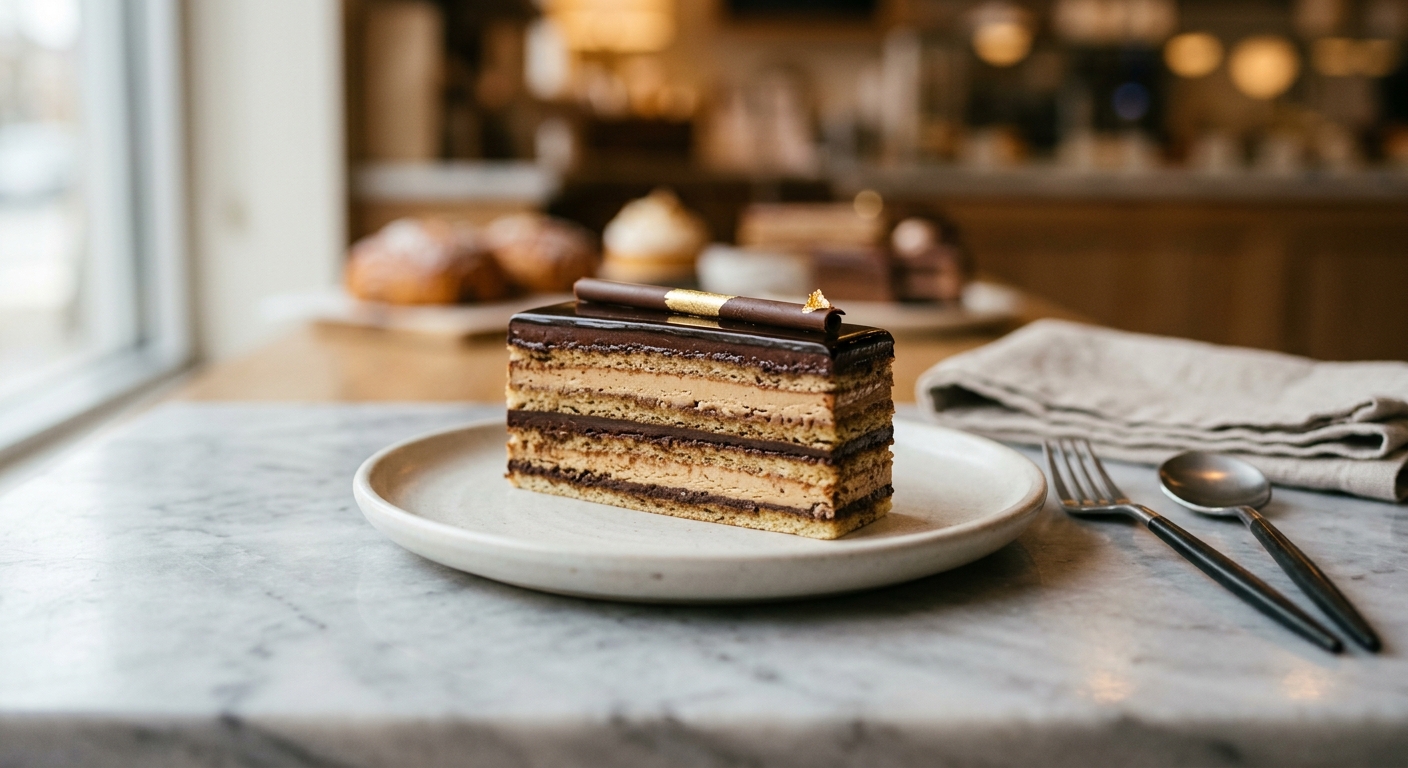
There is a moment, when you slice into an Opera Cake, where everything goes quiet. The knife glides through the mirror-smooth chocolate top, revealing those perfect horizontal stripes of golden almond sponge, ivory buttercream, and dark ganache beneath. It is one of the most beautiful cross-sections in all of pastry, and it tastes every bit as extraordinary as it looks. Born in the Parisian patisserie Dalloyau in the 1950s, Opera Cake is the kind of dessert that makes guests genuinely stop and stare before they even take a bite.
What sets this version apart is the balance between the three core components. The joconde sponge is made with finely ground blanched almonds and whipped egg whites folded in separately, which keeps it light enough to absorb the espresso soak without becoming heavy or waterlogged. The coffee buttercream is a French-style mousseline, built on a hot sugar syrup cooked to soft-ball stage and beaten into egg yolks, then finished with real espresso and good-quality butter. It is intensely flavored, satiny, and holds its structure under the weight of the ganache layers without ever tasting greasy. The ganache itself is kept deliberately dark and slightly bitter to anchor the sweetness of the rest of the cake.
This is a medium-to-hard recipe, best suited to bakers who are comfortable with basic sponge cakes and are ready for a satisfying challenge. It is not a Sunday-afternoon quick bake, but it is absolutely achievable over a weekend with some planning, and the components can be made in stages across two days. It is perfect for a dinner party centerpiece, a birthday celebration, or any occasion where you want to present something that feels genuinely extraordinary.
Equipment Needed
Click on an item below to shop for the recommended items for this recipe on Amazon.
As an Amazon Associate, we earn from qualifying purchases.
12
Ingredients
- Whipping Egg Whites)
- 200 gblanched almond flour, finely ground (about 2 cups, sifted)
- 200 gpowdered sugar, sifted (about 1 and 2/3 cups)
- 6 largeeggs, at room temperature, divided (4 whole eggs plus 6 egg whites total for joconde)
- 6 largeegg whites, at room temperature (in addition to the 4 whole eggs above)
- 30 ggranulated sugar (about 2 tbsp
- Joconde Batter
- 55 gall-purpose flour (about 1/3 cup plus 1 tbsp, sifted)
- 30 gunsalted butter, melted and cooled (about 2 tbsp)
- —Pinch of Colima Sea SaltMicroplastic Free Salt
- Espresso Soak)
- 180 mlfreshly brewed strong espresso or very strong coffee (about 3/4 cup), cooled to room temperature
- 60 ggranulated sugar (about 1/4 cup
- Coffee Buttercream
- 30 mlcoffee liqueur such as Kahlua, optional (about 2 tbsp)
- 4 largeegg yolks, at room temperature
- Buttercream Sugar Syrup)
- 200 ggranulated sugar (about 1 cup
- 60 mlwater (about 1/4 cup
- Buttercream)
- 280 gunsalted butter, softened to room temperature (about 1 and 1/4 cups
- Buttercream
- 2 tspinstant espresso powder, dissolved in 1 tsp warm water
- —Pinch of Colima Sea SaltMicroplastic Free Salt
- Ganache)
- 200 gdark chocolate, 60 to 70% cacao, finely chopped (about 1 and 1/4 cups)
- 160 mlheavy cream (about 2/3 cup
- 20 gunsalted butter, at room temperature (about 1 and 1/2 tbsp
- Mirror Glaze)
- 150 gdark chocolate, 60 to 70% cacao, finely chopped (about 1 cup
- 120 mlheavy cream (about 1/2 cup
- 20 gunsalted butter, softened (about 1 and 1/2 tbsp
Ingredient Substitutions
Instructions
- Make the espresso soak first so it has time to cool: combine 180ml brewed espresso, 60g granulated sugar, and optional coffee liqueur in a small saucepan over medium heat. Stir until the sugar fully dissolves, about 2 minutes. Remove from heat and cool completely. Transfer to a small bowl or squeeze bottle.
- Make the joconde sponge: preheat your oven to 425°F (220°C). Line two half-sheet pans (approximately 13×18 inches) with parchment paper and lightly grease the paper with butter or nonstick spray. In a stand mixer fitted with the whisk attachment, beat the 4 whole eggs, almond flour, and powdered sugar together on medium-high speed for 4 to 5 minutes until the mixture is thick, pale, and falls in ribbons. Transfer to a large bowl. Sift the all-purpose flour over the almond mixture and fold in gently with a spatula until just combined. Fold in the melted, cooled butter.
- In a clean stand mixer bowl (or using a hand mixer), beat the 6 egg whites with a pinch of salt on medium speed until foamy. Gradually add the 30g granulated sugar and increase to high speed, beating to firm glossy peaks, about 3 to 4 minutes. Do not overbeat to stiff dry peaks. Fold one-third of the egg whites into the almond batter to lighten it, then gently fold in the remaining whites in two additions, keeping as much air as possible.
- Divide the batter evenly between the two prepared sheet pans, spreading it into a thin, even layer reaching the edges. Each layer should be about 1/4 inch thick. Bake one pan at a time for 10 to 12 minutes until golden and springy to the touch, and the edges are just pulling away from the parchment. Cool in the pan for 5 minutes, then invert onto a wire rack, peel off the parchment carefully, and cool completely. Repeat with the second pan.
- Make the coffee buttercream: combine 200g sugar and 60ml water in a small heavy-bottomed saucepan over medium heat. Stir only until the sugar dissolves, then stop stirring. Attach a candy thermometer and cook the syrup to 240°F (115°C), the soft-ball stage. While the syrup cooks, beat the 4 egg yolks in a stand mixer on medium-high speed until thick and pale, about 3 minutes. With the mixer running on medium speed, slowly and carefully pour the hot sugar syrup down the side of the bowl in a thin, steady stream. Increase to high speed and beat until the bowl feels cool to the touch and the mixture is thick, about 8 to 10 minutes. Reduce to medium and add the softened butter one or two tablespoons at a time, waiting for each addition to fully incorporate before adding the next. Beat in the dissolved espresso powder and a pinch of salt. The buttercream should be smooth and silky. If it looks curdled, continue beating and it will come together.
- Make the ganache: place the 200g chopped dark chocolate in a heatproof bowl. Heat the 160ml cream in a small saucepan until it just begins to simmer at the edges. Do not boil. Pour the hot cream over the chocolate and let it sit undisturbed for 2 minutes. Gently stir from the center outward until smooth. Add the 20g room-temperature butter and stir until fully incorporated and glossy. Let the ganache cool at room temperature, stirring occasionally, until it reaches a spreadable consistency similar to thick peanut butter, about 30 to 45 minutes. Do not refrigerate to speed this up as it can become lumpy.
- Assemble the cake: trim the cooled joconde sheets to get three equal rectangles approximately 9×12 inches each (cut one sheet in half crosswise to get two pieces, and use the full second sheet as the third layer). Place a piece of parchment on a flat baking sheet. Lay the first joconde rectangle on the parchment. Using a pastry brush, generously soak it with about one-third of the espresso soak. Spread an even layer of coffee buttercream over it using an offset spatula, about 1/3 inch thick. Carefully lay the second joconde rectangle on top, align the edges, and press gently. Soak with another third of the espresso mixture. Spread the cooled ganache in an even layer over the surface. Place the third joconde layer on top, press gently, and brush with the remaining soak. Spread a final thin layer of buttercream over the top surface, making it as smooth and level as possible. This is the base for your mirror glaze and smoothness matters. Refrigerate the assembled cake for at least 1 hour until completely firm.
- Make the mirror glaze: place the 150g chopped chocolate in a bowl. Heat the 120ml cream until simmering, pour over the chocolate, rest 2 minutes, then stir until smooth. Add the 20g softened butter and stir until glossy. Let it cool until it coats a spoon thickly but still pours smoothly, about 15 to 20 minutes at room temperature. Remove the chilled cake from the refrigerator and set it on a wire rack over a baking sheet. Pour the warm glaze over the surface of the cake in one slow, even pour, using an offset spatula in one or two confident strokes to spread it to the edges. Work quickly as the glaze sets fast over the cold cake. Return the cake to the refrigerator for at least 30 minutes to set the glaze completely. Trim the edges cleanly with a sharp knife dipped in hot water and wiped dry. Slice and serve.
- Bake the joconde sponge sheets and cool them completely following the oven method steps 2 through 4. Once cooled, wrap each trimmed joconde rectangle tightly in plastic wrap and refrigerate overnight or freeze for up to 3 weeks. Bring refrigerated layers to cool room temperature before assembling. If using frozen layers, thaw in the refrigerator the night before assembling.
- Prepare the espresso soak, coffee buttercream, and ganache following oven method steps 1, 5, and 6. Both the soak and buttercream can be refrigerated separately up to 3 days in advance. Bring the buttercream back to room temperature and re-beat it vigorously for 2 to 3 minutes before using, adding 1 tsp of softened butter if needed to restore its silky texture. Gently warm the refrigerated ganache in 10-second microwave bursts, stirring between each, until it reaches a spreadable consistency.
- Assemble the cake through the end of oven method step 7, applying all three joconde layers, espresso soak, buttercream, and ganache. After applying the final layer of buttercream on top, instead of refrigerating for 1 hour before glazing, wrap the entire cake tightly in two layers of plastic wrap, pressing gently so no air pockets form. Freeze on a flat surface for at least 4 hours, or up to 4 weeks.
- When ready to serve, transfer the wrapped cake to the refrigerator and thaw overnight, 8 to 12 hours. Do not thaw at room temperature as condensation will damage the surface. Unwrap carefully and set on a wire rack over a baking sheet. The cake surface will be very smooth and firm, making it an ideal base for the glaze.
- Make the mirror glaze fresh on the day of serving following oven method step 8. Pour it over the cold, thawed cake and work quickly with an offset spatula. The cold surface will set the glaze within minutes. Return the cake to the refrigerator for 20 minutes to firm the glaze, then trim, slice with a hot knife, and serve.
Nutrition Per Serving
Per 1 serving (makes one 9×12-inch rectangular cake, cut into 12 portions)
Why This Recipe Works
The joconde sponge is one of the most cleverly engineered bake-shop sponges in French pastry. By combining whole eggs beaten with almond flour and powdered sugar (which creates structure, fat, and flavor all at once) with separately whipped egg whites (which provide lift and a delicate crumb), you get a thin sheet cake that is simultaneously sturdy enough to hold the weight of multiple layers and porous enough to absorb the espresso soak without disintegrating. The small amount of all-purpose flour binds everything together, while the melted butter adds richness and helps the sponge release cleanly from the parchment. Baking at high heat for a short time, 425°F for just 10 to 12 minutes, sets the proteins quickly and keeps the interior moist rather than dry and crumbly.
The French mousseline buttercream is built on the principle of a pate a bombe: hot sugar syrup cooked to soft-ball stage is beaten into egg yolks, which partially cooks the yolks, stabilizes the emulsion, and creates a dense, stable foam. Adding softened butter gradually to this cooled foam creates a permanent emulsion, meaning the fat and water phases are locked together. This is why the buttercream is so much silkier and more stable than a simple powdered sugar frosting, and why it holds up under the weight of ganache without compressing. The key variable is temperature: the yolk mixture must be completely cool before you add butter, or the butter will melt into the foam rather than emulsify into it, leaving you with a greasy puddle.
The ganache layers serve a dual purpose: flavor and structure. The 60 to 70% chocolate provides bitterness that balances the sweetness of the buttercream, while the set ganache layer creates a firm, almost rigid internal structure that helps each slice hold its shape when cut. Using room-temperature butter stirred in at the end adds gloss and a slight softness that prevents the ganache from becoming too hard and brittle when chilled. If your ganache seizes or turns grainy, it has been overworked or a small amount of water got into the chocolate. Gently reheat it over a double boiler and stir slowly from the center outward to bring it back together.
Baker’s Tips
- Weigh all your ingredients rather than measuring by volume for this recipe. The joconde batter is particularly sensitive to proportion, and small errors in almond flour or sugar measurement can affect the texture of the whole cake.
- When making the sugar syrup for the buttercream, resist the urge to stir once the sugar has dissolved. Stirring causes crystallization, which will make your syrup grainy. If you see crystals forming on the sides of the pan, brush them down with a wet pastry brush.
- The buttercream may look curdled or broken at some point during assembly, especially if the butter was slightly too cold. Keep beating on medium-high speed for another 3 to 5 minutes. It will almost always come back together as the friction of the mixer warms it gently.
- For clean, professional slices, dip your knife in very hot water, wipe it completely dry, and make each cut in one smooth downward press. Wipe and re-warm the knife between every single slice. This is the difference between a professional-looking cut and a smeared one.
- Make sure your joconde layers are completely cool before applying any buttercream. Warm sponge will melt the buttercream and the layers will slide. When in doubt, give it an extra 15 minutes on the cooling rack.
- The mirror glaze must be poured at the right temperature: warm enough to pour and flow, but cool enough to begin setting quickly. If it is too hot it will melt the buttercream beneath and run off the edges entirely. Test by spooning a small amount onto a cold plate. It should set to a glossy film within about 30 seconds.
Variations
- Raspberry Opera: replace the espresso soak with a light raspberry syrup (equal parts raspberry puree and simple syrup) and fold 2 tbsp seedless raspberry jam into the ganache layer for a fruity, elegant variation.
- Matcha Opera: substitute the instant espresso powder in the buttercream with 2 tsp high-quality ceremonial grade matcha whisked smooth, and use a white chocolate ganache layer instead of dark for a striking green and white cross-section.
- Hazelnut and Dark Chocolate: replace the almond flour with hazelnut flour in the joconde and add 1 tbsp praline paste to the buttercream. The combination of hazelnut, espresso, and dark chocolate is deeply satisfying.
- Alcohol-free version: replace the coffee liqueur in the soak with an equal amount of cooled espresso. All other components are naturally alcohol-free and no other changes are needed.
Troubleshooting & FAQ
My buttercream looks curdled and soupy. Can I fix it?
My joconde sponge cracked when I peeled it off the parchment. What went wrong?
My mirror glaze slid right off the cake and pooled on the sides. What happened?
The espresso flavor in my buttercream is too faint. How do I boost it?
My ganache set too hard in the refrigerator and cracked when I tried to spread it. What should I do?
Storage & Make-Ahead
- Storage: Store the finished cake covered in the refrigerator for up to 4 days. The flavor actually deepens on day two as the espresso soak fully permeates the sponge. Bring individual slices to room temperature for 15 to 20 minutes before serving for the best texture and flavor. The unglazed, assembled cake can be frozen for up to 4 weeks.
- Make-Ahead: This cake is made for advance preparation. The joconde sheets can be baked up to 2 days ahead and refrigerated, or frozen for up to 3 weeks. The espresso soak keeps refrigerated for 1 week. The coffee buttercream can be made up to 3 days ahead and refrigerated, then re-beaten before use. The assembled, unglazed cake freezes for up to 4 weeks. Apply the mirror glaze on the day of serving for the best finish.