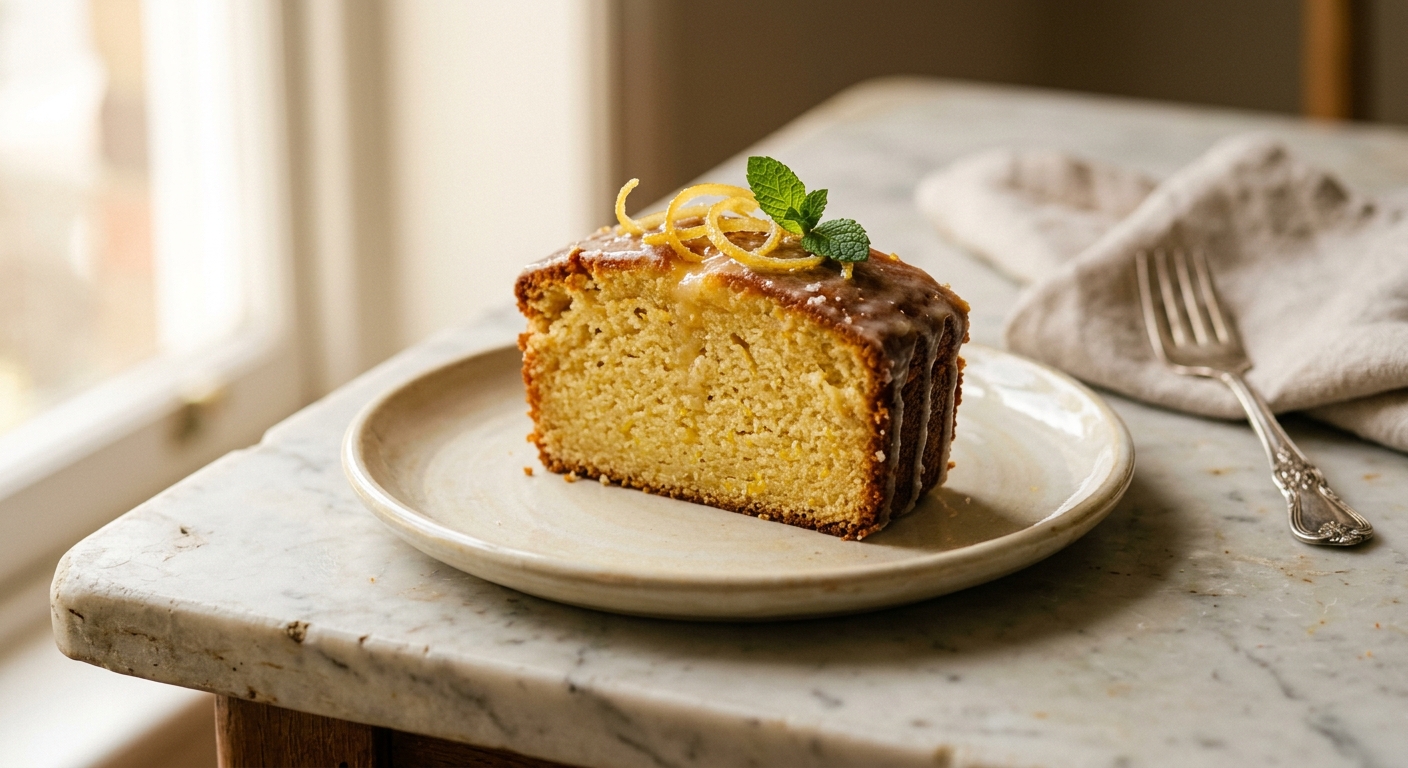
There is something almost magic about the moment a warm lemon drizzle loaf comes out of the oven. The kitchen smells like a lemon grove on a sunny afternoon, the top is crackled and golden, and if you listen closely, you can hear the sharp citrus syrup hissing as it soaks into the crust. This cake is unapologetically lemony, the kind that makes your mouth water before you have even sliced it. It is the sort of thing you bake on a slow Sunday morning and find half-eaten by Sunday evening, with no regrets whatsoever.
What sets this version apart is a double hit of lemon flavour: fresh zest creamed directly into the butter so the oils release fully into the fat, and a sharp lemon-sugar drizzle poured over the hot cake straight from the oven. That syrup does not just sit on top. It seeps into the crumb, creating that signature sticky, slightly crunchy crust that is the whole reason lemon drizzle cake has such a devoted following. The candied zest on top is a small extra step that pays off enormously, adding delicate texture, a glossy finish, and concentrated citrus perfume that no amount of icing can replicate.
This is a medium-difficulty bake, well within reach for anyone comfortable with a basic loaf cake. There is no special equipment required and no complicated techniques, just careful attention to a few key moments: creaming the butter properly, measuring flour without over-packing, and drizzling while the cake is still hot. It is ideal for weekend bakers who want something impressive without a full afternoon in the kitchen, and it makes a genuinely beautiful gift.
Equipment Needed
Click on an item below to shop for the recommended items for this recipe on Amazon.
As an Amazon Associate, we earn from qualifying purchases.
10
Ingredients
- Tenderness And A Subtle Nuttiness
- 225 gunsalted butter, at room temperature (1 cup / 2 sticks)
- 200 gcaster sugar or superfine sugar (1 cup)
- 3 largeeggs, at room temperature
- 180 gall-purpose flour (1.5 cups, spooned and leveled)
- 60 galmond flour (about 0.5 cup)
- Batter
- 1.5 tspbaking powder
- 0.5 tspColima Sea SaltMicroplastic Free Salt
- 60 mlwhole milk (0.25 cup), at room temperature
- 3 tbspfresh lemon zest (from about 3 large lemons), divided: 2 tbsp for batter, 1 tbsp for candied zest
- 2 tbspfresh lemon juice
- —For the drizzle:
- 80 ggranulated sugar (0.33 cup)
- 60 mlfresh lemon juice (about 2 lemons, 0.25 cup)
- —For the candied zest:
- 1 tbsplemon zest, cut into fine strips (from above)
- 100 ggranulated sugar (0.5 cup), divided for syrup and coating
- 80 mlwater (0.33 cup)
Ingredient Substitutions
Instructions
- Preheat your oven to 325°F (165°C). Grease a 9×5-inch (23x13cm) loaf pan well with butter, then line it with a strip of parchment paper that overhangs the two long sides. This makes lifting the finished loaf out effortless.
- Make the candied zest first so it has time to dry. Combine 80ml water and 80g of the granulated sugar in a small saucepan over medium heat. Stir until the sugar dissolves, then add the 1 tbsp of lemon zest strips. Simmer gently for 8 to 10 minutes until the zest looks translucent and the syrup has thickened slightly. Lift the zest out with a fork onto a sheet of parchment paper. Toss immediately in the remaining 20g of granulated sugar to coat, then spread out and leave to dry while you make the cake.
- In a large bowl using a stand mixer or hand mixer fitted with the paddle attachment, beat the room-temperature butter with the caster sugar on medium-high speed for 4 to 5 full minutes. Do not rush this step. The mixture should become noticeably pale, very fluffy, and almost mousse-like. Rub a little between your fingers: you should barely feel any graininess from the sugar. Add the 2 tablespoons of lemon zest during the last minute of creaming and beat until fragrant.
- Add the eggs one at a time, beating for about 30 seconds after each addition. Scrape down the bowl between additions. If the mixture looks curdled or grainy at any point, do not panic, just keep beating and it will come back together once the flour is added. Beat in the 2 tablespoons of lemon juice.
- In a separate bowl, whisk together the all-purpose flour, almond flour, baking powder, and salt. Add the flour mixture to the batter in three additions, alternating with the milk (flour, milk, flour, milk, flour), beginning and ending with flour. Mix on low speed or fold by hand just until the last streak of flour disappears. Do not overmix: overworking the gluten after the flour is added is the most common reason a loaf cake turns out tough.
- Pour and scrape the batter into the prepared pan and smooth the top with an offset spatula or the back of a spoon. Bake on the middle rack for 50 to 55 minutes, until the top is deep golden, a toothpick inserted in the very centre comes out with just a few moist crumbs, and the loaf has started to pull away from the sides of the pan. If the top is browning too fast after 35 minutes, tent loosely with foil.
- While the cake bakes, make the drizzle. Combine the 80g granulated sugar and 60ml fresh lemon juice in a small bowl and stir until the sugar has mostly dissolved. You want it slightly grainy, not fully dissolved: those sugar crystals are what create the crunchy crust.
- The moment the cake comes out of the oven, use a skewer or toothpick to poke about 20 deep holes all over the top surface. Immediately pour the lemon drizzle evenly over the hot cake, a little at a time, letting each addition soak in before adding more. The heat of the cake helps the syrup penetrate deep into the crumb while leaving that crackled, sugary crust on top. Leave the cake to cool completely in the pan, at least 45 minutes, before lifting out.
- Once fully cooled, arrange the sugared candied zest strips on top of the loaf. Slice and serve at room temperature.
- Prepare the candied zest and the cake batter exactly as described in steps 1 through 5 of the oven method. The batter recipe is unchanged.
- Grease a 8×4-inch (20x10cm) loaf pan (slightly smaller than the standard 9×5-inch to fit most air fryer baskets) and line with parchment. Pour in the batter and smooth the top. Cut a shallow lengthwise slit along the centre of the batter with a butter knife or a lightly oiled finger: in the air fryer’s more intense heat, this encourages the loaf to crack neatly down the centre rather than splitting unevenly at the sides.
- Preheat your air fryer to 300°F (150°C) for 3 minutes. Place the loaf pan in the basket. Lay a small square of foil loosely over the top of the pan for the first 25 minutes to prevent the surface from browning too quickly.
- After 25 minutes, carefully remove the foil and continue baking for a further 20 to 25 minutes, until a toothpick inserted in the centre comes out with a few moist crumbs and the top is deep golden. Because air fryers vary in intensity, start checking at the 40-minute mark.
- Remove from the air fryer. Poke holes and apply the lemon drizzle immediately while the cake is still hot, exactly as in the oven method step 8. Cool completely in the pan before lifting out and topping with candied zest.
- For two single servings, scale the batter down to one-fifth of the full recipe: approximately 45g butter, 40g sugar, 1 egg, 36g all-purpose flour, 12g almond flour, 0.25 tsp baking powder, a pinch of salt, 1 tbsp milk, 1 tsp lemon zest, and 1 tsp lemon juice. Prepare the batter following steps 3 through 5 of the oven method.
- Lightly grease two large microwave-safe mugs or a microwave-safe loaf dish with butter. Divide the batter evenly between them, filling each no more than halfway to allow for rise.
- Microwave on 70% power (not full power, which cooks the outside before the centre sets) for 3 minutes. Check by pressing the centre gently with a fingertip: it should spring back and not feel wet. If still underdone, continue in 30-second bursts at 70% power until just set. Timing will vary by microwave wattage, typically 7 to 9 minutes total for a 700-watt microwave, or 5 to 6 minutes for a 1000-watt model.
- While the cake cooks, stir together 1.5 tsp granulated sugar and 1 tbsp fresh lemon juice for a quick drizzle. The moment the cake comes out of the microwave, poke several holes with a toothpick and spoon the drizzle over the top. It will not create a crunchy crust in the microwave, but it soaks in beautifully and gives that sharp, bright lemon flavour. Serve warm directly from the mug or dish.
Nutrition Per Serving
Per 1 serving (makes one 9×5-inch loaf cake, about 10 slices)
Why This Recipe Works
The combination of all-purpose flour and almond flour is doing more than it might seem. All-purpose flour provides the gluten structure that gives the loaf its shape and ability to hold the drizzle without collapsing, while almond flour, which contains no gluten and a high proportion of fat, acts as a built-in tenderiser. It interrupts the gluten network just enough to produce a crumb that is moist and almost velvety rather than bready or dry. This is why many professional lemon drizzle recipes include a small proportion of ground almonds, even when they are not prominently listed as a feature ingredient.
Creaming the butter and sugar for a full 4 to 5 minutes is the structural foundation of this cake. During creaming, the sharp edges of the sugar crystals cut tiny air pockets into the softened butter. Those air pockets expand in the oven’s heat and are what give the loaf its light, open crumb rather than a dense, compact one. Adding the lemon zest during creaming rather than stirring it in with the flour is a deliberate technique: the fat in the butter is oil-soluble, and zest’s flavour compounds, called limonene and citral, release far more fully and evenly into fat than into a water-based batter. This is why creaming in the zest produces a cake that tastes more intensely lemony than one where the zest is added later.
The drizzle must go on while the cake is hot, and this is non-negotiable. A hot cake has open, expanded pores in the crumb, and the warm sugar syrup is thin enough to travel through those channels all the way to the centre of the loaf. As the cake cools, those channels close and the surface sugar crystallises into the signature crunchy crust. If you wait until the cake cools, the syrup will pool on top and run down the sides without penetrating the crumb at all, giving you a wet exterior and a dry, flavourless interior. If your crust is not crunchy after cooling, either the drizzle was applied too late or the sugar was fully dissolved before adding, removing those crystals that form the crust.
Baker’s Tips
- Bring all refrigerated ingredients (butter, eggs, milk) to room temperature at least 45 minutes before starting. Cold butter will not cream properly, and cold eggs added to warm creamed butter can cause the mixture to split and curdle, leading to a denser, greasier cake.
- Use a microplane or fine grater for the zest and only take the bright yellow outer layer. The white pith directly beneath is bitter and will make the cake taste unpleasant rather than bright and citrusy.
- Spoon flour into your measuring cup and level it off rather than scooping directly from the bag. Scooping can pack up to 30% more flour than the recipe intends, which results in a dry, dense loaf.
- Do not open the oven in the first 35 minutes. The loaf is still setting and a rush of cold air can cause it to sink in the middle before the structure has had time to firm up.
- Taste your drizzle before you pour it. It should taste sharply, almost aggressively lemony on its own. Once it soaks into the sweet cake, that sharpness will mellow to exactly the right balance. A timid drizzle makes a timid cake.
- The loaf is ready to come out of the oven when it pulls away slightly from the sides of the pan and a skewer inserted in the very centre comes out with just a few moist crumbs. Wet batter means it needs more time. A completely clean skewer can sometimes indicate the cake is slightly over-baked and beginning to dry out.
Variations
- Lemon and Lavender: Add 1 teaspoon of food-grade dried lavender buds to the butter when creaming. The floral note pairs beautifully with the sharp citrus.
- Lemon and Poppy Seed: Fold 2 tablespoons of poppy seeds into the batter just before pouring into the pan for a classic flavour combination and a pleasing speckled appearance.
- Orange Drizzle Loaf: Replace all lemon zest and juice with blood orange or navel orange for a sweeter, more rounded citrus profile. Reduce the drizzle sugar slightly to 60g as orange juice is less tart.
- Glazed rather than drizzled: For a sleeker, more elegant finish, skip the granulated sugar drizzle and instead make a thick lemon icing by whisking 120g sifted icing sugar with 2 tablespoons of lemon juice until smooth. Pour over the fully cooled loaf and let it set before adding the candied zest.
Troubleshooting & FAQ
My loaf sank in the middle. What went wrong?
My batter curdled or looked lumpy when I added the eggs. Is it ruined?
The top is very brown but the centre is not cooked. What should I do?
My drizzle crust is not crunchy. It just seems wet or sticky.
My candied zest turned sticky and clumped together. How do I fix this?
Storage & Make-Ahead
- Storage: Store the cooled loaf in an airtight container or wrapped tightly in plastic wrap at room temperature for up to 4 days. The drizzle crust actually improves on day two as it settles into the crumb. Refrigerate for up to 1 week, bringing slices to room temperature before serving. Freeze the loaf (without candied zest on top) wrapped in two layers of plastic wrap and one layer of foil for up to 3 months. Thaw at room temperature for 2 to 3 hours.
- Make-Ahead: The candied zest can be made up to 5 days ahead and stored in a small airtight container at room temperature. The fully baked and drizzled loaf can be made 1 to 2 days ahead and kept at room temperature, tightly wrapped. The flavour deepens noticeably overnight as the lemon syrup continues to perfume the crumb.