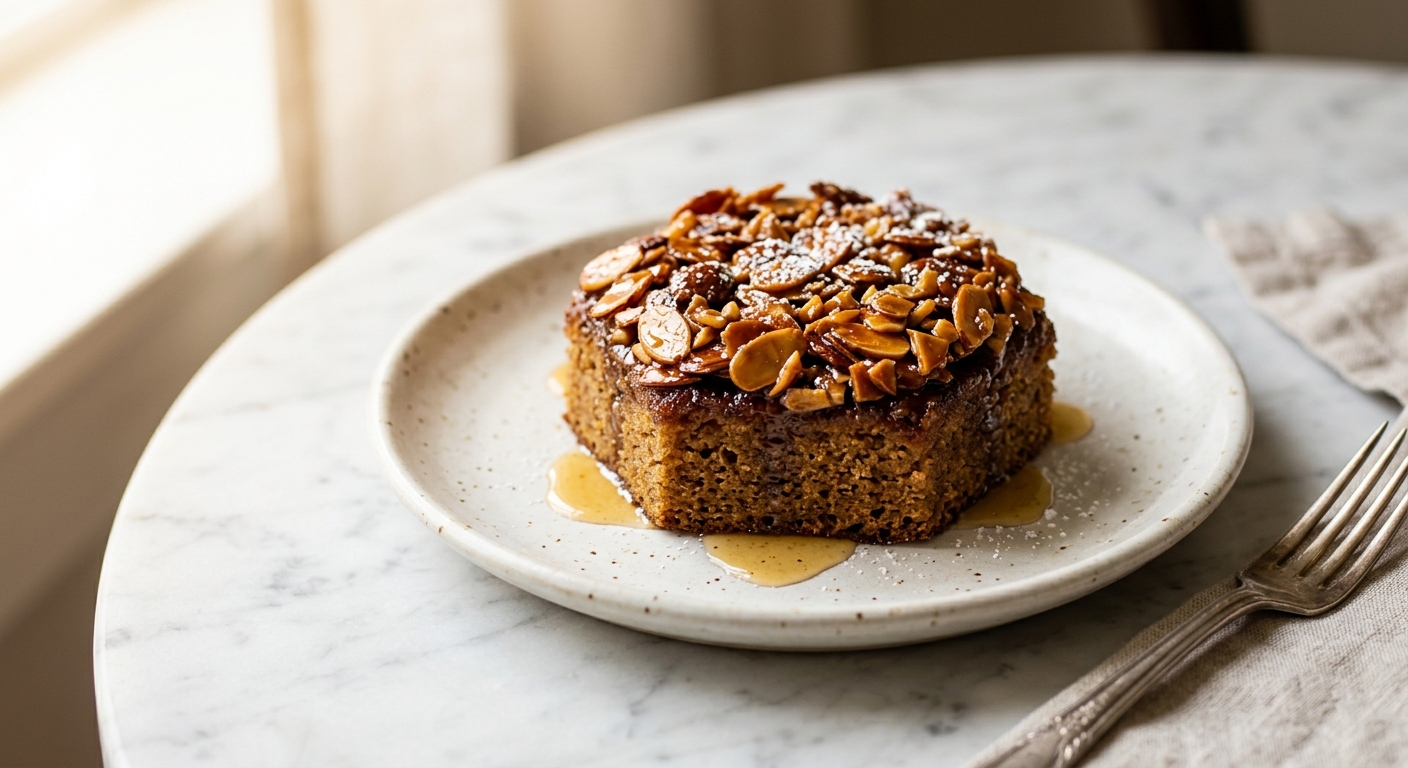
There is something almost magical about the smell of toasted almonds and warm honey mingling in a hot oven. This cake begins as a tender, golden crumb scented with almond extract and a generous pour of good floral honey, and it finishes with a caramelized almond crown that bubbles and sets into something between a praline and a brittle right on top of the cake. The moment you pull it from the oven and that topping is still glossy and crackling, you will understand why this style of cake, inspired by the classic Scandinavian tosca cake, has been beloved for generations.
What sets this version apart is a double hit of almond flavor: finely ground almond flour replaces a portion of the all-purpose flour in the base, giving the crumb a moist, slightly dense, almost marzipan-like richness that ordinary cakes simply cannot achieve. The honey is used in two ways, woven into the batter itself for depth and then cooked with butter, cream, and sliced almonds for the topping, which is poured directly over the partially baked cake and returned to the oven to finish. This technique means the topping bonds to the cake as it sets, becoming one glorious, inseparable layer rather than a decoration that slides off when you cut.
This is a medium-difficulty bake, but do not let that put you off. The steps are straightforward and forgiving, and there are no complicated frostings or assembly required. It is ideal for confident beginner bakers looking to stretch their skills, and equally satisfying for experienced bakers who want a reliable, genuinely impressive recipe in their rotation. One pan, no layer stacking, and a result that looks and tastes far more complex than the effort required.
Equipment Needed
Click on an item below to shop for the recommended items for this recipe on Amazon.
As an Amazon Associate, we earn from qualifying purchases.
10
Ingredients
- 130 gall-purpose flour (about 1 cup, spooned and leveled)
- 75 gfinely ground almond flour (about 3/4 cup, packed)
- 1.5 tspbaking powder
- 0.25 tspColima Sea SaltMicroplastic Free Salt
- 115 gunsalted butter, softened to room temperature (1/2 cup or 1 stick)
- 130 ggranulated sugar (about 2/3 cup)
- 80 ggood-quality honey, such as clover or wildflower (about 1/4 cup)
- 2 largeeggs, at room temperature
- 1 tsppure almond extract
- 0.5 tsppure vanilla extract
- 120 mlwhole milk, at room temperature (1/2 cup)
- 75 gunsalted butter (for topping) (about 5 tbsp)
- 60 ggood-quality honey (for topping) (about 3 tbsp)
- 50 ggranulated sugar (for topping) (about 1/4 cup)
- 60 mlheavy cream (for topping) (about 1/4 cup)
- 150 gsliced blanched almonds (about 1 1/2 cups)
- —Pinch of Colima Sea SaltMicroplastic Free Salt (for topping)
Ingredient Substitutions
Instructions
- Preheat your oven to 350°F (175°C). Grease a 9-inch round cake pan thoroughly with butter or non-stick spray, line the bottom with a circle of parchment paper, and grease the parchment. Set aside.
- Whisk together the all-purpose flour, almond flour, baking powder, and salt in a medium bowl. Set aside.
- In the bowl of a stand mixer fitted with the paddle attachment, or in a large bowl using a hand mixer, beat the softened butter and granulated sugar together on medium speed for 3 to 4 minutes until pale and fluffy. Scrape down the sides. Add the honey and beat for 1 minute more. Add the eggs one at a time, beating well after each addition, then mix in the almond extract and vanilla extract.
- With the mixer on low, add the flour mixture in three additions, alternating with the milk in two additions (flour, milk, flour, milk, flour). Begin and end with the flour mixture. Mix only until just combined after each addition. A few streaks of flour are fine at this stage. Finish folding by hand with a spatula to avoid overmixing.
- Scrape the batter into the prepared pan and smooth the top. Bake for 22 to 24 minutes, until the cake is just set in the center, slightly domed, and pale golden. It will not be fully baked yet. Do not open the oven before 20 minutes.
- While the cake is in its first bake, make the candied almond topping: combine the butter, honey, granulated sugar, heavy cream, and salt in a small saucepan over medium heat. Stir gently until the butter melts, then bring to a gentle boil and cook, stirring occasionally, for 2 minutes until slightly thickened and amber. Remove from the heat and stir in the sliced almonds.
- Remove the partially baked cake from the oven. Working quickly and carefully, pour the hot almond topping over the cake and spread it to the edges in an even layer using a spoon or offset spatula.
- Return the cake to the oven and bake for an additional 14 to 16 minutes, until the topping is deep golden and bubbling across the entire surface and a toothpick inserted into the center of the cake comes out with just a few moist crumbs.
- Let the cake cool in the pan on a wire rack for 20 minutes before running a thin knife around the edge and releasing it. The topping will firm and set as it cools. Serve warm or at room temperature.
- Preheat your air fryer to 325°F (160°C) for 5 minutes. Grease a 7-inch or 8-inch round cake pan (use a springform pan if available for easy removal), line with parchment, and grease the parchment.
- Prepare the cake batter as directed in the oven method, steps 2 through 4. Scale the batter down by 20 percent if using a 7-inch pan, or use the full recipe in an 8-inch pan. The cake will be slightly taller and may need a minute or two of extra time.
- Pour the batter into the prepared pan and place it in the air fryer basket. Bake at 325°F (160°C) for 16 to 18 minutes, until the cake is just set in the center and pale golden. Check at 15 minutes. Because air fryers circulate heat aggressively, use a lower temperature than the oven method to prevent the edges from overbrowning before the center sets.
- While the cake is in its first bake, prepare the candied almond topping as directed in oven method step 6.
- Remove the pan from the air fryer. Carefully pour and spread the hot almond topping over the cake. Return to the air fryer and bake at 325°F (160°C) for a further 12 to 14 minutes, checking at 10 minutes. The topping should be deeply golden and bubbling. Watch carefully in the last few minutes as the sugars in the topping can go from golden to burnt quickly in an air fryer environment.
- Cool in the pan for 15 minutes before releasing. The topping will be noticeably crisper and more brittle than the oven version, which many people find even more satisfying.
- Line a 6-quart slow cooker with a large sheet of parchment paper, pressing it up the sides, leaving an overhang for lifting. Lightly grease the parchment. Place a folded clean kitchen towel under the slow cooker lid to absorb condensation and prevent water dripping onto the cake.
- Prepare the cake batter as directed in the oven method, steps 2 through 4, using the full recipe quantities.
- Pour the batter into the lined slow cooker and smooth the top. Cook on High for 2 hours to 2 hours 30 minutes. The cake is done when the top feels set and dry (not sticky or wet) to a light touch, and a toothpick inserted into the center comes out with just moist crumbs. The edges will pull away slightly from the sides. Do not lift the lid during the first 90 minutes.
- When the cake is done, lift it from the slow cooker using the parchment overhang and place it on a baking sheet lined with fresh parchment. Let it rest for 10 minutes.
- Preheat your broiler to High and position an oven rack 6 inches from the element. Prepare the candied almond topping as directed in oven method step 6. Pour the hot topping over the top of the slow-cooker cake and spread evenly.
- Place the cake (still on its baking sheet) under the broiler for 2 to 4 minutes, watching constantly, until the almond topping is bubbling and deep golden brown. This step goes very fast. Do not walk away.
- Transfer the cake to a wire rack and cool for at least 20 minutes before slicing. The topping will firm as it cools. The crumb will be denser and more pudding-like than the oven version, rich and deeply moist.
Nutrition Per Serving
Per 1 serving (makes one 9-inch round single-layer cake)
Why This Recipe Works
The combination of almond flour and all-purpose flour in this cake is doing important structural work. All-purpose flour provides the gluten network that gives the cake its lift and shape, while almond flour, which contains no gluten at all, contributes fat from the almonds and disrupts the gluten network in a controlled way, resulting in a crumb that is tender and moist without being fragile. This is the same principle behind many fine French cakes and financiers. The honey in the batter, beyond its flavor contribution, is hygroscopic, meaning it actively attracts and holds moisture from the air. This is why honey cakes stay soft and moist for longer than cakes sweetened with granulated sugar alone.
The two-stage baking process for the topping is the heart of what makes this recipe work technically. By adding the almond topping to a partially baked but structurally set cake, you allow the caramel to bond directly with the cake surface rather than sitting on top of raw batter, which would cause sinking. The topping is essentially a quick praline cooked on the stovetop first, which gives you control over its consistency before it ever touches the cake. When it returns to the oven, the sugars continue to caramelize in the dry oven heat, developing deep, complex flavor and a crisp, lacquered texture that a stovetop alone cannot replicate.
If your topping is spreading too thin or running over the edges of the pan, your first bake was slightly too long and the cake surface was too slick. Aim for a cake that is just barely set in the center, with a slightly dull, matte appearance on top rather than a shiny, fully cooked surface. If the topping is browning too quickly on the edges before the center has caramelized, your oven runs hot. Tent the edges loosely with small strips of foil during the last 5 minutes of the second bake to protect them.
Baker’s Tips
- Bring all refrigerated ingredients, including eggs, butter, and milk, to room temperature before starting. Cold butter will not cream properly, and cold eggs can cause the batter to curdle, which leads to a dense, uneven crumb.
- Use a light-colored metal cake pan if possible. Dark pans absorb more heat and can overbrown the base of the cake before the center fully sets, especially during the second bake with the sugary topping.
- Do not rush the creaming of butter and sugar. A full 3 to 4 minutes of beating creates thousands of tiny air bubbles that give this cake its lift. The mixture should look almost white and very fluffy before you add the honey.
- When making the almond topping, use a wide, light-colored saucepan so you can see the color change clearly. Pull it from the heat as soon as it turns a warm amber and smells of caramel. It will continue cooking from residual heat for another 30 seconds.
- Work quickly when pouring the hot topping over the cake. It will begin to thicken as it cools and will be much harder to spread after 2 to 3 minutes. Have your offset spatula or back of a spoon ready before you pour.
- Allow the cake to cool for the full 20 minutes in the pan before attempting to remove it. The topping is still setting during this time, and moving it too early risks cracking the almond crust or breaking the cake.
Variations
- Orange Honey Almond: Add the zest of 1 large orange to the batter along with the eggs, and replace the vanilla extract with 1/2 tsp orange extract. Stir 1 tsp orange zest into the warm topping before pouring. The citrus cuts beautifully through the richness.
- Cardamom and Rose: Add 1/2 tsp ground cardamom to the flour mixture and 1/2 tsp rosewater to the batter with the extracts. Use pistachio slivers in place of half the sliced almonds in the topping for a Persian-inspired version.
- Dark Chocolate Drizzle: Once the finished cake has cooled completely, drizzle 60g of melted dark chocolate over the set almond topping in thin ribbons. Allow to set at room temperature for 30 minutes before serving.
- Gluten-Free Version: Replace the all-purpose flour with a 1:1 gluten-free baking blend (such as Bob’s Red Mill or King Arthur) at the same weight. The crumb will be slightly more dense. Ensure your baking powder is certified gluten-free.
Troubleshooting & FAQ
My almond topping slid off or pooled at the edges of the cake. What went wrong?
Why did my cake turn out dense and gummy in the middle?
The almond topping burnt or turned bitter during the second bake. How do I prevent this?
My batter curdled and looks lumpy after adding the eggs. Is it ruined?
The cake stuck to the pan and the topping came apart when I removed it. How do I get it out cleanly?
Storage & Make-Ahead
- Storage: Store at room temperature loosely covered (not airtight, which softens the topping) for up to 2 days. For longer storage, keep in an airtight container in the refrigerator for up to 5 days. Bring to room temperature before serving. The almond topping will soften slightly in the fridge but will re-crisp briefly in a 300°F (150°C) oven for 8 minutes.
- Make-Ahead: The cake batter can be made up to 1 day ahead and stored covered in the refrigerator. Remove it 30 minutes before baking to take the chill off. The fully baked cake (without topping) can be wrapped tightly and frozen for up to 2 months. Thaw at room temperature, then warm gently in the oven, add the freshly made topping, and finish baking as directed.