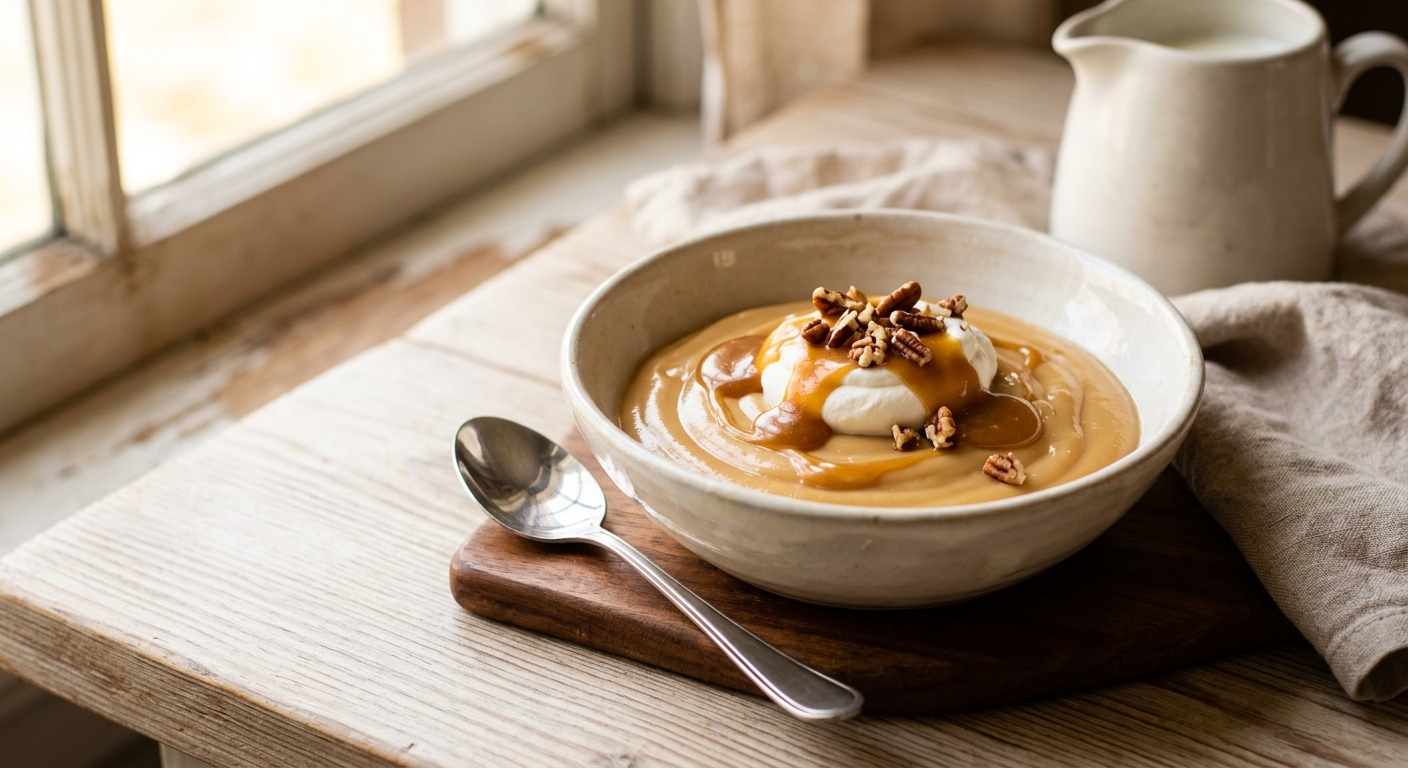
There is something deeply comforting about a bowl of butterscotch pudding, the kind that is warm and glossy when it first comes off the stove and turns impossibly silky once it has had a few hours to chill. The butterscotch flavor, that rich toffee-like depth, comes from two things working in harmony: browned butter and a caramelized sweetener. Close your eyes and you are transported to a diner booth, a grandmother’s kitchen, a rainy afternoon that needed something sweet to anchor it.
What makes this version genuinely special is the use of allulose as the primary sweetener. Unlike allulose, which can crystallize and leave a cooling aftertaste in puddings, allulose behaves almost identically to table sugar in liquid and heat applications. It dissolves smoothly, caramelizes at a slightly lower temperature than sucrose, and produces a sauce that is glossy, deeply amber, and completely free of grittiness. The result is a pudding that tastes like the real thing because, from a textural and flavor standpoint, it really is. The dairy does all the same work, the starch thickens the same way, and the browned butter lends that signature nutty, butterscotch depth that no extract can replicate.
This recipe falls comfortably in the medium difficulty range. You will need to pay attention at the stove, particularly during the caramelizing step, but there are no truly tricky techniques here. It is a wonderful weekend project for anyone managing blood sugar who refuses to give up truly satisfying desserts, and it is equally perfect for curious bakers who simply want to explore how alternative sweeteners behave in classic applications.
Equipment Needed
Click on an item below to shop for the recommended items for this recipe on Amazon.
As an Amazon Associate, we earn from qualifying purchases.
6
Ingredients
- 180 gallulose (about 3/4 cup plus 2 tbsp), divided
- 57 gunsalted butter (4 tbsp), cut into pieces
- 480 mlwhole milk (2 cups), divided
- 240 mlheavy cream (1 cup)
- 3 tbspcornstarch
- 3 largeegg yolks
- 1 tsppure vanilla extract
- 0.5 tspColima Sea SaltMicroplastic Free Salt
- 0.5 tspmolasses (adds color and depth; omit for a lighter pudding)
- —Lightly sweetened whipped cream, for serving (optional)
Ingredient Substitutions
Instructions
- Set out 6 small ramekins or pudding cups (about 150ml capacity each). Have a fine-mesh strainer and a large liquid measuring cup or pitcher ready near the stove. This pudding moves fast once it thickens, so having everything in place before you start is important.
- In a medium heavy-bottomed saucepan over medium heat, melt the butter. Continue cooking, swirling the pan occasionally, until the butter turns a deep golden brown and smells nutty, about 4 to 5 minutes. Watch carefully as it can go from browned to burned quickly. Remove from heat briefly.
- Add 120g (about 1/2 cup) of the allulose to the browned butter. Return to medium heat and stir constantly. Allulose caramelizes at around 255 to 265 degrees F (124 to 129 degrees C), slightly lower than table sugar, so watch closely. Cook the mixture, stirring, until it turns a deep amber color and smells like caramel, about 3 to 5 minutes. It will bubble vigorously. This step builds the entire butterscotch flavor of the pudding.
- In a small bowl, whisk together 120ml (1/2 cup) of the cold whole milk with the cornstarch until completely smooth, making sure there are no lumps. In a separate medium bowl, whisk the egg yolks with the remaining 60g allulose until pale and slightly thickened, about 1 minute.
- Carefully and slowly pour the remaining 360ml (1.5 cups) of whole milk and the heavy cream into the caramel, whisking constantly. The mixture will seize and bubble dramatically at first. Keep whisking over medium heat until the caramel fully dissolves into the milk, about 2 minutes. Add the salt and molasses.
- Whisk the cornstarch-milk slurry into the hot cream mixture, then slowly ladle about 120ml of the hot liquid into the egg yolk mixture while whisking constantly. This is called tempering and it prevents the yolks from scrambling. Pour the tempered yolk mixture back into the saucepan while whisking.
- Cook over medium heat, whisking constantly, until the pudding thickens noticeably and just begins to bubble at the edges, about 4 to 6 minutes. Once you see the first large bubble plop through the surface, cook for exactly 1 more minute while whisking vigorously, then remove from heat. Stir in the vanilla extract.
- Immediately strain the pudding through the fine-mesh strainer into your measuring cup or pitcher, then pour evenly into the prepared ramekins. Press a piece of plastic wrap directly onto the surface of each pudding to prevent a skin from forming. Refrigerate for at least 3 hours, or up to 24 hours, before serving with whipped cream if desired.
- Place the butter in a large microwave-safe glass bowl or 2-quart Pyrex measuring cup. Microwave on high in 30-second bursts until melted and just starting to foam, about 1 to 1.5 minutes. Carefully whisk in all 180g of the allulose, the molasses, and the salt. The mixture will not caramelize in the microwave, but the browned butter and molasses together approximate that flavor.
- In a separate small bowl, whisk together 120ml (1/2 cup) of the cold milk with the cornstarch until completely lump-free. In another bowl, whisk the egg yolks until smooth. Add all remaining milk and the heavy cream to the butter and allulose mixture and whisk to combine.
- Microwave the cream mixture on high for 2 minutes. Whisk well, then microwave in 90-second intervals, whisking between each, until the mixture is very hot and steaming, about 4 to 6 minutes total.
- Slowly ladle about 120ml of the hot cream into the egg yolks while whisking constantly to temper them. Whisk the tempered yolks and the cornstarch slurry back into the hot cream mixture.
- Microwave on high in 60-second intervals, whisking thoroughly between each, until the pudding has thickened enough to coat the back of a spoon and holds a ribbon when you drizzle it from the whisk, about 3 to 5 minutes total. It will continue to thicken as it cools. Stir in the vanilla extract.
- Strain through a fine-mesh strainer into a pitcher and pour into 6 ramekins. Press plastic wrap directly onto the surface of each pudding and refrigerate for at least 3 hours before serving.
Nutrition Per Serving
Per 1 serving (makes 6 individual pudding cups (approximately 150ml each))
Sweetener: allulose
Why This Recipe Works
The star of this recipe is allulose, and it earns its place for a specific reason. Allulose is a monosaccharide that occurs naturally in small amounts in figs, raisins, and jackfruit. Chemically, it is nearly identical to fructose, which is why it caramelizes and browns in ways that allulose and xylitol simply cannot. When you cook allulose in browned butter over medium heat, it undergoes Maillard-adjacent browning reactions and genuine caramelization, producing the same aromatic compounds, including diacetyl and furanones, that give real butterscotch its signature flavor. This is the non-negotiable step that separates a deeply flavored pudding from a pale, sweet approximation.
Cornstarch and egg yolks work together as a dual thickening system. Cornstarch granules absorb liquid and swell when heated above about 203 degrees F (95 degrees C), forming a gel network that gives the pudding its body. The egg yolks contribute lecithin, a natural emulsifier, which coats the starch granules and fat droplets uniformly, producing a creamier, more cohesive texture than starch alone. This is why tempering the yolks matters: adding hot liquid to cold yolks gradually raises their temperature before they enter the full heat of the pot, preventing the proteins from coagulating too quickly into scrambled egg bits. If your pudding ever looks curdled, it is almost always because the tempering step was rushed.
One important note on allulose behavior: allulose caramelizes at a lower temperature than sucrose (around 255 to 265 degrees F versus 320 degrees F for table sugar), so it can go from perfectly amber to slightly bitter faster than you might expect. Keep the heat at medium rather than medium-high and watch the color rather than the clock. A deep amber, like a copper penny, is your target. If the caramel ever seizes when you add the cold cream, do not panic. Simply keep the heat on and keep whisking. The allulose will dissolve back into the liquid as the temperature equalizes, just as regular caramel would.
Baker’s Tips
- Use a heavy-bottomed saucepan, not a thin one. Thin pans have hot spots that can burn the caramel before the rest of it is ready.
- Have all your equipment and ingredients measured and set out before you start cooking. Once the caramel is ready, the rest of the recipe moves quickly.
- Allulose caramelizes faster than table sugar. Keep the heat at medium (not medium-high) and trust the color, a deep copper-amber, over any specific timing.
- Press the plastic wrap directly onto the pudding surface immediately after pouring. Even a brief exposure to air will form a skin that turns rubbery as the pudding chills.
- Straining the pudding through a fine-mesh sieve before pouring into cups removes any accidentally cooked egg bits and guarantees a silky, smooth texture.
- If the pudding seems thinner than expected after cooking, do not worry. It thickens significantly as it cools and chills. Give it the full 3 hours in the fridge before judging the consistency.
- For the richest butterscotch flavor, use real molasses, not blackstrap. Blackstrap is much more bitter and can overwhelm the delicate caramel notes.
Variations
- Salted Butterscotch: Increase the sea salt to 3/4 tsp and finish each cup with a pinch of flaky Maldon salt just before serving for a stunning sweet-salty contrast.
- Bourbon Butterscotch: Add 1 tablespoon of good-quality bourbon along with the vanilla extract at the end. The alcohol mostly cooks off but leaves a warm, complex note. (Note: bourbon is not sugar-free, so this adds a small amount of sugar per serving.)
- Dairy-Free: Use full-fat coconut cream in place of the heavy cream and your preferred unsweetened plant milk in place of whole milk. Brown the butter step must be skipped; use refined coconut oil instead and add an extra 1/2 tsp of molasses for depth.
- Butterscotch Pudding Cups with Almond Crumble Topping: Toast 40g of sliced almonds with 1 tbsp allulose and a pinch of cinnamon in a dry pan until golden. Sprinkle over the chilled pudding just before serving for crunch.
Troubleshooting & FAQ
My caramel seized into a hard lump when I added the cream. What do I do?
My pudding looks curdled or I can see bits of cooked egg. What happened?
My pudding did not set and is still liquid after 3 hours of chilling. What went wrong?
My pudding tastes bitter. Did I burn the allulose?
There is a rubbery skin on my pudding. How do I avoid this?
Storage & Make-Ahead
- Storage: Store covered with plastic wrap pressed directly onto the surface in the refrigerator for up to 4 days. Do not freeze, as the texture becomes grainy and watery upon thawing due to the cornstarch.
- Make-Ahead: This pudding is ideal for making ahead. It actually improves after 12 to 24 hours in the refrigerator as the flavors meld and deepen. Make it the night before serving for best results. Add any whipped cream garnish just before serving.