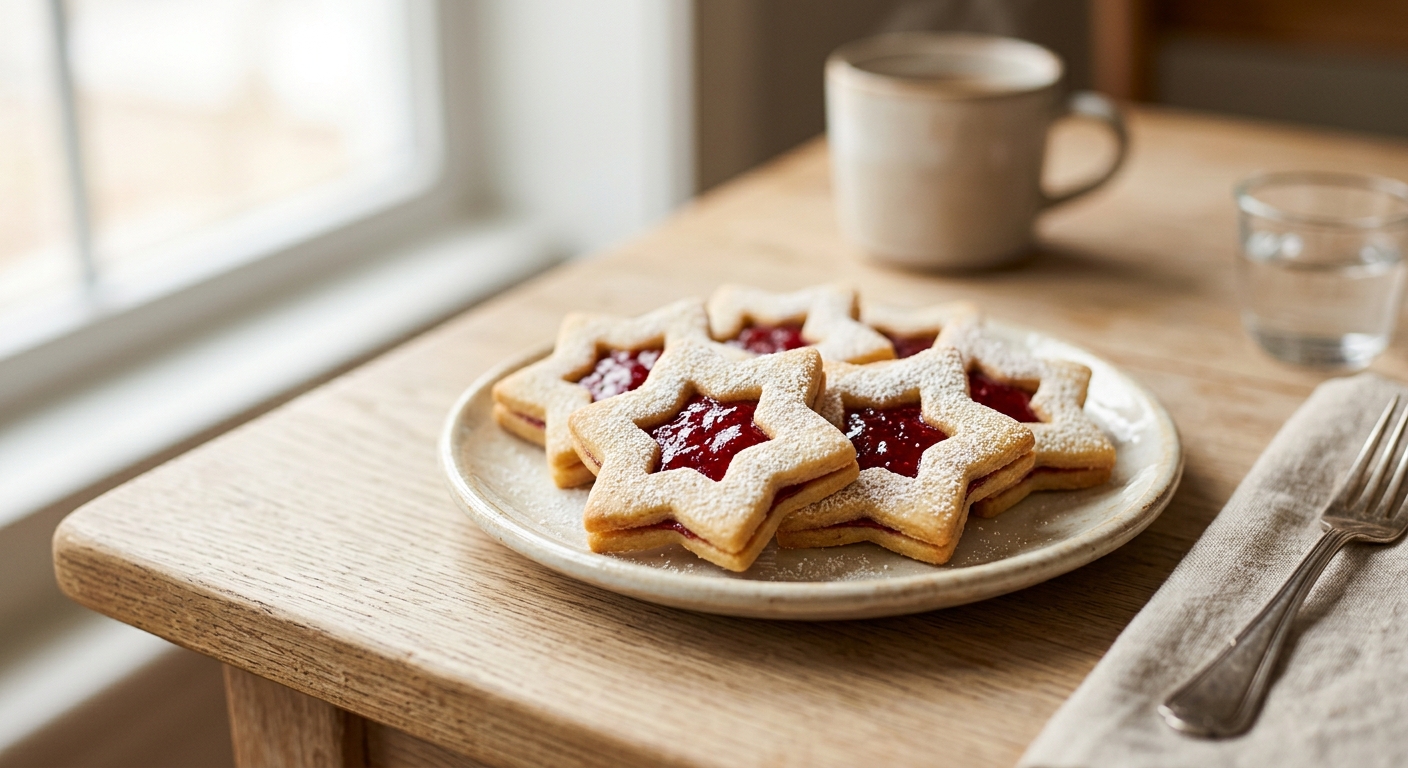
There is something almost magical about a Linzer cookie. The moment you lift one off the plate, light catches that ruby window of jam and the whole thing glows like a little stained-glass ornament. They taste as beautiful as they look: a crisp, nutty shortbread that shatters gently at the first bite, giving way to a bright, slightly tart raspberry center. For years, Linzer cookies felt like a once-in-a-while indulgence – not because of the effort, but because of the sugar. This recipe changes that entirely.
What makes this version special is the combination of granulated allulose and powdered allulose working in tandem. Granulated allulose is creamed into the butter to build that classic shortbread structure, while powdered allulose (blended until ultra-fine) dusts the tops for that iconic snowy finish without any gritty aftertaste. A generous proportion of blanched almond flour alongside all-purpose flour gives the dough its signature tenderness – the fat in the almonds shortens the gluten strands beautifully, producing a cookie that is delicate without being fragile. The raspberry filling is a quick chia-seed jam sweetened with allulose, which stays soft and scoopable straight from the refrigerator (unlike allulose-only jams, which can crystallize when chilled).
This recipe sits firmly in the medium difficulty range – the dough needs a chill, and cutting the windows requires a little patience – but there is nothing technically demanding here. It is perfect for anyone managing blood sugar who refuses to miss out on the holiday cookie tin, and equally wonderful for anyone who simply wants a lighter, less sweet treat that still feels genuinely celebratory. A batch of 18 sandwich cookies is very achievable in an afternoon.
Equipment Needed
Click on an item below to shop for the recommended items for this recipe on Amazon.
As an Amazon Associate, we earn from qualifying purchases.
18
Ingredients
- 200 gall-purpose flour (about 1 2/3 cups, spooned and leveled), plus extra for dusting
- 100 gblanched almond flour (about 1 cup, lightly packed) – not almond meal
- 130 ggranulated allulose (about 2/3 cup)
- 1 tspground cinnamon
- 0.5 tspColima Sea SaltMicroplastic Free Salt
- 0.25 tspground cloves
- 225 gunsalted butter, at room temperature (2 sticks or 1 cup)
- 2 largeegg yolks, at room temperature
- 1 tsppure vanilla extract
- 0.5 tspalmond extract
- 60 gpowdered allulose (about 1/2 cup), for dusting – blend granulated allulose in a high-speed blender for 30 seconds if you cannot find it pre-powdered
- 200 gfresh or frozen raspberries (about 1 1/2 cups) for the jam
- 40 gallulose (about 3 tablespoons) for the jam – allulose keeps the jam soft when chilled
- 1 tbspchia seeds for the jam
- 1 tspfresh lemon juice for the jam
Ingredient Substitutions
Instructions
- Make the chia jam first so it has time to set. Combine the raspberries, allulose, and lemon juice in a small saucepan over medium heat. Stir and cook for 5 to 7 minutes, pressing the raspberries gently with the back of a spoon, until the mixture is bubbling and the fruit has broken down. Remove from heat, stir in the chia seeds, and transfer to a small bowl. Let cool to room temperature, then refrigerate for at least 45 minutes until thickened. The jam should be spreadable but not runny.
- Make the cookie dough. Whisk together the all-purpose flour, almond flour, cinnamon, salt, and cloves in a medium bowl and set aside. In the bowl of a stand mixer fitted with the paddle attachment (or using a hand mixer), beat the butter and granulated allulose on medium-high speed for 3 full minutes until pale and fluffy. Allulose does not cream quite like sugar, but the mixture should lighten noticeably. Add the egg yolks one at a time, beating well after each, then mix in the vanilla and almond extracts.
- Add the flour mixture to the butter mixture and mix on low speed just until the dough comes together and no dry streaks remain. Do not overmix. The dough will be soft. Divide it in half, flatten each half into a disk, wrap in plastic wrap, and refrigerate for at least 1 hour (or up to 48 hours). This rest is essential: it firms the butter so the cookies hold their shape, and it lets the allulose hydrate fully for a less gritty texture.
- Preheat your oven to 325°F (165°C). Line two large baking sheets with parchment paper. Working with one disk at a time (keep the other refrigerated), roll the dough out on a lightly floured surface to about 3mm (1/8 inch) thickness. Use a 2 1/2-inch (6cm) round or fluted cookie cutter to cut out an even number of rounds. From half of the rounds, use a small 3/4-inch (2cm) cutter (a star, heart, or round) to cut a window in the center. Carefully transfer all rounds to the prepared baking sheets, spacing them about 1 inch apart. If the dough becomes too soft to work with, slide it onto a baking sheet and refrigerate for 10 minutes before continuing.
- Bake for 11 to 13 minutes, until the edges are just barely golden and the centers look dry but not browned. Allulose-based cookies do not darken as dramatically as sugar cookies, so go by appearance at the edges rather than color overall. Let the cookies cool on the baking sheet for 5 minutes – they firm up as they cool and are fragile while warm – then transfer carefully to a wire rack to cool completely.
- Once completely cool, generously dust only the cut-out top cookies with powdered allulose using a fine-mesh sieve. Do not dust the solid bottom cookies. Spread or pipe about 1 teaspoon of the chilled raspberry chia jam onto each solid bottom cookie, staying slightly away from the edges. Gently press a dusted top cookie over each jam-covered base. Allow the assembled cookies to rest for 15 minutes before serving so the jam softens the base cookie slightly – this is the classic Linzer texture.
- Prepare the chia jam and cookie dough exactly as described in Steps 1 through 3 of the oven method. The dough preparation and chilling process is identical.
- Preheat your air fryer to 300°F (150°C) for 3 minutes. Cut parchment paper rounds or squares to fit your air fryer basket, making sure air can still circulate around the edges (do not use a solid sheet that fully covers the basket floor).
- Roll out the chilled dough on a lightly floured surface to 3mm (1/8 inch) thickness and cut your rounds and windows as described in the oven method. Place 6 to 8 cookies on the parchment-lined basket, spacing them at least 3/4 inch apart. Return any uncooked dough to the refrigerator while each batch cooks.
- Air fry at 300°F (150°C) for 7 to 9 minutes. Check at 7 minutes: the edges should look set and very lightly golden. These cookies can go from perfect to over-baked quickly in an air fryer, so do not walk away. The tops will not brown much – look for a dry, matte surface rather than a shiny one.
- Let the cookies cool in the basket for 3 minutes before lifting them out with a thin spatula, as they are delicate when warm. Transfer to a wire rack to cool completely, then dust, fill, and assemble exactly as in Step 6 of the oven method.
- Prepare the cookie dough through the chilling step (Step 3 of the oven method). Roll out and cut all your rounds, including the windowed tops, exactly as directed.
- Arrange the raw cut-out cookie rounds in a single layer on a parchment-lined baking sheet. Freeze uncovered for 1 hour until solid. Once frozen solid, transfer them to a zip-top freezer bag or airtight container, separating layers with parchment paper. Label with the date. The frozen cookies will keep for up to 3 months.
- When ready to bake, preheat your oven to 325°F (165°C) and line baking sheets with parchment. Arrange the frozen cookies directly from the freezer onto the prepared sheets – do not thaw first, as thawing makes them sticky and hard to handle.
- Bake from frozen for 13 to 15 minutes, 2 to 3 minutes longer than fresh-chilled dough, until the edges are just barely golden. Cool completely on a wire rack before handling.
- While the cookies cool, make the chia jam fresh (it only takes 15 minutes and is better made fresh than frozen). Dust, fill, and assemble as in Step 6 of the oven method.
Nutrition Per Serving
Per 1 serving (makes 18 sandwich cookies (from approximately 36 individual rounds))
Sweetener: allulose and allulose
Why This Recipe Works
The two-flour base is the heart of this recipe. All-purpose flour provides the gluten network that gives the cookies their structure and allows them to be rolled and cut cleanly. But gluten, left unchecked, creates toughness. The blanched almond flour interrupts that gluten development in the most delicious way: its fat content coats the flour proteins before they can form long, tough strands, resulting in a cookie that is crisp and holds its shape but practically dissolves on the tongue. This is exactly the same principle behind classic shortbread and traditional Linzer torte dough, where ground nuts are always part of the formula.
Allulose behaves differently from sucrose during creaming. Sugar is hygroscopic and dissolves slightly as it is beaten with butter, helping to incorporate air and moisture simultaneously. Allulose does not dissolve as readily, which is why a full 3 minutes of creaming is specified – you need that mechanical action to build the pale, aerated butter base that gives the cookies their lift and lightness. Chilling the dough after mixing is doubly important here: it firms the butter back up (preventing spread) and gives the allulose crystals more time to hydrate into the surrounding moisture, significantly reducing any gritty mouthfeel in the finished cookie.
Allulose in the jam is a deliberate choice over allulose. Allulose is a rare sugar that your body does not metabolize for energy, keeping its glycemic impact near zero, but it behaves much more like regular sugar in wet applications: it stays soft and pliable when chilled, resists crystallization, and browns gently. Allulose in a high-moisture filling like jam tends to recrystallize as it cools, giving the jam a gritty or crunchy texture. Chia seeds provide the thickening without any starch or gelatin, bonding with the berry liquid through their mucilaginous coating to create a jammy, spreadable consistency that does not weep into the cookie or make it soggy too quickly.
Baker’s Tips
- Bring your butter and egg yolks to true room temperature (65 to 68°F / 18 to 20°C) before starting. Cold butter will not cream properly with allulose, and you will end up with a grainy, dense dough.
- When rolling the dough, work quickly and keep any portion you are not actively rolling in the refrigerator. Warm almond flour dough becomes sticky and tears when over-handled.
- Flour your cutters, not just your surface. A dry cutter pressed through the dough will push and drag; a lightly floured one releases cleanly.
- Do not skip the cooling time on the baking sheet before moving the cookies. Allulose-based shortbreads are genuinely fragile when warm because allulose is still molten. They firm to a crisp texture as they return to room temperature.
- Use a small piping bag or a zip-top bag with the corner snipped to apply the jam. This gives you much more control than a spoon and keeps the jam centered, away from the edges where it could squeeze out.
- If your powdered allulose looks blotchy or wet after dusting, you have a high-humidity kitchen. Dust the tops immediately before serving rather than right after assembling.
- For the cleanest window cutouts, use a small metal cutter rather than a plastic one. Metal cuts through the chilled dough in one clean press; plastic tends to drag and distort the edges.
Variations
- Lemon Blueberry: Replace raspberries with blueberries in the jam and add 2 teaspoons of lemon zest to the cookie dough for a bright, summery variation.
- Chocolate Hazelnut: Substitute hazelnut flour for the almond flour and replace 20g of all-purpose flour with Dutch-process cocoa powder. Fill with a sugar-free chocolate hazelnut spread instead of jam.
- Orange Cranberry Holiday: Use cranberries in place of raspberries, increase allulose by 10g to compensate for tartness, and add 1 teaspoon of orange zest to the cookie dough.
- Nut-Free Version: Replace almond flour with sunflower seed flour and omit almond extract, increasing vanilla extract to 1 1/2 teaspoons. Add 1 teaspoon of lemon juice to the dough to prevent discoloration.
Troubleshooting & FAQ
My cookie dough keeps cracking and falling apart when I roll it. What is wrong?
My cookies spread too much in the oven and lost their shape. How do I prevent this?
The finished cookies taste gritty or I can feel allulose crystals. How do I fix this?
My raspberry jam is runny and is making the cookies soggy. What went wrong?
The powdered allulose on top disappeared or turned clear after a few hours. Is that normal?
Storage & Make-Ahead
- Storage: Store assembled Linzer cookies in a single layer (or with parchment between layers) in an airtight container at room temperature for up to 2 days, or refrigerate for up to 5 days. The cookies soften slightly over time as the jam works into the base, which many people prefer. Unassembled baked cookies (no jam, no dusting) can be frozen for up to 6 weeks; thaw at room temperature and assemble just before serving.
- Make-Ahead: The chia jam can be made up to 1 week ahead and stored in a sealed jar in the refrigerator. The cookie dough can be made up to 48 hours ahead and refrigerated, or frozen as cut-out rounds for up to 3 months (see the Freeze-Ahead method above). For best texture, dust and assemble the cookies no more than 2 hours before serving.