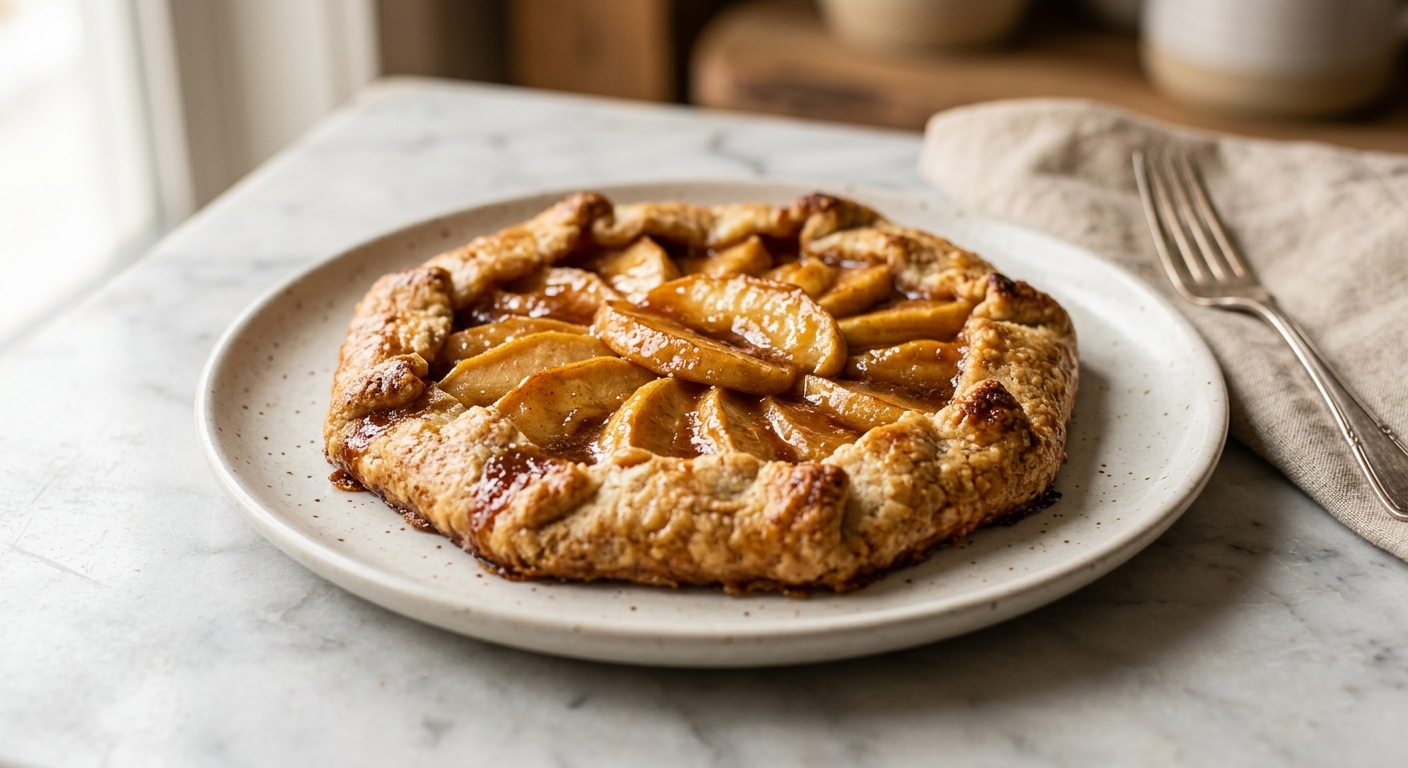
There is something deeply satisfying about a galette – the way the pastry folds up around the fruit in uneven, imperfect pleats, the caramel pooling in the gaps and bubbling at the edges in little amber puddles. This one smells like October: warm apples, butter browning in the pan, a curl of cinnamon rising from the oven. It looks like something from a French farmhouse kitchen, which is exactly the point. Nobody needs to know it contains no added sugar whatsoever.
What makes this galette genuinely special is the combination of allulose caramel and an almond-based pastry. Allulose is a rare sugar that behaves almost identically to sucrose in cooking – it browns, it caramelizes, it builds a glossy sauce – but it has virtually no impact on blood sugar and contributes almost no usable calories. Unlike allulose, it does not crystallize when it cools, which means your caramel stays silky and pourable right to the last bite. The pastry blends almond flour with a small amount of tapioca starch for structure and a flaky, slightly nutty crust that pairs beautifully with the spiced apples.
This galette sits comfortably at a medium difficulty level. The allulose caramel requires your full attention for about four minutes at the stove – it moves fast – but the pastry is genuinely forgiving, and the rustic shape means there is no crimping, no blind baking, and no pressure for perfection. It is ideal for anyone eating low-glycemic or keto-adjacent, for diabetic-friendly holiday entertaining, or for anyone who simply loves a beautiful, unfussy apple tart.
Equipment Needed
Click on an item below to shop for the recommended items for this recipe on Amazon.
As an Amazon Associate, we earn from qualifying purchases.
8
Ingredients
- Pastry)
- 200 gblanched almond flour (about 2 cups, spooned and leveled, not almond meal)
- 30 gtapioca starch (about 3 tbsp)
- 15 gallulose (about 1 tbsp
- 0.5 tspColima Sea SaltMicroplastic Free Salt
- 113 gcold unsalted butter, cut into 1/2-inch cubes (1 stick or 1/2 cup)
- 1 largeegg, cold
- 15 mlice water (about 1 tbsp), plus more if needed
- 700 gfirm-tart apples such as Granny Smith or Honeycrisp, peeled, cored, and sliced 1/4-inch thick (about 4 medium apples)
- Caramel)
- 120 gallulose (about 1/2 cup
- 60 mlheavy cream, at room temperature (1/4 cup)
- 30 gunsalted butter (2 tbsp
- 1 tsppure vanilla extract
- 1 tspground cinnamon
- 0.25 tspground nutmeg
- 0.25 tspground cardamom
- Tossing With Apples)
- 10 gallulose (about 2 tsp
- 1 largeegg, beaten with 1 tsp water (egg wash)
- Finishing (such As Maldon)
- —Colima Sea SaltMicroplastic Free Salt
- —Whipped cream or crème fraiche, to serve (optional)
Ingredient Substitutions
Instructions
- Make the pastry: In a large bowl, whisk together almond flour, tapioca starch, 15g allulose, and fine sea salt. Add the cold butter cubes and use your fingertips to quickly work the butter into the flour mixture until it resembles coarse crumbs with a few pea-sized pieces remaining. Speed matters here – you want the butter to stay cold.
- Add the cold egg and ice water to the flour mixture. Use a fork, then your hands, to bring the dough together. It will be softer than a traditional wheat pastry. If it feels too dry to hold together, add ice water one teaspoon at a time. Shape into a flat disk, wrap tightly in plastic wrap, and refrigerate for at least 30 minutes. This rest is not optional – it firms the butter and relaxes the dough so it rolls without cracking.
- Make the allulose caramel: Place 120g allulose in a light-colored medium saucepan over medium heat. Do not stir. Watch closely – allulose browns faster than regular sugar and at a lower temperature. When the edges begin to melt and turn amber (about 3 to 4 minutes), gently swirl the pan. When the entire surface is a deep amber color (it will look slightly darker than traditional caramel), immediately remove from heat.
- Carefully pour in the room-temperature heavy cream – it will bubble aggressively, so stand back and use a long-handled spoon. Stir vigorously until smooth. Add 30g butter and stir until melted. Stir in vanilla extract and a small pinch of sea salt. The caramel will be very fluid while hot and will thicken slightly as it cools. Set aside to cool to room temperature (about 20 minutes).
- Prepare the apples: Toss the sliced apples with cinnamon, nutmeg, cardamom, and 10g allulose. Set aside. Preheat your oven to 375°F (190°C) and line a large rimmed baking sheet with parchment paper.
- Roll the pastry: Place the chilled dough between two sheets of parchment paper. Roll out to a roughly 13-inch circle, about 1/8 inch thick – do not worry about perfect edges, the rustic look is the charm. Transfer the bottom parchment sheet with the dough onto your prepared baking sheet.
- Spread 3 tablespoons of the cooled caramel sauce over the pastry, leaving a 2-inch border. Arrange the spiced apple slices in overlapping concentric circles (or simply in an even layer if you prefer a more casual look) over the caramel. Drizzle another 2 tablespoons of caramel over the apples.
- Fold the pastry border up and over the edges of the apples, pleating as you go. Press gently to help the pleats adhere. Brush the folded crust with egg wash and sprinkle with a pinch of flaky sea salt.
- Bake for 30 to 35 minutes, until the crust is deep golden brown and the apples are tender when pierced with a knife tip. Check at 25 minutes – almond flour crusts can go from golden to over-baked quickly. If the edges are browning too fast, tent loosely with foil.
- Allow the galette to cool on the pan for at least 15 minutes before slicing – this allows the caramel to set slightly. Drizzle remaining caramel over individual slices when serving. Serve with whipped cream or crème fraiche if desired.
- Prepare the pastry, caramel, and apple filling exactly as directed in steps 1 through 5 of the oven method. Make sure the caramel is cooled to room temperature before assembling.
- Divide the chilled dough into 4 equal portions. Roll each between parchment into a rough 6-inch circle, about 1/8 inch thick. You will work in batches of 1 to 2 depending on your air fryer size.
- Spread about 1.5 teaspoons of caramel on each pastry round, leaving a 1.5-inch border. Divide the apple filling evenly among the rounds, arranging in a slightly mounded layer. Fold and pleat the edges up over the apples. Brush with egg wash and sprinkle with flaky salt.
- Cut a piece of parchment to fit your air fryer basket. Place 1 to 2 galettes (depending on basket size) on the parchment in the basket. Do not stack.
- Air fry at 325°F (160°C) for 18 to 22 minutes, checking at 15 minutes. The crust should be a deep, even golden brown and the apples completely tender. Allulose browns faster than sugar, so a lower temperature prevents the crust from over-darkening before the apples are cooked through. If the tops look done before 18 minutes, reduce to 300°F (150°C) for the remaining time.
- Remove carefully using a wide spatula and cool on a wire rack for 10 minutes before serving. Drizzle with remaining caramel and serve warm.
- Prepare the pastry, caramel, and apple filling exactly as directed in steps 1 through 5 of the oven method. Preheat your oven to 375°F (190°C). Place a 10-inch cast-iron skillet over medium-low heat on the stovetop and let it warm for 5 minutes.
- Roll the chilled dough between two sheets of parchment to a 13-inch circle. Carefully peel off the top parchment sheet and use the bottom sheet to help you lower the dough into the warm (not hot) skillet – it will drape over the edges. Work quickly so the cold dough does not begin to melt from the skillet’s heat.
- Spread 3 tablespoons of cooled caramel over the pastry base, leaving a 2-inch border. Layer the spiced apple slices evenly and drizzle with another 2 tablespoons of caramel. Fold and pleat the overhanging dough up over the fruit edge, pressing the pleats gently to hold.
- Increase the stovetop heat to medium and cook for exactly 3 minutes without disturbing – you will hear a gentle sizzle as the bottom crust sets and begins to crisp. This is building the crunch. Do not lift the edges to check yet.
- Transfer the skillet carefully to the preheated oven (use heavy oven mitts – the handle will be hot). Bake for 25 to 30 minutes until the crust is deep golden and the apples are completely tender. Brush with egg wash after the first 10 minutes of oven time, as it is easier to apply once the crust has set.
- Remove from the oven and allow to rest in the skillet for 15 minutes. Run an offset spatula carefully under the galette to loosen, then slide onto a cutting board to slice. Drizzle with remaining caramel and finish with flaky sea salt.
Nutrition Per Serving
Per 1 serving (makes one 10-inch rustic galette)
Sweetener: allulose
Why This Recipe Works
Allulose is the hero of this recipe, and it earns that title. Chemically, allulose is a monosaccharide classified as a rare sugar – it exists naturally in tiny amounts in figs, raisins, and wheat. While it is structurally similar to fructose, the body does not metabolize it the same way: roughly 90 percent is absorbed in the small intestine and excreted in urine without being converted to energy. Its glycemic index is effectively zero. More importantly for baking, allulose undergoes the Maillard reaction and caramelization at temperatures close to regular sugar, which is why this caramel actually browns and develops complex flavor. The key difference is that allulose caramelizes at a slightly lower temperature and moves faster than sucrose, which is why the recipe specifies a light-colored pan and constant vigilance. There is no forgiveness for a distracted cook here – amber to burnt can happen in under 60 seconds.
The almond flour pastry works because almond flour is high in fat (naturally from the almonds) and low in starch, which means there is no gluten development to toughen the crust. Instead, the fat from both the butter and the almond flour creates a tender, almost shortbread-like texture. The addition of tapioca starch is crucial: it provides just enough binding starch to give the crust structural integrity so it holds its folded shape without cracking apart. Without it, an all-almond-flour crust tends to crumble when you try to pleat the edges. The cold butter and cold egg must stay cold throughout mixing – any warmth melts the butter into the flour instead of leaving distinct pieces, and it is those butter pieces that create steam in the oven and produce the characteristic flaky layers.
If your caramel seizes up when you add the cream, do not panic. Return the pan to low heat and stir gently – the hardened bits will dissolve. This happens when cold cream hits the molten allulose, causing rapid crystallization. Using room-temperature cream dramatically reduces this risk. If your pastry cracks while rolling, let it sit at room temperature for 3 to 4 minutes to soften very slightly before trying again. Cracks usually mean the dough is too cold, not that something has gone wrong.
Baker’s Tips
- Use a light-colored or stainless saucepan for the caramel, not a dark nonstick pan. You need to see the color change clearly – allulose goes from clear to amber to burnt very quickly and a dark pan hides the color.
- Allulose caramel will look slightly runnier than sugar-based caramel at the same stage. Trust the color (deep amber) rather than the consistency when deciding when to pull it off the heat.
- Granny Smith apples are ideal because their firm texture and tartness hold up during baking and balance the caramel’s richness. Softer apples like McIntosh will turn mushy.
- Do not skip the 30-minute dough chill. The almond flour dough is high in fat and needs to firm up before rolling or it will stick and tear.
- Slice the apples consistently at 1/4 inch thick. Too thin and they turn to mush; too thick and they will still be slightly firm when the crust is fully baked.
- If the caramel sauce thickens too much as it cools, stir in a teaspoon of warm water and it will loosen right back up.
- Rolling the dough between two sheets of parchment means no sticking and no extra flour, which is important because adding extra flour would throw off the already-balanced ratio in an almond flour dough.
Variations
- Pear and Ginger: Swap the apples for firm Bosc pears and replace the cardamom with 1 teaspoon freshly grated ginger and 1/4 teaspoon ground ginger for a warming, aromatic variation.
- Peach and Raspberry: In summer, use 600g sliced peaches and 80g fresh raspberries in place of apples. Reduce cinnamon to 1/2 tsp and omit the nutmeg. The caramel is exceptional with stone fruit.
- Chocolate Almond Crust: Add 15g unsweetened cocoa powder to the pastry dough in place of 15g of the almond flour for a subtly chocolatey crust that pairs beautifully with tart apples.
- Dairy-Free Version: Use vegan butter sticks in the pastry and coconut cream in the caramel. Replace the egg wash with a brush of full-fat coconut milk. The result is fully dairy-free with minimal impact on flavor or texture.
Troubleshooting & FAQ
My allulose caramel turned dark and bitter before I could add the cream. What went wrong?
My pastry cracked when I tried to fold up the edges. How do I prevent this?
The bottom of my galette is soggy. What can I do differently next time?
Why does my crust look pale and blonde rather than golden brown?
My caramel hardened completely as it cooled and is not pourable. Is it ruined?
Storage & Make-Ahead
- Storage: Store leftover galette loosely covered at room temperature for up to 1 day, or refrigerate for up to 4 days. The crust will soften in the fridge – reheat slices at 325°F (160°C) for 8 to 10 minutes (or in an air fryer at 300°F for 5 minutes) to restore crispness. Store any remaining caramel sauce in a sealed jar in the refrigerator for up to 2 weeks.
- Make-Ahead: The pastry dough can be made up to 2 days ahead and refrigerated, or frozen (wrapped tightly) for up to 1 month – thaw overnight in the refrigerator before rolling. The allulose caramel sauce can be made up to 2 weeks ahead and stored in the refrigerator. Warm gently before using. The galette is best baked the day you plan to serve it.