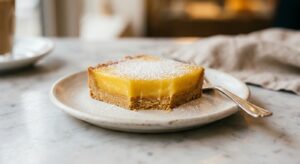
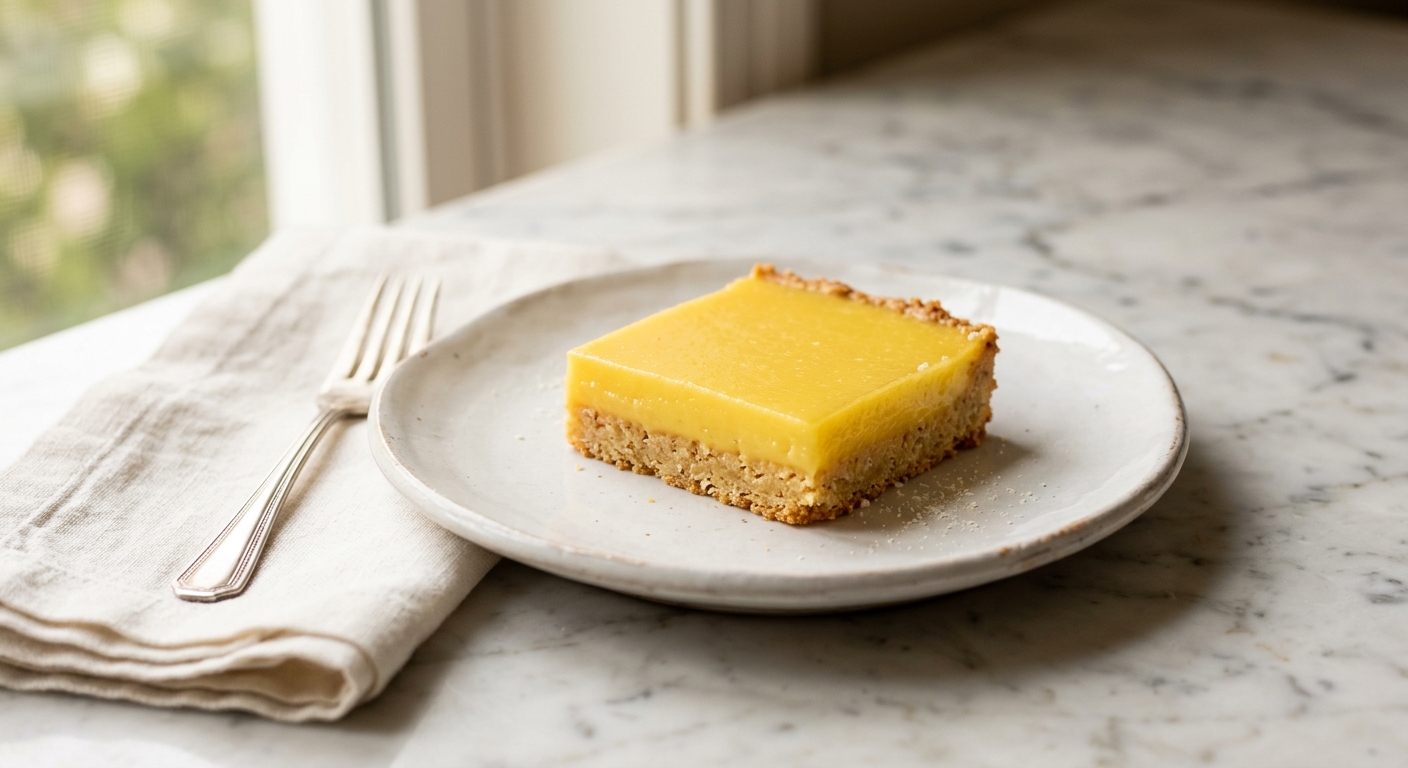
There is something about a lemon bar that feels like a little gift. That first bite, where your fork breaks through the silky, quivering curd and hits the crumbly, golden crust beneath, is one of the great simple pleasures of the dessert world. These monk fruit lemon bars have all of that magic: a filling that is intensely citrusy and just sweet enough, with that characteristic wobble that sets as it cools into something smooth and luminous. A dusting of powdered monk fruit on top, a few curls of lemon zest, and they look every bit as elegant as anything from a bakery case.
What sets this version apart is the coconut flour shortbread crust, which is toasted briefly in the oven before the filling goes in. That extra step, just 12 minutes of pre-baking, transforms the crust from merely acceptable into something genuinely wonderful: nutty, fragrant, with a snap and a crumble that holds up beautifully under the lemon curd without turning soggy. Coconut flour is highly absorbent, which means it creates a denser, more compact crumb than all-purpose flour, and that density is exactly what you want here as a sturdy, flavorful base. Monk fruit sweetener, used in both the crust and the filling, provides clean sweetness without any of the cooling aftertaste that allulose can sometimes leave behind, and it behaves beautifully in the curd, allowing the eggs to set the filling properly.
These bars fall squarely in the medium difficulty range. The crust comes together in one bowl with no special equipment, and the lemon curd filling is whisked together and poured straight in. The most important thing is patience: the bars need a full 2 hours in the refrigerator to set completely, and cutting them too soon is the number one mistake. They are perfect for anyone managing blood sugar, following a keto or low-carb lifestyle, or simply looking to cut refined sugar without sacrificing dessert. They are also a wonderful thing to bring to a gathering, because almost nobody will guess they are sugar-free.
Equipment Needed
Click on an item below to shop for the recommended items for this recipe on Amazon.
As an Amazon Associate, we earn from qualifying purchases.
16
Ingredients
- 120 gcoconut flour (about 1 cup, spooned and leveled)
- 85 gunsalted butter, melted and slightly cooled (about 6 tbsp)
- 60 gpowdered monk fruit sweetener for the crust (about 1/2 cup; use a powdered or ‘confectioners’ style blend)
- 1 tsppure vanilla extract
- —Pinch of Colima Sea SaltMicroplastic Free Salt for the crust
- 4 largeeggs, at room temperature
- 2 largeegg yolks, at room temperature
- 150 gpowdered monk fruit sweetener for the filling (about 1 1/4 cups; powdered blend)
- 120 mlfreshly squeezed lemon juice (from about 3 to 4 lemons; approximately 1/2 cup)
- 2 tbspfinely grated lemon zest (from the same lemons)
- 30 gcoconut flour for the filling (about 1/4 cup; this acts as the thickener in place of all-purpose flour)
- —Pinch of Colima Sea SaltMicroplastic Free Salt for the filling
- —Extra powdered monk fruit sweetener for dusting, to finish
Ingredient Substitutions
Instructions
- Preheat your oven to 325°F (165°C). Line an 8×8-inch baking pan with parchment paper, leaving an overhang on two sides to use as handles later. Lightly grease any exposed pan edges with butter or coconut oil.
- Make the crust: In a medium bowl, whisk together the coconut flour, 60g powdered monk fruit sweetener, and the pinch of sea salt. Pour in the melted butter and vanilla extract and stir with a fork until the mixture comes together into a soft, slightly crumbly dough. It will look drier than a conventional shortbread dough because coconut flour is so absorbent. Press the dough evenly into the bottom of the prepared pan using your fingertips or the flat bottom of a measuring cup, getting into all the corners. Aim for an even layer about 1/4 inch thick.
- Blind bake the crust: Bake for 12 to 14 minutes, until the crust is lightly golden at the edges and feels set and dry to the touch in the center. It should smell faintly nutty and toasty. Remove from the oven and let it cool for 5 minutes while you prepare the filling. Leave the oven on.
- Make the lemon filling: In a large bowl, whisk together the 4 whole eggs, 2 egg yolks, and the 150g powdered monk fruit sweetener until the mixture is smooth and slightly paler in color, about 1 minute. Whisk in the lemon juice and lemon zest. Sprinkle the 30g coconut flour and pinch of salt over the top and whisk vigorously until completely smooth with no lumps. Let the filling rest for 2 minutes, then whisk once more. Resting allows the coconut flour to fully hydrate and prevents a grainy texture in the finished bars.
- Bake the bars: Pour the lemon filling over the warm pre-baked crust. Carefully transfer the pan to the oven and bake for 22 to 25 minutes, until the filling is set around the edges but still has a gentle jiggle in the very center, like a loosely set gelatin. Do not overbake: if the filling puffs or cracks, it has gone too far and the texture will be rubbery rather than silky.
- Cool and chill: Remove from the oven and place on a wire rack. Allow the bars to cool completely at room temperature, about 45 minutes, then refrigerate uncovered for at least 2 hours (or overnight) before cutting. The filling will firm up significantly as it chills.
- Slice and serve: Lift the bars out of the pan using the parchment overhang. Using a sharp knife wiped clean between each cut, slice into 16 squares (4 rows by 4 rows). Dust generously with powdered monk fruit sweetener just before serving.
- Line an 8×8-inch pan with parchment paper with overhang on two sides. Make the no-bake crust: In a medium bowl, combine the coconut flour, 60g powdered monk fruit sweetener, salt, vanilla extract, and melted butter. Stir until a uniform dough forms. Press firmly and evenly into the bottom of the pan. Use the flat base of a glass to really compact it. Refrigerate the crust while you prepare the filling.
- Make the stovetop lemon curd: In a medium heavy-bottomed saucepan, whisk together the 4 whole eggs, 2 egg yolks, 150g powdered monk fruit sweetener, lemon juice, lemon zest, and the pinch of salt until smooth. Do not add the coconut flour yet.
- Cook the curd over medium-low heat, stirring constantly with a silicone spatula or wooden spoon, making sure to scrape the bottom and corners of the pan. Cook for 8 to 12 minutes, until the mixture thickens noticeably and coats the back of the spoon. It should reach about 170°F (77°C) on an instant-read thermometer. Do not let it boil or the eggs will scramble.
- Remove the pan from the heat. Sift the 30g coconut flour directly over the hot curd and whisk immediately and vigorously until completely smooth. Pass the finished curd through a fine-mesh sieve into a clean bowl or measuring jug to catch any small lumps or any accidentally cooked egg bits. Stir in the butter now if you want a richer, glossier curd: add 2 tablespoons of cold unsalted butter cut into cubes and whisk until melted and emulsified.
- Pour the warm curd over the chilled raw crust. Gently tap the pan on the counter to release any air bubbles. Allow to cool to room temperature for 20 minutes, then refrigerate for at least 3 hours or overnight until fully set. The stovetop curd sets more firmly than the baked version. Slice, dust with powdered monk fruit sweetener, and serve cold.
Nutrition Per Serving
Per 1 serving (makes 16 bars from one 8×8-inch pan)
Sweetener: monk fruit (monk fruit extract and allulose blend)
Why This Recipe Works
Coconut flour is one of the most absorbent flours available, absorbing up to four times more liquid than all-purpose flour by weight. This is why the crust uses far less flour than you might expect and still comes together into a cohesive dough when combined with melted butter. That same absorbency is put to work in the filling: the 30g of coconut flour acts as the thickener for the lemon curd, taking the place of the all-purpose flour used in traditional lemon bar recipes. As the filling bakes (or, in the stovetop method, as it heats), the coconut flour granules fully hydrate and swell, helping the egg proteins set into a smooth, sliceable layer. The brief rest period after mixing the raw filling is critical for this reason: it gives the coconut flour time to absorb the lemon juice before it goes into the oven, preventing a grainy or underhydrated texture in the finished curd.
Monk fruit sweetener behaves differently from sugar in a few important ways. Unlike sugar, it does not caramelize or provide structure through crystallization, which means it cannot be used as a one-for-one replacement in every application. However, in this recipe it performs beautifully because the structure of the bars comes entirely from eggs (coagulated proteins) and coconut flour (hydrated starch and fiber), not from sugar. Powdered monk fruit sweetener, which is typically a blend of monk fruit extract and allulose, dissolves smoothly into both the butter-based crust and the liquid filling, providing even sweetness throughout. The egg yolks in the filling serve two purposes: richness and color (the extra yolks give the curd a deeper golden hue) and extra emulsifying power from their lecithin, which helps the filling set to a smooth, velvety texture rather than a grainy one.
Pre-baking the crust before adding the filling, a technique called blind baking, is non-negotiable in this recipe. Coconut flour crust is more delicate than a conventional wheat crust, and without that initial bake it would absorb moisture from the liquid filling and turn pasty and underdone. The 12-minute pre-bake sets the proteins in the eggs and firms the crust so it can support the filling without becoming soggy. If your crust edges seem to be browning too quickly during the second bake, lay a small piece of foil loosely over the pan without pressing it onto the filling.
Baker’s Tips
- Use a powdered or ‘confectioners’ style monk fruit sweetener, not granulated. Granulated monk fruit blends will not dissolve fully in either the crust or the filling, leaving a sandy or slightly gritty texture. If you only have granulated, pulse it in a blender for 30 seconds until powdery.
- Zest your lemons before juicing them. It is nearly impossible to zest a juiced lemon. Use a microplane for the finest, most fragrant zest and avoid grating into the white pith, which is bitter.
- Room temperature eggs are important. Cold eggs whisk less efficiently and can lower the temperature of the filling unevenly, which can cause the coconut flour to not hydrate properly before baking. Take your eggs out of the refrigerator 30 minutes before you start.
- The jiggle test: when the bars are done, gently shake the pan. The outer 2 inches should be fully set and only the very center should wobble like a soft-set gelatin. If the whole surface ripples like water, give it another 3 to 4 minutes.
- For the cleanest cuts, refrigerate the bars overnight, then use a sharp chef’s knife dipped in hot water and wiped dry between every single slice. Cold, fully set bars cut much more cleanly than barely chilled ones.
- Do not skip the parchment overhang. Coconut flour bars are more fragile than conventional ones and the parchment sling is the safest way to get the whole slab out of the pan in one piece.
Variations
- Meyer Lemon Version: Swap regular lemons for Meyer lemons (same quantity of juice and zest). Meyer lemons are sweeter and more floral, producing a milder, more delicate bar that is particularly lovely in late winter when they are in season.
- Lemon Lavender: Add 1 teaspoon of dried culinary lavender to the filling along with the zest. Steep it in the lemon juice for 10 minutes, then strain before adding to the other filling ingredients for a subtle floral note.
- Lime Coconut: Replace lemon juice and zest with fresh lime juice and lime zest. Stir 30g of toasted desiccated coconut into the crust dough for extra tropical flavor.
- Dairy-Free: Use refined coconut oil in place of butter in the crust (same weight). For the no-bake stovetop method, omit the optional butter finish or use a vegan butter alternative.
Troubleshooting & FAQ
My lemon filling is grainy or has a gritty texture. What went wrong?
My bars are still liquid or very soft after the full bake time. Why?
The crust crumbled apart when I tried to slice the bars. How do I fix this?
The top of my filling cracked during baking. Did I overbake?
The powdered monk fruit sweetener I dusted on top dissolved and disappeared. How do I keep it looking pretty?
Storage & Make-Ahead
- Storage: Store bars in a single layer in an airtight container in the refrigerator for up to 5 days. Place parchment between layers if stacking. Do not store at room temperature for more than 2 hours due to the egg-based filling. Freeze for up to 2 months: wrap individual bars in plastic wrap, then place in a freezer bag. Thaw overnight in the refrigerator and dust with fresh powdered monk fruit sweetener before serving.
- Make-Ahead: These bars are an excellent make-ahead dessert. Bake or assemble them the day before, refrigerate overnight without the powdered sweetener dusting, and add the finishing dusting right before serving for the neatest presentation. The flavor actually deepens slightly after a full night in the refrigerator.