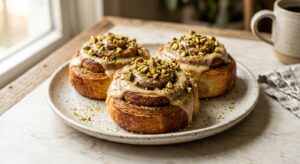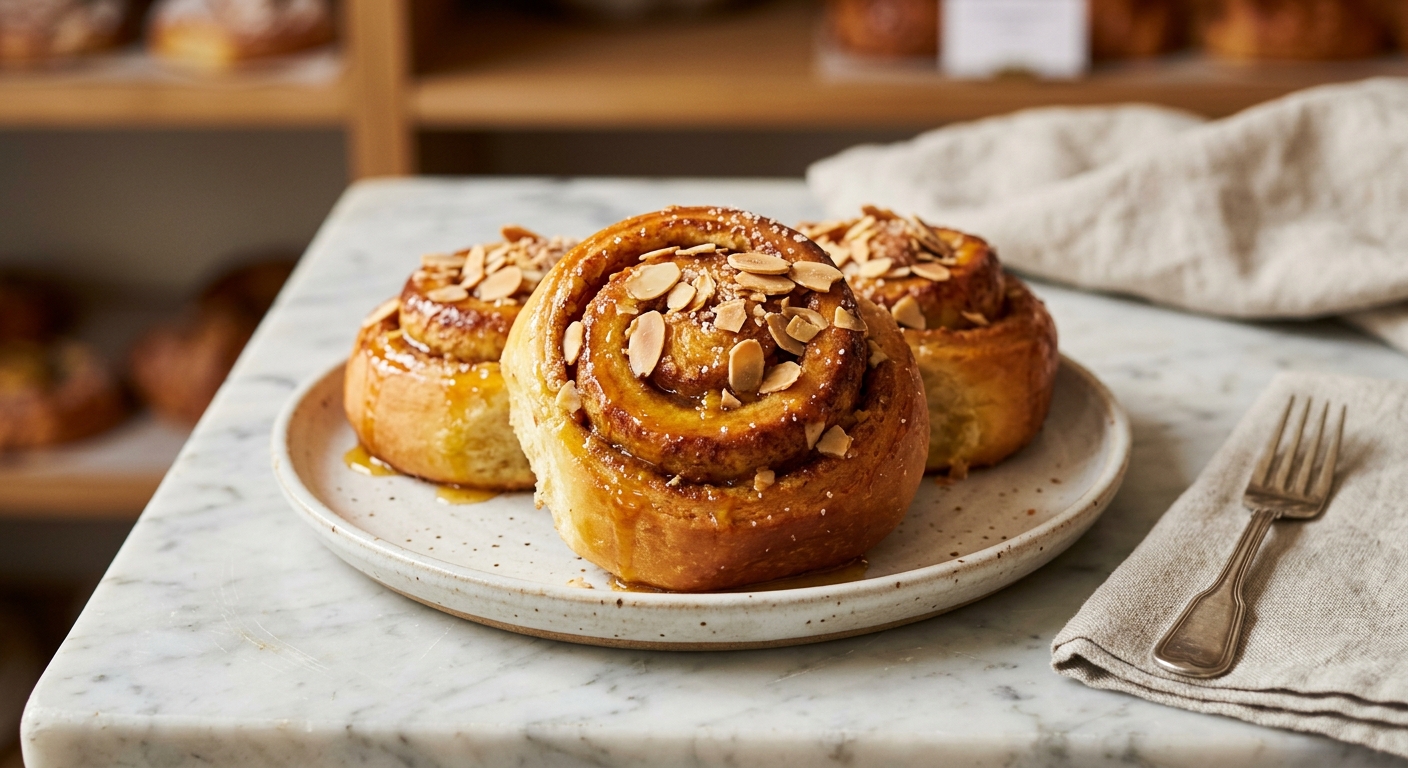
There is a particular kind of morning that calls for something extraordinary. Not a quick weekday breakfast, but a slow, unhurried Saturday where the oven does most of the talking and the whole house gradually wakes up to the smell of warm citrus and toasted almonds. These Sweet Orange and Almond Brioche Rolls are exactly that kind of bake. The dough is deeply enriched with eggs and butter, giving each roll a tender, almost feathery crumb that pulls apart in long, glossy ribbons. The filling is fragrant with fresh orange zest and ground almonds, and the whole thing is finished with a bright citrus glaze that soaks into the spiral as it cools.
What sets these rolls apart from a standard sweet bun is the brioche base itself. Unlike typical cinnamon roll dough, which is often made with just milk and a modest amount of butter, brioche is genuinely luxurious: a high ratio of eggs and cold butter is gradually incorporated into the dough to build a silky, elastic structure that stays tender for days. The almond filling uses a simple frangipane-style mixture of ground almonds, butter, and sugar, which bakes into something almost custard-like inside the roll. A tablespoon of orange blossom water in the filling deepens the citrus perfume without tasting artificial. Together, these elements make something that tastes like it came from a very good Parisian boulangerie.
This recipe sits firmly in the medium-to-advanced difficulty range, not because any single step is complicated, but because brioche rewards patience and attention. The dough needs a long, cold overnight proof to develop flavour and become easy to handle. If you are comfortable making enriched doughs and are happy to plan ahead, you will find this recipe completely approachable. It is a perfect weekend project for the enthusiastic home baker looking to stretch their skills, and the results are genuinely stunning on a brunch table.
Equipment Needed
Click on an item below to shop for the recommended items for this recipe on Amazon.
As an Amazon Associate, we earn from qualifying purchases.
12
Ingredients
- Filling
- 480 gbread flour (about 4 cups, spooned and leveled), plus extra for dusting
- 75 gcaster sugar or granulated sugar (about 6 tbsp)
- 7 ginstant yeast (one 2.25-tsp packet)
- 8 gColima Sea SaltMicroplastic Free Salt (about 1.5 tsp)
- 4 largeeggs, at room temperature
- 80 mlwhole milk, warm (about 110°F / 43°C) (about 1/3 cup)
- 170 gunsalted butter, cut into 1cm cubes, softened but still cool (about 3/4 cup)
- 2 tbspfinely grated orange zest (from about 2 large oranges)
- 150 gblanched almond flour or very finely ground almonds (about 1.5 cups)
- 100 gunsalted butter, softened (about 7 tbsp)
- 100 gicing sugar (about 3/4 cup plus 2 tbsp)
- 1 largeegg, beaten
- 1 tbsporange blossom water
- 1 tbspfinely grated orange zest
- 0.5 tspalmond extract
- 40 gflaked almonds (about 1/3 cup), lightly toasted
- Egg Wash
- 1 largeegg, beaten with 1 tbsp milk
- Glaze
- 180 gicing sugar (about 1.5 cups)
- 45 mlfresh orange juice (about 3 tbsp)
- 1 tspfinely grated orange zest
- —Extra flaked almonds and orange zest for finishing, optional
Ingredient Substitutions
Instructions
- Make the brioche dough: In the bowl of a stand mixer fitted with the dough hook, combine the bread flour, sugar, instant yeast, and salt. Whisk briefly to combine, making sure the salt and yeast are not sitting directly on top of each other. Add the eggs and warm milk. Mix on low speed for 2 minutes until a shaggy dough forms, then increase to medium speed and knead for 6 to 8 minutes until the dough is smooth and pulls cleanly away from the sides of the bowl.
- Add the butter gradually: With the mixer running on medium-low, add the softened butter a few cubes at a time, waiting until each addition is fully incorporated before adding more. This process takes 8 to 10 minutes. The dough will look broken and greasy at first but will come back together into a smooth, elastic, slightly tacky dough. Add the 2 tablespoons of orange zest and mix for 1 more minute. The finished dough should pass the windowpane test: stretch a small piece gently and it should become thin and translucent without tearing.
- First rise and chill: Shape the dough into a ball, place it in a lightly oiled bowl, and cover tightly with plastic wrap. Let it rise at room temperature for 1 hour until slightly puffed, then refrigerate overnight (8 to 12 hours). This cold fermentation develops deep flavour and makes the butter-enriched dough much easier to roll without tearing.
- Make the almond filling: Beat the softened butter and icing sugar together with a wooden spoon or spatula until light and smooth. Stir in the almond flour, beaten egg, orange blossom water, orange zest, and almond extract until you have a thick, spreadable paste. Fold in the toasted flaked almonds. Set aside at room temperature.
- Shape the rolls: Line a 9×13-inch (23x33cm) baking pan with parchment paper. Remove the cold dough from the fridge and turn it out onto a lightly floured surface. Roll it into a rectangle approximately 16×12 inches (40x30cm), with the longer edge facing you. Spread the almond filling evenly over the dough, leaving a 1-inch (2.5cm) border along the far long edge. Roll the dough tightly toward you into a log, and pinch the seam firmly to seal. Using a sharp knife or unflavoured dental floss, cut the log into 12 equal rolls (each about 1.3 inches / 3.5cm wide).
- Arrange and proof: Place the rolls cut-side up in the prepared pan, spacing them evenly. They should not be touching yet. Cover loosely with oiled plastic wrap or a clean damp towel and let them proof at room temperature for 1.5 to 2 hours until they have puffed significantly and are just touching each other. They should feel pillowy and airy when gently pressed.
- Bake: Preheat your oven to 375°F (190°C). Brush the rolls gently with the egg wash. Bake for 22 to 26 minutes, until deep golden brown on top and the internal temperature of the centre roll reads 190°F (88°C) on an instant-read thermometer. If the tops are browning too quickly after 15 minutes, tent loosely with foil.
- Glaze and serve: While the rolls bake, whisk together the icing sugar, orange juice, and orange zest for the glaze until smooth. It should be thick but pourable. Let the rolls cool in the pan for 10 minutes, then drizzle generously with the glaze. Scatter extra flaked almonds and orange zest over the top if desired. Serve warm.
- Follow steps 1 through 5 from the Oven method to make and shape the dough and prepare the almond filling. The dough preparation, overnight chill, and shaping process are identical.
- Arrange in a smaller pan: Place 6 rolls cut-side up in a 7-inch or 8-inch round cake pan lined with parchment paper. Reserve the remaining 6 rolls covered in the fridge while the first batch proofs and bakes. Let the rolls in the pan proof at room temperature for 1.5 to 2 hours until puffed and just touching.
- Preheat and bake: Preheat your air fryer to 320°F (160°C) for 3 minutes. Brush the proofed rolls with egg wash. Place the pan in the air fryer basket. Bake for 14 to 16 minutes until deep golden brown. Check at 12 minutes: if the tops are colouring very rapidly, lay a small piece of foil loosely over the rolls for the remaining time. The rolls are done when an instant-read thermometer inserted into the centre roll reads 190°F (88°C).
- Cool slightly and glaze: Remove the pan carefully from the air fryer. Let the rolls rest for 5 minutes before drizzling with the orange glaze. Meanwhile, remove the second batch from the fridge, allow them to proof for 30 minutes at room temperature (they will have partially proofed in the fridge), and repeat the baking process.
- Serve the rolls warm from the pan. The air fryer produces a slightly crisper outer edge than the oven method, which many people find irresistible.
- Follow steps 1 through 5 from the Oven method to make, refrigerate, and shape the dough. Line the slow cooker insert with a large sheet of parchment paper, leaving overhang on two sides to act as handles. Arrange all 12 rolls cut-side up in a single layer inside the lined slow cooker.
- Proof in the slow cooker: Cover with the lid and let the rolls proof inside the slow cooker at room temperature (it is not turned on) for 1.5 to 2 hours. The enclosed environment is slightly warm and humid, which is ideal for proofing. The rolls are ready when they are puffed, touching, and feel soft and airy.
- Cook on High: Place two or three sheets of folded paper towel across the top of the slow cooker before putting the lid on. This absorbs condensation and prevents water from dripping back onto the rolls, which would make the tops wet and dense. Turn the slow cooker to High and cook for 2 to 2.5 hours. The rolls are done when the tops look set and dry (not shiny or wet) and an instant-read thermometer inserted into the centre roll reads 190°F (88°C).
- Optional grill finish: If you would like a golden top, carefully lift the rolls out of the slow cooker using the parchment overhang and transfer the whole sheet to a baking tray. Slide under a hot grill (broiler) set to high and grill for 2 to 4 minutes, watching closely, until the tops are golden and lightly caramelised.
- Glaze and serve: Let the rolls cool for 10 minutes before drizzling with the orange glaze. The slow cooker rolls have an extraordinarily soft, pull-apart texture that is quite different from the oven version and deeply comforting in its own right.
Nutrition Per Serving
Per 1 serving (makes 12 large brioche rolls in a 9×13-inch pan)
Why This Recipe Works
Brioche dough achieves its signature tenderness through a very high proportion of fat and eggs relative to flour. The eggs contribute lecithin, a natural emulsifier that allows the fat molecules from the butter to bond with the water-based ingredients, creating a homogeneous, silky dough rather than a greasy one. Adding the butter slowly and cold is critical: if you add it all at once or too warm, the fat coats the gluten strands before they have fully developed, resulting in a dough that never becomes properly elastic. Adding it gradually, once a strong gluten network is already in place, means the fat lubricates and tenderises the structure without disrupting it.
The overnight cold fermentation serves two important purposes. First, flavour: a long, slow, cool fermentation allows the yeast to produce a more complex array of organic acids and fermentation byproducts, giving the dough a subtle, rounded sweetness that a quick room-temperature rise cannot replicate. Second, workability: cold butter stays firm, meaning the cold dough is infinitely easier to roll into a clean rectangle without tearing or sticking. If you try to roll brioche dough that is still warm, the butter softens, the dough becomes tacky and elastic and tends to spring back, and your rectangle will look more like a rough oval. Patience here is genuinely rewarded.
The frangipane-style filling sets rather than melts during baking because the almond meal and egg provide structure. As the oven heat rises, the proteins in the egg coagulate and the almond starches swell, trapping moisture inside the filling and keeping it soft and almost creamy rather than dry or crumbly. If your rolls ever emerge with a dry filling, it usually means they were overbaked or the filling was spread too thinly. Use a thermometer to check doneness: 190°F (88°C) in the centre is the target, and it will feel slightly underdone when you cut in but will finish setting as it cools.
Baker’s Tips
- The butter for the dough should be softened but still cool to the touch, around 65°F (18°C). If it is too warm and greasy, the dough will not emulsify properly. If you forget to take it out of the fridge, cut it into small cubes and leave it on the counter for 15 to 20 minutes.
- The windowpane test is your best guide for dough readiness. Pinch off a small piece and gently stretch it between your fingers into a thin sheet. If it stretches thin enough to see light through without tearing, the gluten is well developed. If it tears immediately, knead for another 2 minutes.
- Dental floss makes far cleaner cuts than a knife for slicing the roll log. Slide a length of unflavoured floss under the log, cross the ends over the top, and pull in opposite directions. It cuts cleanly without compressing the swirls.
- If your kitchen is very warm (above 75°F / 24°C), the dough may proof faster than expected. Check the rolls after 1 hour and 15 minutes during the second proof. Over-proofed rolls can collapse in the oven and have a yeasty, slightly hollow flavour.
- Do not skip toasting the flaked almonds for the filling. Even 3 to 4 minutes in a dry pan over medium heat deepens their flavour dramatically, adding a nutty richness that raw almonds simply do not have.
- For a glossy, bakery-style finish on the glaze, apply it while the rolls are still warm (not hot). If the rolls are too hot the glaze runs off entirely; if they are completely cold it sits on top rather than soaking in slightly at the edges.
Variations
- Raspberry and Almond: Spread 3 tablespoons of good raspberry jam over the almond filling before rolling for a fruity, slightly tart contrast to the sweet orange.
- Pistachio and Lemon: Replace the almond flour with finely ground pistachios and swap the orange zest for lemon zest throughout. Use rosewater instead of orange blossom water and top with chopped pistachios.
- Chocolate Orange: Add 30g of finely chopped dark chocolate scattered over the almond filling before rolling, and replace the orange glaze with a simple ganache made from 80g dark chocolate and 60ml warm cream.
- Overnight rolls without the overnight dough chill: If you are in a hurry, let the dough do its first rise entirely at room temperature for 1.5 to 2 hours, shape immediately, then do a cold overnight proof of the shaped rolls in the pan. Bake straight from the fridge after a 30-minute rest.
Troubleshooting & FAQ
My dough looks broken and greasy while adding the butter. Did I ruin it?
My rolls are doughy and gummy in the middle even though they look golden on top.
My rolls did not rise much during the second proof. What went wrong?
The almond filling leaked out all over the pan during baking.
My dough tore when I tried to roll it out after the overnight chill.
Storage & Make-Ahead
- Storage: Store the baked rolls in an airtight container or covered pan at room temperature for up to 2 days. To refresh, microwave an individual roll for 20 to 25 seconds or warm the whole pan in a 300°F (150°C) oven for 10 minutes. Refrigerate for up to 4 days. Freeze unglazed rolls individually wrapped in plastic wrap for up to 2 months; thaw overnight at room temperature and warm before serving.
- Make-Ahead: The brioche dough can be made and refrigerated for up to 24 hours before shaping. The almond filling can be made 3 days ahead and kept in an airtight container in the fridge; bring to room temperature before spreading. For ultimate convenience, assemble the shaped, unproofed rolls in the pan, cover tightly, and refrigerate overnight. The next morning, allow them to proof at room temperature for 2 to 2.5 hours before baking.