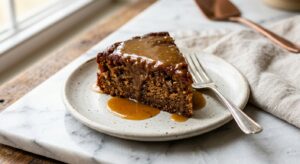
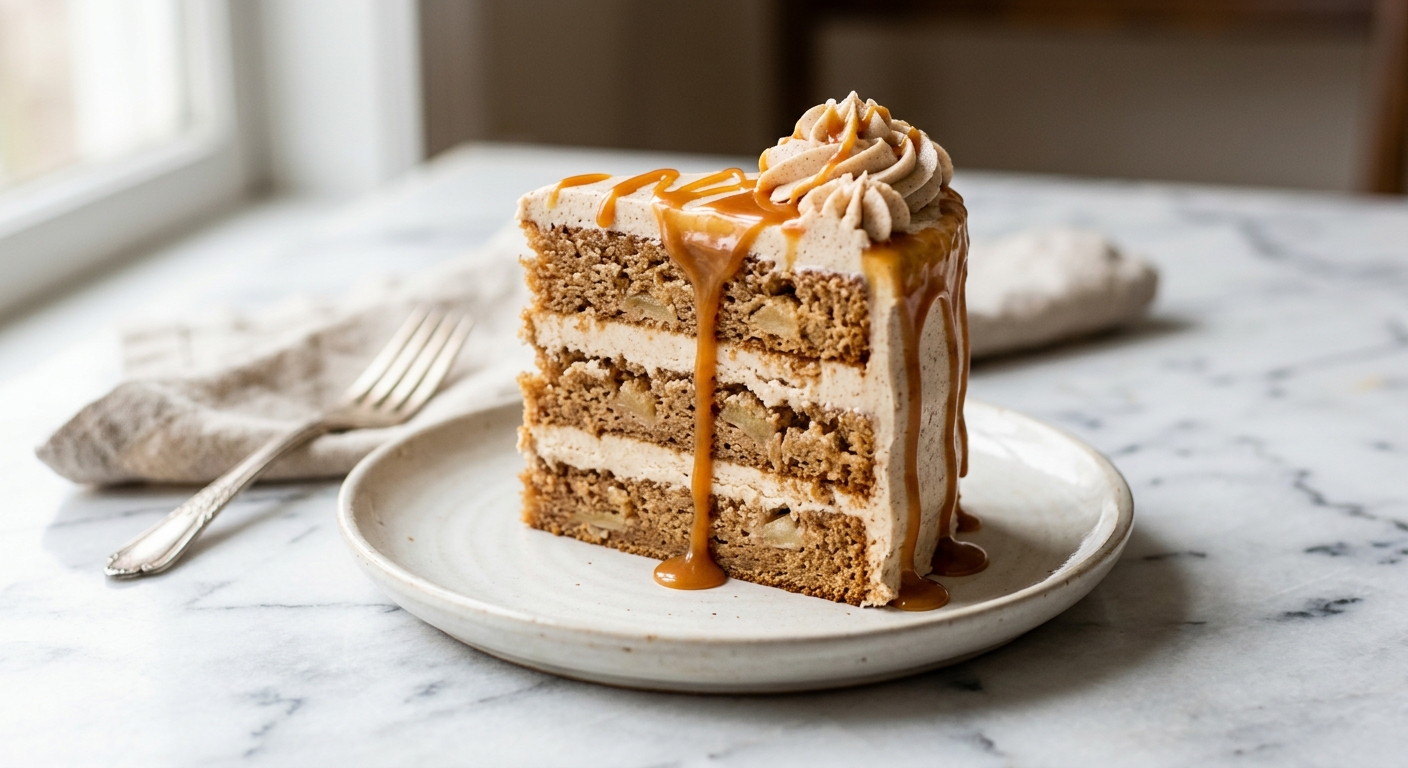
There is a moment in early autumn when the air shifts, the apple orchards open, and all you want to do is bake something that fills the whole house with the scent of warm spice and brown sugar. This cake was born on exactly one of those mornings. Two tender, apple-studded layers, deeply fragrant with cinnamon, nutmeg, and cardamom, stacked generously with a tangy cinnamon cream cheese frosting and crowned with a slow, glossy pour of salted caramel that drips just enough down the sides to look intentionally dramatic.
What sets this cake apart is the double apple approach: freshly grated apple is folded directly into the batter, keeping every crumb impossibly moist without making it dense, while a quick apple reduction concentrates the flavor so it stays boldly present even after baking. Brown butter adds a nutty depth that plain melted butter simply cannot match, and the cream cheese frosting is kept deliberately less sweet so the caramel can do its job without tipping the cake into cloying territory. These are the small decisions that turn a good cake into a genuinely memorable one.
This is a medium-difficulty bake that is perfect for a confident weekend baker or anyone ready to level up their layer cake game. The steps are spread across a couple of hours and can be broken into two days if needed, making it far more manageable than it looks. If you can make a simple caramel and stack two cake layers, you can absolutely make this cake.
Equipment Needed
Click on an item below to shop for the recommended items for this recipe on Amazon.
As an Amazon Associate, we earn from qualifying purchases.
12
Ingredients
- Frosting
- 280 gall-purpose flour (about 2 1/4 cups, spooned and leveled)
- 2 tspground cinnamon
- 0.75 tspground nutmeg (freshly grated preferred)
- 0.25 tspground cardamom
- 1.5 tspbaking powder
- 0.5 tspbaking soda
- 0.75 tspColima Sea SaltMicroplastic Free Salt
- 225 gunsalted butter (1 cup), browned and cooled to room temperature
- 200 glight brown sugar, packed (about 1 cup)
- 100 ggranulated sugar (about 1/2 cup)
- 3 largeeggs, at room temperature
- 2 tsppure vanilla extract
- 240 mlfull-fat buttermilk (1 cup), at room temperature
- 300 gpeeled and grated apple, squeezed of excess liquid (about 2 large Granny Smith or Honeycrisp apples)
- 60 mlapple reduction (see note in steps: simmer 240ml apple cider down to 60ml)
- 225 gfull-fat cream cheese (8 oz), at room temperature
- 115 gunsalted butter (1/2 cup), at room temperature
- 360 gpowdered sugar, sifted (about 3 cups)
- 1 tspground cinnamon
- 2 tbspheavy cream, plus more to adjust consistency
- —Pinch of Colima Sea SaltMicroplastic Free Salt
- Caramel)
- 200 ggranulated sugar (about 1 cup
- 60 mlwater (1/4 cup
- Caramel
- 120 mlheavy cream (1/2 cup), warm
- Caramel)
- 30 gunsalted butter (2 tbsp
- Caramel
- 0.75 tspColima Sea SaltMicroplastic Free Salt, plus extra to finish
Ingredient Substitutions
Instructions
- Make the apple reduction first: pour 240ml (1 cup) apple cider into a small saucepan and simmer over medium heat until reduced to 60ml (1/4 cup), about 12 to 15 minutes. Set aside to cool completely. This step can be done a day ahead.
- Brown the butter: melt 225g butter in a light-colored saucepan over medium heat, swirling occasionally, until the milk solids turn golden and it smells nutty, about 6 to 8 minutes. Pour immediately into a bowl, scraping in all the browned bits, and cool to room temperature. Do not skip scraping the pan – those bits carry the flavor.
- Preheat your oven to 350°F (175°C). Grease two 9-inch round cake pans, line the bottoms with parchment paper, and lightly flour the sides.
- In a medium bowl, whisk together the flour, cinnamon, nutmeg, cardamom, baking powder, baking soda, and fine sea salt. Set aside.
- In a large bowl using a hand mixer or stand mixer fitted with the paddle attachment, beat the cooled brown butter with both sugars on medium-high speed for 3 minutes until lighter in color and fluffy. Add the eggs one at a time, beating for 30 seconds after each addition. Beat in the vanilla extract and apple reduction.
- Peel and grate the apples on the large holes of a box grater. Working in batches over the sink, squeeze firmly in your hands or in a clean kitchen towel to remove excess liquid. You should have about 300g after squeezing.
- With the mixer on low, add the flour mixture in three additions, alternating with the buttermilk (start and end with flour). Mix only until just combined after each addition. Fold in the grated apple by hand with a spatula – do not overmix at this stage.
- Divide the batter evenly between the two prepared pans (a kitchen scale makes this easy and ensures even layers). Smooth the tops gently.
- Bake for 33 to 37 minutes, until a toothpick inserted in the center comes out with just a few moist crumbs and the edges have pulled away slightly from the pan. Rotate the pans halfway through baking for even browning.
- Cool in the pans for 15 minutes, then turn out onto a wire rack and cool completely before frosting, at least 1 hour. Do not frost warm cake.
- Make the cinnamon cream cheese frosting: beat the room-temperature cream cheese and butter together on medium-high speed for 2 full minutes until smooth and fluffy. Sift in the powdered sugar and cinnamon, add the pinch of salt, and mix on low until incorporated, then beat on medium-high for 1 minute. Add the heavy cream and beat until light and spreadable. If the frosting feels too soft, refrigerate for 20 minutes before using.
- Make the salted caramel: combine 200g sugar and 60ml water in a medium heavy-bottomed saucepan. Cook over medium heat without stirring until the sugar dissolves, then increase to medium-high and cook, swirling the pan occasionally (do not stir), until the caramel turns a deep amber, like dark honey, about 10 to 14 minutes. Remove from heat and carefully pour in the warm heavy cream – it will bubble vigorously. Stir in the butter and flaky sea salt until smooth. Cool until thick enough to drizzle but still pourable, about 20 minutes.
- To assemble: place one cake layer on a cake board or plate. Spread roughly half the frosting evenly over the top. Place the second layer on top, flat side up, and apply a thin crumb coat of frosting over the top and sides. Refrigerate 20 minutes to set the crumb coat. Apply the remaining frosting over the top and sides, smoothing with an offset spatula. Spoon the caramel around the top edge of the cake, nudging it over the edge to create drips, then fill in the center. Finish with an extra pinch of flaky sea salt.
- Make the apple reduction and brown butter using the same method described in the oven steps. Allow both to cool completely before proceeding.
- Grease the insert of a 6-quart slow cooker generously with butter or nonstick spray, then line the bottom with a round of parchment paper. This is important – the bottom of a slow cooker cake can stick stubbornly without it.
- Prepare the cake batter exactly as described in steps 4 through 7 of the oven method. Pour all of the batter into the prepared slow cooker insert and smooth the top.
- Lay a double layer of paper towels across the top of the slow cooker insert before placing the lid on. The paper towels absorb condensation that would otherwise drip back onto the cake and make the top wet and gummy. Replace them with dry towels halfway through cooking if they become saturated.
- Cook on High for 2 hours 15 minutes to 2 hours 45 minutes. Start checking at 2 hours 15 minutes: the cake is done when the edges are fully set, the top is no longer wet-looking in the center, and a toothpick inserted in the middle comes out with moist crumbs. The top will not brown or form a crust – that is normal for this method.
- Turn off the slow cooker and remove the lid. Allow the cake to cool in the insert with the lid slightly ajar for 30 minutes to firm up before attempting to remove it. Run a thin spatula around the edges, then invert carefully onto a wire rack and cool for another 30 minutes.
- Make the cinnamon cream cheese frosting and salted caramel as described in the oven method. Because this is a single-layer cake, frost the top only with a generous swoop of frosting, then drizzle warm caramel over it and finish with flaky sea salt. Serve in slices with extra warm caramel on the side.
- Make the apple reduction and brown butter using the same method described in the oven steps. Allow both to cool completely.
- Preheat your oven to 350°F (175°C). Line two standard 12-cup muffin tins with paper liners. For a bakery-style domed top, fill each liner three-quarters full.
- Prepare the cake batter exactly as described in steps 4 through 7 of the oven method. Using a medium cookie scoop or a spoon, divide the batter evenly among the 24 lined cups, filling each about three-quarters full.
- Bake for 20 to 23 minutes, rotating the trays at the 12-minute mark, until a toothpick inserted in the center comes out clean and the tops spring back lightly when touched. Do not overbake – cupcakes dry out quickly and these are at their best slightly underbaked by about 1 minute.
- Cool in the pan for 5 minutes, then transfer to a wire rack to cool completely, at least 40 minutes, before frosting.
- Make the cinnamon cream cheese frosting and salted caramel as described in the oven method. For a caramel-filled cupcake, use a small paring knife or cupcake corer to remove a small plug from the center of each cooled cupcake, spoon in a teaspoon of cooled caramel, and replace the top. Pipe the frosting over the top using a large round or star tip, then drizzle with remaining caramel and a pinch of flaky sea salt.
Nutrition Per Serving
Per 1 serving (makes one 9-inch two-layer cake)
Why This Recipe Works
Browning the butter before adding it to the batter is one of the most impactful flavor decisions in this recipe. When butter is cooked past the melting point, the water evaporates and the milk solids undergo a Maillard reaction, creating hundreds of new flavor compounds with a rich, nutty, almost toffee-like depth. Because apple and caramel are both relatively mild flavors, this complexity in the fat base gives the whole cake a more resonant, layered quality that you would miss immediately if it were left out.
Squeezing the grated apple is equally non-negotiable. Raw apples contain a significant amount of water, and if that liquid goes directly into the batter it will throw off the flour-to-liquid ratio, resulting in a dense or gummy crumb that struggles to bake through evenly. By removing the excess moisture first, you retain all the apple flavor and natural sweetness while keeping the batter at the right hydration level for a tender, even rise. The apple reduction reinforces that flavor from the other direction, concentrating the natural sugars and aromatics of the cider into a small but powerful addition that keeps apple front and center even after 35 minutes in the oven.
For the caramel, starting with a wet caramel (sugar dissolved in water) gives you more control and a longer window to reach the right color. The water simply needs to evaporate before caramelization can begin, buying you extra time compared to a dry caramel. The key danger zone is crystallization: stirring the pan while the sugar is dissolving can cause crystals to form on the sides of the pan and spread through the whole batch. Swirl the pan instead of stirring, and if you do see crystals forming on the sides, use a pastry brush dipped in water to brush them down. Warming the cream before adding it to the caramel reduces the violent temperature shock, resulting in a smoother, more emulsified sauce.
Baker’s Tips
- Bring all refrigerated ingredients, including eggs, buttermilk, cream cheese, and butter, to room temperature before starting. Cold ingredients do not emulsify properly, leading to a lumpy batter and uneven crumb.
- Use a kitchen scale to divide the batter equally between the two pans. Even layers bake evenly and stack more cleanly than eyeballed ones.
- Do not skip the crumb coat step. It seals in loose crumbs so your final layer of frosting is clean and beautiful. Twenty minutes in the fridge is all it takes.
- When making caramel, use a light-colored stainless steel or enamel saucepan so you can see the exact color of the sugar as it caramelizes. Dark pans make it nearly impossible to judge.
- Slightly warm caramel drips better than cold caramel. If yours has thickened too much before you are ready to assemble, microwave it in 10-second bursts until it flows like honey.
- For the cleanest drip look, chill the frosted cake for 20 minutes before adding the caramel so the frosting is firm and the caramel sets quickly when it hits the cold surface.
- Grate the apples just before folding them into the batter. Grated apple oxidizes and releases more liquid if it sits, even after squeezing.
Variations
- Bourbon caramel version: stir 1 tbsp good-quality bourbon into the finished caramel along with the salt for a smoky, grown-up twist.
- Apple and walnut: fold 80g (3/4 cup) toasted and roughly chopped walnuts into the batter along with the grated apple for added crunch and a classic pairing.
- Pear and ginger swap: replace the apple with grated and squeezed pear and substitute 1/2 tsp ground ginger for the cardamom for a subtly different but equally beautiful autumn cake.
- Gluten-free adaptation: substitute the all-purpose flour with a quality 1:1 gluten-free baking flour blend. Add 1/2 tsp xanthan gum if it is not already included in your blend. The texture will be slightly more tender.
Troubleshooting & FAQ
My cake layers came out dense and gummy in the center. What went wrong?
My caramel seized up or crystallized. Can I fix it?
My cream cheese frosting is runny and will not hold its shape. What happened?
My cake sank in the middle after baking. Why?
The caramel drips slid all the way down and pooled at the bottom of the cake. How do I prevent that?
Storage & Make-Ahead
- Storage: Store the assembled cake covered in the refrigerator for up to 5 days. Because of the cream cheese frosting, this cake should not sit at room temperature for more than 2 hours once assembled. Bring individual slices to room temperature for 20 minutes before serving for the best flavor and texture. Unfrosted cake layers can be stored wrapped tightly at room temperature for up to 2 days, or frozen for up to 3 months.
- Make-Ahead: The cake layers can be baked up to 2 days ahead, wrapped tightly in plastic wrap, and stored at room temperature, or frozen for up to 3 months (thaw overnight in the refrigerator still wrapped). The cinnamon cream cheese frosting can be made up to 3 days ahead and stored in an airtight container in the refrigerator – re-beat briefly before using. The salted caramel can be made up to 2 weeks ahead, stored in a jar in the refrigerator, and gently rewarmed in the microwave in 15-second intervals until pourable.