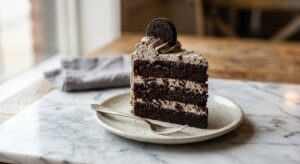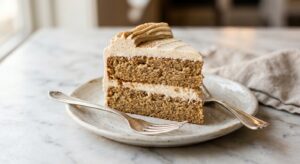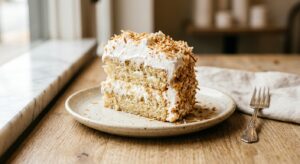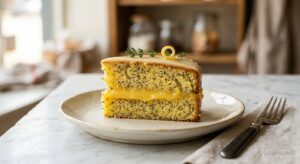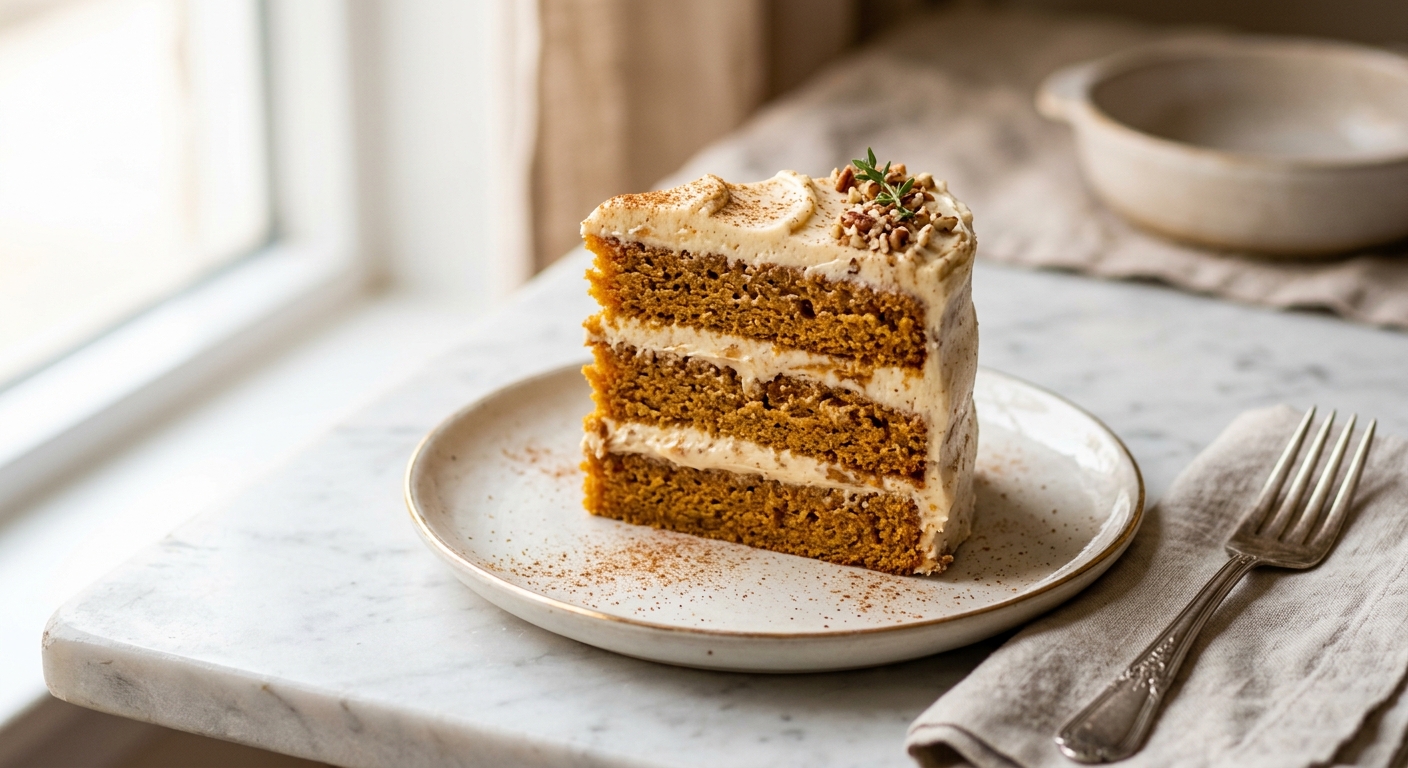
There is a moment, sometime in late September, when the air shifts and you find yourself wanting something warm and spiced and deeply comforting. This pumpkin spice layer cake was made for exactly that moment. The crumb is tender and dense with moisture, a rich amber color that hints at the cinnamon, ginger, clove, and nutmeg folded into every layer. The maple cream cheese frosting is cool and tangy against the warm spice, with a gentle sweetness from real maple syrup rather than just powdered sugar. Cut a slice and the layers reveal themselves beautifully, each one a soft, fragrant cushion waiting to be eaten.
What sets this cake apart from most pumpkin spice recipes is two key decisions: brown butter and pumpkin reduction. Browning the butter before adding it to the batter adds a nutty, almost caramel-like depth that lifts the whole cake out of the ordinary. And gently simmering the canned pumpkin for a few minutes before using it concentrates the flavor and drives off excess water, which is the real reason so many pumpkin cakes turn out heavy or gummy. These are not difficult steps, but they make a dramatic difference in the final result.
This is a medium-difficulty bake, well within reach of any home baker who has made a layer cake before. The steps are straightforward and the batter comes together quickly once your mise en place is ready. It is perfect for a weekend autumn bake, a Thanksgiving gathering, or honestly any time you want to make something that will genuinely impress people without spending an entire day in the kitchen.
Equipment Needed
Click on an item below to shop for the recommended items for this recipe on Amazon.
As an Amazon Associate, we earn from qualifying purchases.
12
Ingredients
- 425 gcanned pumpkin puree (one 15 oz can, not pumpkin pie filling)
- 115 gunsalted butter (1/2 cup, for browning)
- 200 ggranulated sugar (1 cup)
- 200 glight brown sugar, packed (1 cup)
- 3 largeeggs, at room temperature
- 120 mlAvocado Oil100% Pure Avocado Oil such as sunflower or vegetable (1/2 cup)
- 2 tsppure vanilla extract
- 280 gall-purpose flour (about 2 1/4 cups, spooned and leveled)
- 2 tspbaking powder
- 1 tspbaking soda
- 2.5 tspground cinnamon
- 1.5 tspground ginger
- 0.5 tspground nutmeg, freshly grated if possible
- 0.25 tspground cloves
- 0.25 tspground allspice
- 0.75 tspColima Sea SaltMicroplastic Free Salt
- 120 mlwhole milk, at room temperature (1/2 cup)
- —For the Maple Cream Cheese Frosting:
- 450 gfull-fat block cream cheese (two 8 oz blocks), cold
- 115 gunsalted butter (1/2 cup), softened to room temperature
- 360 gpowdered sugar, sifted (about 3 cups)
- 60 mlpure maple syrup, Grade A dark (1/4 cup)
- 1 tsppure vanilla extract
- —Pinch of Colima Sea SaltMicroplastic Free Salt
- —Optional garnish: toasted pecans, a light dusting of cinnamon, or candied pepitas
Ingredient Substitutions
Instructions
- Reduce the pumpkin: Pour the pumpkin puree into a medium saucepan over medium heat. Cook, stirring frequently, for 5 to 7 minutes until the puree has darkened slightly and no longer steams heavily. It should reduce by about 2 to 3 tablespoons. Scrape onto a plate to cool completely before using.
- Brown the butter: In a light-colored saucepan over medium heat, melt the butter, swirling occasionally. Continue cooking for 4 to 5 minutes as it foams and then the foam subsides. The milk solids will turn golden brown and the butter will smell nutty and toasty. Immediately pour into a large mixing bowl and let cool to room temperature, at least 15 minutes.
- Preheat your oven to 350°F (175°C). Grease two 9-inch round cake pans, line the bottoms with parchment paper circles, then grease the parchment. Lightly flour the pans and tap out any excess.
- Whisk the wet ingredients: Into the bowl of cooled brown butter, add the granulated sugar, brown sugar, eggs, neutral oil, and vanilla extract. Whisk vigorously for about 2 minutes until the mixture is smooth and slightly lightened. Add the cooled reduced pumpkin and the milk, whisking until fully combined.
- Combine the dry ingredients: In a separate bowl, whisk together the flour, baking powder, baking soda, cinnamon, ginger, nutmeg, cloves, allspice, and salt. Add the dry ingredients to the wet ingredients and fold with a rubber spatula until just combined. A few small streaks of flour are fine. Do not overmix or the cake will be tough.
- Divide the batter evenly between the prepared pans (a kitchen scale is helpful here for even layers). Smooth the tops gently with an offset spatula. Bake on the center rack for 32 to 35 minutes, until a toothpick inserted in the center comes out with just a few moist crumbs and the edges pull slightly from the sides of the pan.
- Cool in the pans on a wire rack for 15 minutes, then turn out carefully, peel off the parchment, and cool completely on the rack before frosting. This usually takes at least 1 hour. Do not rush this step as warm cake will melt the frosting.
- Make the frosting: In a stand mixer fitted with the paddle attachment, beat the cold cream cheese on medium speed for about 1 minute until smooth. Add the room-temperature butter and beat on medium-high for 2 minutes until fluffy and well combined. Scrape down the bowl. With the mixer on low, gradually add the sifted powdered sugar, then the maple syrup, vanilla, and salt. Increase to medium and beat for 1 to 2 minutes until smooth and spreadable. If the frosting seems too soft, refrigerate for 15 minutes before using.
- Assemble: Place one cake layer flat-side up on your serving plate or cake board. Spread about one-third of the frosting across the top in an even layer using an offset spatula. Place the second layer on top, flat-side up. Frost the top and sides with the remaining frosting. Garnish with toasted pecans, a dusting of cinnamon, or candied pepitas if desired. Refrigerate for at least 30 minutes before slicing for cleaner cuts.
- Prepare the batter exactly as described in steps 1 through 5 of the oven method, including reducing the pumpkin and browning the butter.
- Line the inside of a 6-quart oval or round slow cooker with a large sheet of parchment paper, pressing it up the sides and leaving an overhang. Spray the parchment lightly with cooking spray. Pour the full batter into the lined slow cooker and smooth the top.
- Lay two layers of paper towel across the top of the slow cooker insert before putting on the lid. This absorbs the condensation that would otherwise drip onto the cake and make the surface soggy. Put the lid on over the paper towels.
- Cook on High for 2 hours 15 minutes to 2 hours 45 minutes. The cake is done when the edges are set and no longer glossy, the center is just barely wobbly (it will firm on cooling), and a toothpick inserted in the middle comes out with moist crumbs but no wet batter. Do not lift the lid during the first 2 hours.
- Turn off the slow cooker and leave the lid slightly ajar for 20 minutes to allow steam to escape. Then use the parchment overhang to carefully lift the cake out onto a wire cooling rack. Cool completely, at least 1 hour, before frosting.
- Make the maple cream cheese frosting as described in step 8 of the oven method. Spread generously over the top of the cooled cake. Serve directly from the rack or transfer to a platter. Because this is a single thick layer, slice into 12 portions from the center outward.
- Prepare the batter exactly as described in steps 1 through 5 of the oven method, including reducing the pumpkin and browning the butter. Preheat your oven to 350°F (175°C).
- Grease a 9×13 inch (23×33 cm) metal baking pan thoroughly, line with parchment paper leaving an overhang on the long sides, and grease the parchment.
- Pour the entire batter into the prepared pan and smooth into an even layer. Bake on the center rack for 38 to 42 minutes, until a toothpick inserted in the center comes out with just a few moist crumbs. The top will be deep golden and the edges will pull from the pan sides.
- Cool in the pan on a wire rack for 20 minutes. If you want to frost the cake directly in the pan (simplest approach), skip removing it. If you want to transfer it, use the parchment overhang to lift it out and cool completely on the rack.
- Make the maple cream cheese frosting as described in step 8 of the oven method. Spread the full batch of frosting in a thick, swooping layer across the top of the completely cooled cake. Garnish as desired and refrigerate 20 minutes before cutting into 12 to 16 squares.
Nutrition Per Serving
Per 1 serving (makes one 9-inch two-layer cake)
Why This Recipe Works
Two techniques do the heavy lifting in this cake. First, reducing the pumpkin puree on the stovetop drives off excess moisture before it ever enters the batter. Canned pumpkin contains a significant amount of water, and when that water is still present in the batter, it can interfere with gluten development, create a gummy crumb, and make the layers feel heavy. By cooking off some of that moisture first, you concentrate the pumpkin flavor and give the batter a better fat-to-water ratio, which means a more tender, cohesive crumb. Second, browning the butter creates hundreds of new flavor compounds through the Maillard reaction, converting the milk solids from bland to deeply nutty and caramel-like. Those flavor compounds amplify the warm spices in a way that simply melted butter never could.
The combination of baking powder and baking soda serves a specific purpose here. Baking soda requires an acid to activate, and it gets that from the brown sugar (which is slightly acidic) and any residual acidity in the pumpkin. It also helps with browning via the Maillard reaction. Baking powder provides additional lift more neutrally and at two stages: once when it hits liquid, and again when it hits heat. Using both gives the cake reliable rise and a fine, even crumb without being airy or dry.
For the frosting, cold cream cheese is the key to stability. At room temperature, cream cheese is soft enough that it can weep or become too loose once maple syrup is added. Starting cold gives the frosting structure. The butter, by contrast, must be genuinely room temperature, soft enough to leave a thumbprint, so it incorporates smoothly without leaving lumps. If your frosting ever looks curdled or soupy, it is almost always a temperature issue: refrigerate the whole bowl for 15 to 20 minutes and then beat again on medium speed and it will come back together.
Baker’s Tips
- Use block-style cream cheese for the frosting, not the kind sold in a tub. Tub cream cheese contains stabilizers and extra water that will make your frosting too soft to hold its shape.
- Weigh your flour rather than measuring by volume. Spooning flour into a measuring cup and compacting it can add up to 30 percent more flour than the recipe intends, leading to a dry, dense cake.
- Do not skip cooling the brown butter and reduced pumpkin before adding them to the batter. Adding them warm will partially cook the eggs and result in a greasy, scrambled batter.
- Level your cake layers with a long serrated knife if they domed during baking. This gives you flat, stable layers that stack neatly and slice cleanly.
- Toast any pecan or pepita garnish in a dry skillet for 3 to 4 minutes before using. It deepens their flavor considerably and adds a pleasant crunch against the soft frosting.
- For the cleanest slices, refrigerate the assembled cake for at least 30 minutes and use a sharp knife dipped in hot water and wiped dry between each cut.
- Grade A dark maple syrup has a stronger, more pronounced maple flavor than lighter grades. It is worth seeking out for the frosting since the maple is the star.
Variations
- Brown butter toffee version: Fold 100g of chopped toffee bits or crushed Heath bar into the batter before dividing. Add a drizzle of salted caramel between the layers in place of some of the frosting.
- Chocolate chip pumpkin cake: Fold 150g of dark chocolate chips (tossed in 1 tsp flour) into the finished batter. The bittersweet chocolate plays beautifully against the warm spices.
- Cupcakes: Divide the batter among 24 lined standard muffin cups (fill two-thirds full) and bake at 350°F (175°C) for 20 to 23 minutes. The full frosting batch will frost all 24 generously.
- Naked cake style: Spread a very thin layer of frosting on the sides so the golden cake layers show through, and pile the remaining frosting thickly on top. Finish with candied pecans and a sprinkle of flaky salt.
Troubleshooting & FAQ
My cake layers came out dense and gummy in the center. What went wrong?
My maple cream cheese frosting is too soft and won’t hold its shape. How do I fix it?
Why did my cake layers sink or pull away from the sides of the pan unevenly?
The cake tastes bland. I can barely taste the spices. What happened?
My cake layers rose unevenly and one is much thicker than the other. How do I prevent this?
Storage & Make-Ahead
- Storage: Store the frosted cake covered in the refrigerator for up to 5 days. Bring individual slices to room temperature for 20 to 30 minutes before serving for the best texture and flavor. Unfrosted cake layers can be stored wrapped tightly at room temperature for up to 2 days, or frozen for up to 3 months.
- Make-Ahead: The cake layers can be baked up to 2 days ahead, wrapped tightly in plastic wrap, and stored at room temperature, or frozen (well wrapped) for up to 3 months. Thaw overnight in the refrigerator still wrapped. The frosting can be made up to 3 days ahead and stored in an airtight container in the refrigerator. Let it soften for 20 minutes at room temperature and give it a quick stir before using. The fully assembled and frosted cake can be refrigerated overnight before serving, which actually improves the flavor as the spices meld.