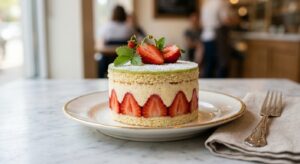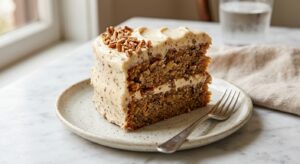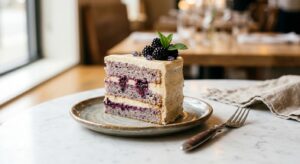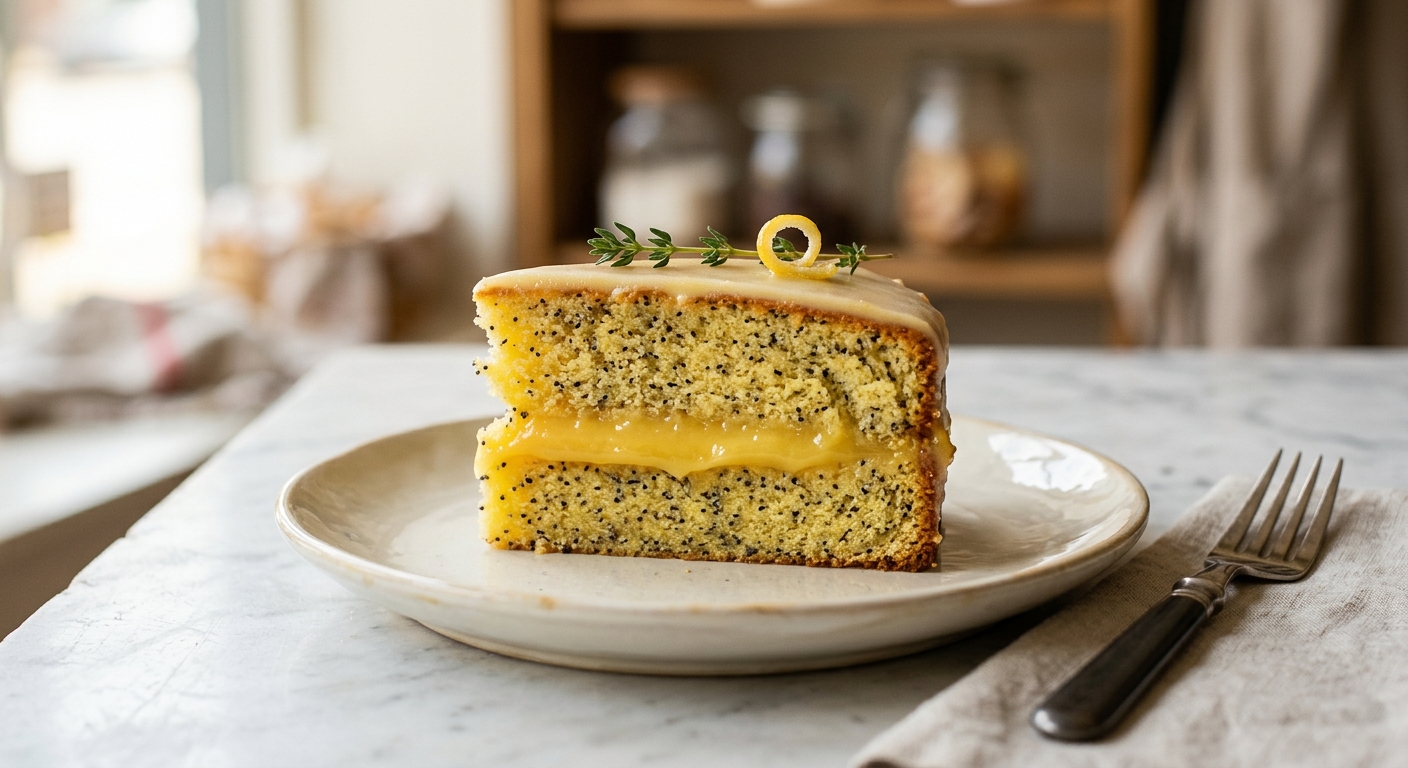
There is something about the combination of lemon and poppy seeds that feels both nostalgic and quietly elegant. Maybe it is the way the tiny black seeds dot each golden crumb like confetti, or the way the sharp citrus perfume fills your kitchen the moment the pans come out of the oven. This cake leans into all of that and then goes one step further, with a glossy, vibrant lemon curd tucked between each layer that tastes like concentrated sunshine. Finished with a cloud of lemon-scented cream cheese frosting, it is the kind of cake that earns a long silence at the table before the compliments start.
What sets this recipe apart is the attention to lemon flavor at every single stage. Instead of relying on one source of citrus, we build it in three ways: fresh zest worked into the sugar to release its essential oils, fresh juice in both the cake batter and the curd, and a touch of lemon extract in the frosting. The poppy seeds are not just decoration either. They add a gentle nuttiness and a subtle textural crunch that balances the smooth, yielding crumb. The curd filling is cooked low and slow until thick and spoonable, firm enough to hold its position between layers without oozing, yet silky enough to melt the moment it touches your tongue.
This is a medium-difficulty bake, mostly because the lemon curd requires your full attention for about ten minutes of stirring. The cake itself, however, is genuinely straightforward and forgiving, built on a simple creaming method that any home baker can master. It is ideal for spring entertaining, birthday celebrations, or any occasion where you want to bring something that looks impressive and tastes even better than it looks.
Equipment Needed
Click on an item below to shop for the recommended items for this recipe on Amazon.
As an Amazon Associate, we earn from qualifying purchases.
12
Ingredients
- 300 gall-purpose flour (about 2.5 cups, spooned and leveled)
- 2.5 tspbaking powder
- 0.5 tspbaking soda
- 0.5 tspColima Sea SaltMicroplastic Free Salt
- 30 gpoppy seeds (about 3 tablespoons)
- 300 ggranulated sugar (about 1.5 cups)
- 3 tbspfinely grated lemon zest (from about 4 large lemons)
- 170 gunsalted butter, softened to room temperature (about 3/4 cup or 1.5 sticks)
- 3 largeeggs, at room temperature
- 2 tsppure vanilla extract
- 60 mlfresh lemon juice (about 2 lemons, about 1/4 cup)
- 180 mlwhole milk, at room temperature (about 3/4 cup)
- 120 gfull-fat sour cream, at room temperature (about 1/2 cup)
- —For the Lemon Curd Filling:
- 150 ggranulated sugar (about 3/4 cup)
- 3 largeeggs
- 2 largeegg yolks
- 120 mlfresh lemon juice (about 4 lemons, about 1/2 cup)
- 2 tbspfinely grated lemon zest
- 85 gunsalted butter, cold and cubed (about 6 tablespoons)
- —For the Lemon Cream Cheese Frosting:
- 340 gfull-fat block cream cheese, softened (about 12 oz or 1.5 packages)
- 170 gunsalted butter, softened (about 3/4 cup or 1.5 sticks)
- 480 gpowdered sugar, sifted (about 4 cups)
- 2 tbspfresh lemon juice
- 1 tsppure lemon extract
- —Pinch of Colima Sea SaltMicroplastic Free Salt
Ingredient Substitutions
Instructions
- Make the lemon curd first so it has time to chill. In a medium saucepan, whisk together the sugar, eggs, egg yolks, lemon juice, and lemon zest. Set over medium-low heat and cook, stirring constantly with a heatproof silicone spatula or wooden spoon, for 8 to 12 minutes until the mixture thickens noticeably and coats the back of the spoon. It should register between 160°F and 170°F (71°C to 77°C) on an instant-read thermometer. Do not let it boil.
- Remove the curd from the heat and immediately add the cold cubed butter, stirring until completely melted and smooth. Strain through a fine-mesh sieve into a clean bowl to remove the zest and any cooked egg bits. Press plastic wrap directly onto the surface of the curd to prevent a skin from forming. Refrigerate for at least 2 hours, or until thick and fully chilled. The curd can be made up to 5 days ahead.
- Preheat your oven to 350°F (175°C). Grease three 8-inch round cake pans, line the bottoms with parchment paper circles, then grease the parchment and lightly flour the sides of the pans.
- In a medium bowl, whisk together the flour, baking powder, baking soda, salt, and poppy seeds. Set aside. In a small bowl or measuring cup, combine the milk, sour cream, lemon juice, and vanilla extract. Stir briefly and set aside.
- In the bowl of a stand mixer fitted with the paddle attachment (or in a large bowl with a hand mixer), combine the granulated sugar and lemon zest. Using your fingertips, rub the zest into the sugar for about 30 seconds until the sugar is fragrant and slightly damp. This releases the lemon essential oils directly into the sugar and is what gives the cake its deep lemon flavor.
- Add the softened butter to the lemon sugar and beat on medium-high speed for 3 to 4 full minutes, scraping down the sides as needed, until the mixture is pale, noticeably fluffy, and has increased in volume. Do not rush this step. Add the eggs one at a time, beating for 20 to 30 seconds after each addition and scraping the bowl between additions.
- With the mixer on low speed, add the flour mixture in three additions, alternating with the milk mixture in two additions (flour, milk, flour, milk, flour). Begin and end with flour. Mix only until each addition is just combined. As soon as you add the last portion of flour, stop the mixer and finish folding gently by hand with a spatula to avoid overworking the batter. A few streaks of flour are fine at this stage.
- Divide the batter evenly among the three prepared pans. A kitchen scale is the most accurate method, roughly 430 to 440g of batter per pan. Smooth the tops with an offset spatula. Bake for 30 to 35 minutes, rotating the pans halfway through, until the cakes are golden at the edges, spring back lightly when pressed in the center, and a toothpick inserted into the middle comes out with just a few moist crumbs attached.
- Cool the cakes in their pans on a wire rack for 15 minutes before turning them out. Peel off the parchment and let the layers cool completely on the rack, at least 1 hour, before assembling. Attempting to fill a warm cake will melt the curd.
- Make the frosting: Beat the softened cream cheese and butter together on medium-high speed for 2 minutes until smooth and unified. Reduce speed to low and add the sifted powdered sugar in two additions, mixing until incorporated before adding the next. Add the lemon juice, lemon extract, and salt. Increase speed to medium and beat for 1 to 2 minutes until the frosting is smooth, creamy, and spreadable. If it feels too soft, refrigerate for 15 to 20 minutes before using.
- Assemble: Place the first cake layer on your serving plate or cake board. Spread or pipe a ring of frosting around the outer edge of the layer to act as a dam. Spoon half of the chilled lemon curd inside the frosting dam and spread it evenly. Place the second layer on top, press gently, and repeat with another frosting dam and the remaining curd. Add the final cake layer. Apply a thin crumb coat of frosting over the entire cake, then refrigerate for 20 minutes. Apply the final coat of frosting, smoothing with an offset spatula. Decorate with lemon slices, extra zest, or a few poppy seeds scattered on top.
- Make a half batch of the lemon curd (halve all curd ingredients) and chill for at least 1 hour. Alternatively, use 1/2 cup of good-quality store-bought lemon curd. Preheat your oven to 350°F (175°C). Grease a 9×13-inch baking pan, line with parchment paper leaving overhang on the long sides, and grease the parchment.
- Prepare the full cake batter exactly as described in steps 4 through 7 of the oven method, rubbing the lemon zest into the sugar, creaming thoroughly, and alternating the dry and wet ingredients.
- Pour the batter into the prepared 9×13 pan and spread evenly. Drop spoonfuls of the chilled lemon curd over the surface of the batter, about 8 to 10 dollops. Use a butter knife or a thin skewer to swirl the curd through the top surface of the batter in a figure-eight motion. Do not over-swirl or the curd will disappear into the batter rather than creating a visible swirl.
- Bake for 28 to 33 minutes, rotating at the halfway point, until golden at the edges, the center springs back when gently pressed, and a toothpick inserted in the center (avoiding a curd pocket) comes out with just a few moist crumbs. The curd pockets will look slightly darker and glossy where they bake into the top.
- Cool completely in the pan on a wire rack, at least 1 hour. Make the full batch of frosting as described. Spread the frosting generously over the cooled cake. Finish with a fine grating of fresh lemon zest and a light scatter of poppy seeds. Cut into squares to serve directly from the pan, or lift out using the parchment overhangs.
- Make the full batch of lemon curd and refrigerate until thick and cold, at least 2 hours. Preheat your oven to 350°F (175°C). Line 24 standard muffin cups with paper liners.
- Prepare the full cake batter following steps 4 through 7 of the oven method. Divide the batter evenly among the lined cups, filling each about two-thirds full. A standard ice cream scoop (about 3 tablespoons) makes portioning quick and consistent.
- Bake for 18 to 22 minutes until the tops are golden, spring back gently when pressed, and a toothpick comes out clean or with just a few moist crumbs. Do not overbake. Begin checking at 17 minutes as cupcake ovens vary. Cool in the pan for 5 minutes before transferring to a wire rack to cool completely.
- Once the cupcakes are fully cool, use a small sharp paring knife or a cupcake corer to remove a small cylinder of cake from the center of each cupcake, cutting to about 3/4 inch deep. Fill a piping bag or a small zip-lock bag with the chilled lemon curd and pipe the curd into each cavity until it is level with the top of the cupcake. Replace the little cake plug on top (trim the bottom slightly so it sits flat over the curd) or simply leave it off and let the curd show.
- Prepare the frosting as described. Transfer to a piping bag fitted with a large round or star tip and pipe a generous swirl onto each cupcake starting from the outside and spiraling inward. Garnish each with a small pinch of lemon zest and a few poppy seeds. Refrigerate if not serving within 2 hours, due to the cream cheese frosting.
Nutrition Per Serving
Per 1 serving (makes one 8-inch three-layer cake)
Why This Recipe Works
The fat-to-flour ratio in this cake is deliberately generous, with sour cream joining the butter to provide a rich, tender crumb. Sour cream accomplishes two things at once: its fat coats the gluten strands to keep the cake soft, and its acidity reacts with the baking soda to produce carbon dioxide, contributing to the light, even rise. Using both baking powder and a small amount of baking soda gives the cake lift from two sources, making the texture more reliable even if your butter and eggs are not perfectly at room temperature.
Rubbing the lemon zest directly into the sugar before creaming is one of the most impactful things you can do for flavor. Lemon zest contains volatile aromatic compounds in its essential oils, and the abrasive action of the sugar crystals physically ruptures the oil cells, releasing those compounds into the fat. Because flavor compounds are fat-soluble, they bond with the butter during creaming and distribute themselves throughout every bite of the cake. Simply adding zest to the batter without this step would leave much of that aroma locked away. The extended creaming time (3 to 4 minutes) is equally important: it incorporates microscopic air bubbles into the butter-sugar mixture, and those bubbles expand in the oven heat to give the cake its structure and lift.
For the lemon curd, cooking over medium-low heat with constant stirring is not optional. The thickening comes entirely from egg proteins slowly coagulating as the temperature rises. Too much heat, too fast, and you will scramble the eggs before they can form the smooth, glossy gel you are looking for. Straining the finished curd through a sieve removes any accidentally overcooked bits and the spent zest, guaranteeing a perfectly silky filling. The cold butter added off the heat emulsifies into the warm curd, adding richness, gloss, and a slightly lower set temperature that keeps the curd spreadable and smooth rather than rubbery.
Baker’s Tips
- Bring all refrigerated ingredients (butter, eggs, milk, sour cream, cream cheese) to room temperature before starting. Cold butter will not cream properly, and cold eggs can cause the batter to curdle, resulting in a denser crumb.
- When zesting lemons, use a Microplane and zest only the bright yellow outer skin. The white pith just beneath is intensely bitter and will negatively affect the flavor of both the cake and the curd.
- Weigh your flour. A cup of flour measured by scooping can pack in 20 to 30 percent more flour than is intended, leading to a dry, dense cake. Spooning flour into the measuring cup and leveling it off is the next best option.
- The frosting dam is essential when assembling the layered cake. Without a ring of frosting holding it in, the lemon curd will slide out from between the layers under the weight of the cake above, especially when the cake is at room temperature.
- If your cream cheese frosting seems too soft or runny, do not add more powdered sugar first. Refrigerate the whole bowl for 20 minutes and then re-beat. Soft cream cheese frosting is almost always a temperature issue rather than a ratio issue.
- To get clean, bakery-style slices, chill the assembled frosted cake for at least 30 minutes before cutting. Use a long sharp knife, and wipe the blade clean with a warm damp cloth between each cut.
Variations
- Lavender lemon version: Add 1 teaspoon of culinary dried lavender to the milk mixture, let steep for 10 minutes, then strain out the lavender before adding to the batter. The floral note pairs beautifully with the citrus.
- Lemon blueberry version: Fold 150g (about 1 cup) of fresh or frozen blueberries (tossed in 1 tablespoon of flour) into the finished batter just before baking. The pockets of jammy berry complement the lemon curd filling perfectly.
- Gluten-free version: Substitute the all-purpose flour with a 1-to-1 gluten-free baking blend (such as Bob’s Red Mill 1-to-1). Add 1/4 teaspoon of xanthan gum if your blend does not already include it. Let the batter rest for 5 minutes before baking to allow the starches to hydrate.
- Extra-moist version: After the baked layers have cooled, brush each one generously with a simple lemon syrup (2 tablespoons sugar dissolved in 3 tablespoons warm lemon juice). This adds moisture and amplifies the citrus flavor significantly.
Troubleshooting & FAQ
My lemon curd did not thicken. What went wrong?
My cake layers came out dense and gummy rather than light and tender. What happened?
My cream cheese frosting is too runny and will not hold its shape on the cake.
The curd is leaking out from between my cake layers after assembly. How do I fix this?
My cake layers domed significantly in the middle and are uneven. How do I get flat layers?
Storage & Make-Ahead
- Storage: Store assembled cake covered in the refrigerator for up to 5 days. Bring individual slices to room temperature for 20 to 30 minutes before serving for the best texture and flavor. The lemon curd on its own keeps refrigerated for up to 5 days in a sealed jar. Unfrosted cake layers can be stored wrapped in plastic wrap at room temperature for up to 2 days.
- Make-Ahead: The lemon curd can be made up to 5 days ahead and stored refrigerated. The cake layers can be baked up to 2 days ahead, wrapped tightly in plastic wrap, and stored at room temperature, or frozen for up to 3 months. The frosting can be made up to 3 days ahead, refrigerated in a sealed container, and re-beaten briefly before using. The fully assembled cake can be assembled 1 day ahead and refrigerated overnight.