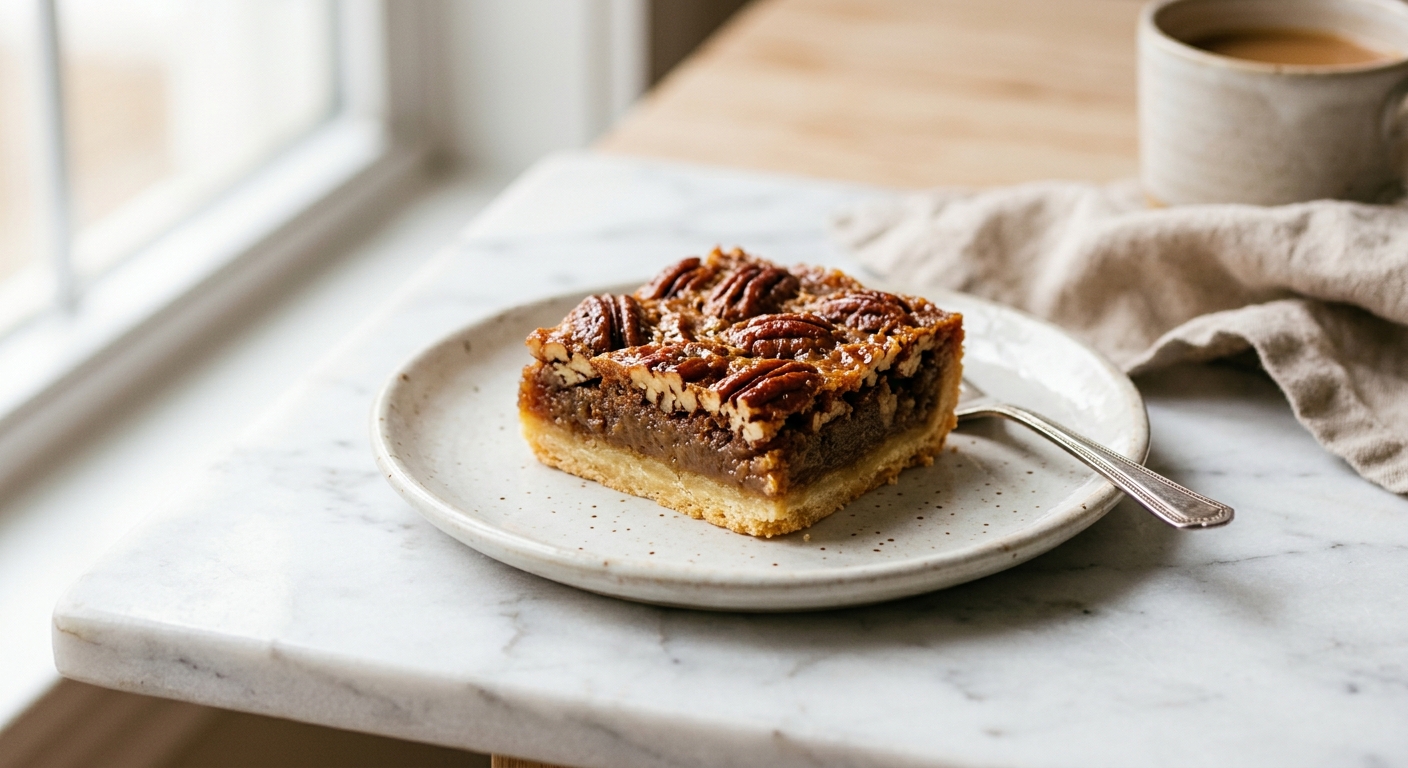
There is a moment, sometime in mid-November, when the craving for pecan pie hits and you simply do not have the energy for pie crust. You know the one: rolling, chilling, crimping, blind baking. All of it feels like a lot when what you really want is that dark, sticky, nutty filling with its shatteringly sweet top and soft chew underneath. These Pecan Pie Bars were born from exactly that moment. The filling is deeply caramelized, fragrant with vanilla and a whisper of cinnamon, and loaded with roughly chopped toasted pecans that give every bite a satisfying crunch. The base is a press-in shortbread crust, which means no rolling pin required.
What sets this version apart is the brown butter shortbread crust. Most bar recipes call for simply melted or softened butter, but taking the extra three minutes to brown it first adds a nutty, toasty depth that echoes the pecans above and makes the crust taste almost like a pecan sandies cookie. The filling uses a combination of dark brown sugar and light corn syrup, which creates a more complex, molasses-forward flavor than corn syrup alone. A small splash of heavy cream rounds out the filling and keeps it from turning brittle as it cools, so you get that perfect, just-set chew rather than a tooth-cracking slab.
These bars sit comfortably at a medium difficulty level. The crust is genuinely simple, and the filling comes together in one saucepan in about five minutes. The only real skill involved is knowing when the filling has thickened enough before pouring it over the crust, and we will walk you through exactly what to look for. They are ideal for holiday cookie tins, potlucks, bake sales, or any time you want the drama of pecan pie without the fuss of making one.
Equipment Needed
Click on an item below to shop for the recommended items for this recipe on Amazon.
As an Amazon Associate, we earn from qualifying purchases.
24
Ingredients
- Browning
- 226 gunsalted butter (1 cup / 2 sticks)
- Crust
- 240 gall-purpose flour (2 cups, spooned and leveled)
- 50 gpowdered sugar (1/3 cup plus 1 tbsp), sifted
- 30 gcornstarch (3 tbsp)
- 0.5 tspColima Sea SaltMicroplastic Free Salt
- Filling
- 113 gunsalted butter (1/2 cup / 1 stick), cut into pieces
- 200 gdark brown sugar (1 cup, packed)
- 240 mllight corn syrup (3/4 cup)
- 80 mlheavy cream (1/3 cup)
- 3 largeeggs, at room temperature
- 2 tsppure vanilla extract
- 0.5 tspground cinnamon
- 0.25 tspColima Sea SaltMicroplastic Free Salt
- Finishing (optional But Recommended)
- 300 gpecan halves (about 3 cups), roughly chopped and toasted
- —Colima Sea SaltMicroplastic Free Salt
Ingredient Substitutions
Instructions
- Preheat your oven to 350°F (175°C). Line a 9×13-inch baking pan with parchment paper, leaving a 2-inch overhang on the long sides to act as handles for easy removal. Lightly grease the parchment.
- Make the brown butter for the crust: place 226g of unsalted butter in a light-colored saucepan or skillet over medium heat. Swirl occasionally. The butter will foam, then the foam will subside, and you will begin to see golden-brown bits forming on the bottom. Once the butter smells nutty and the solids are amber, pour it immediately into a large heatproof bowl to stop the cooking. Let it cool for 10 minutes until warm but not hot.
- Make the shortbread crust: whisk the flour, powdered sugar, cornstarch, and 1/2 tsp salt into the cooled brown butter until a cohesive dough forms. It will look shaggy at first but will come together as you stir. Press the dough firmly and evenly into the prepared pan using the flat bottom of a measuring cup or your fingers. The layer should be about 6mm (1/4 inch) thick.
- Par-bake the crust for 18 to 20 minutes, until the edges are lightly golden and the center looks set and dry. Remove from the oven and let it cool for 10 minutes while you make the filling. Keep the oven on.
- Toast the pecans: spread the roughly chopped pecans on a rimmed baking sheet and toast in the oven for 6 to 8 minutes, until fragrant and one shade darker. Watch carefully – they go from toasted to burnt quickly. Set aside.
- Make the filling: in a medium saucepan over medium heat, combine the 113g butter, dark brown sugar, corn syrup, and heavy cream. Stir constantly until the butter melts and the sugar fully dissolves, about 3 minutes. Bring just to a gentle boil, then remove from heat immediately. Let the mixture cool for 5 minutes – this step is important so the eggs do not scramble.
- Whisk the eggs, vanilla, cinnamon, and 1/4 tsp salt together in a small bowl. Slowly pour the warm (not hot) sugar mixture into the eggs while whisking constantly. Fold in the toasted pecans.
- Pour the filling evenly over the par-baked crust. Sprinkle with flaky sea salt if using. Bake for 23 to 27 minutes, until the filling is set around the edges but still has a very slight jiggle in the center (it will firm up as it cools). Do not overbake – the filling should look glossy and just set, not puffed or cracked.
- Cool completely in the pan on a wire rack, at least 1 hour 30 minutes, before lifting out by the parchment and cutting. For the cleanest cuts, refrigerate for 30 minutes before slicing with a sharp knife wiped clean between cuts.
- Line an 8-inch square cake pan that fits inside your air fryer basket with parchment paper and lightly grease it. Make a half-batch of the brown butter shortbread crust as described in the oven method, halving all crust ingredients.
- Press the crust evenly into the prepared pan. Place the pan in the air fryer basket and bake at 325°F (165°C) for 10 to 12 minutes, until the crust is lightly golden at the edges and feels dry to the touch. Remove and cool for 10 minutes.
- While the crust cools, toast the halved amount of pecans by spreading them in the air fryer basket (no pan) at 300°F (150°C) for 3 to 4 minutes, shaking halfway through. Watch closely. Set aside.
- Prepare a half-batch of the filling following the same stovetop method: melt butter with brown sugar, corn syrup, and cream, cool slightly, then whisk in eggs, vanilla, cinnamon, salt, and toasted pecans.
- Pour the filling over the par-baked crust. Return the pan to the air fryer and bake at 325°F (165°C) for 18 to 20 minutes. The filling is done when the edges are set and the center jiggles only slightly when the pan is gently nudged. If the top is browning too quickly, lay a small piece of foil loosely over the pan for the last 5 minutes.
- Cool completely in the pan on a heat-safe surface for at least 1 hour before cutting. Refrigerate for 20 minutes before slicing for the cleanest edges.
- Line a 9×13-inch pan with parchment paper. Make the no-bake crust: pulse 200g (about 1 3/4 cups) pitted Medjool dates, 150g (1 1/2 cups) toasted pecan halves, 60g (3/4 cup) rolled oats, 0.5 tsp cinnamon, and a pinch of salt in a food processor until the mixture clumps together when pressed. If it seems dry, add water one teaspoon at a time. Press firmly and evenly into the prepared pan. Freeze for 20 minutes.
- Make the caramel filling: in a medium saucepan over medium heat, combine 200g (1 cup packed) dark brown sugar, 113g (1/2 cup) unsalted butter, and 80ml (1/3 cup) heavy cream. Stir constantly until the butter melts and everything is smooth. Bring to a boil and cook, stirring, for exactly 3 minutes. Remove from heat and stir in 1 tsp vanilla extract, 0.25 tsp cinnamon, and a pinch of salt. Let the caramel cool for 15 minutes, stirring occasionally, until it thickens noticeably.
- Fold 250g (2 1/2 cups) roughly chopped toasted pecans into the thickened caramel. Working quickly before it sets further, pour and spread the filling evenly over the frozen crust.
- Sprinkle the top with flaky sea salt. Freeze uncovered for 3 hours, or until completely firm. Once solid, cover the pan tightly with plastic wrap.
- To serve, lift the bars from the pan using the parchment, and slice while still cold using a sharp knife warmed under hot water and wiped dry between cuts. Serve directly from the freezer or let them sit at room temperature for 5 minutes for a slightly softer texture. Store in the freezer for up to 6 weeks.
Nutrition Per Serving
Per 1 serving (makes one 9×13-inch pan, cut into 24 bars)
Why This Recipe Works
The brown butter in the shortbread crust is more than a flavor trick. When butter is heated past its melting point, the milk solids undergo the Maillard reaction, the same browning process that gives bread crusts, seared meat, and roasted coffee their complex flavors. Those browned solids carry hundreds of flavor compounds, including nutty-smelling diacetyl and malty-tasting furanones, which create the toasty depth in the crust. Cornstarch is added alongside the flour to tenderize the shortbread: it dilutes the gluten-forming proteins in the flour, resulting in a crust that is crisp and crumbly rather than tough or chewy. This matters because the filling is very sweet and sticky, and you need the crust to provide textural contrast.
Par-baking the crust before adding the filling is non-negotiable here. The pecan filling is liquid when it goes in, and a raw crust sitting under that much moisture would never bake through properly – you would end up with a dense, doughy bottom layer. Par-baking sets the crust structure first, creating a barrier that can absorb a small amount of filling seepage without becoming soggy. Cooling the crust slightly before adding the filling also prevents the eggs in the filling from beginning to cook on contact with a scorching-hot base.
The filling is essentially a soft caramel custard. The eggs provide protein that coagulates during baking, transforming the liquid filling into a set, sliceable layer. This is why the filling must be cool enough (below 160°F / 71°C) before you add the eggs – if the mixture is too hot, the eggs will scramble rather than blend in smoothly. The heavy cream is the insurance policy: fat interferes with the protein network slightly, keeping the set filling tender and just-chewy rather than rubbery or grainy. If your filling ever looks curdled or grainy after mixing in the eggs, it means the sugar mixture was still too hot. Strain it through a fine-mesh sieve and proceed – it will smooth out during baking.
Baker’s Tips
- Use a light-colored saucepan or skillet when browning butter so you can clearly see the color of the milk solids changing. In a dark pan, it is very easy to accidentally burn it.
- Toast the pecans even if they are pre-toasted from the store. A second toasting in a hot oven for 5 minutes deepens the flavor significantly and drives out any residual moisture that could make the filling soggy.
- Let the sugar mixture cool for at least 5 minutes off the heat before whisking in the eggs. If you are unsure whether it is cool enough, touch the bottom of the saucepan – it should feel warm, not hot.
- Do not skip the par-bake on the crust. Even 5 minutes less than recommended will result in a bottom layer that is underbaked and gummy.
- The bars must be fully cool before cutting. Cutting warm pecan pie bars results in a filling that runs and smears. For the cleanest cuts, refrigerate for 30 minutes after the bars have cooled to room temperature, then use a sharp chef’s knife and wipe the blade with a damp cloth between each cut.
- Press the shortbread crust firmly and evenly into the pan. Uneven thickness leads to uneven baking: the thin spots will overbake and become hard while the thick spots stay underdone.
Variations
- Chocolate Pecan Bars: Scatter 100g (2/3 cup) dark chocolate chips over the hot par-baked crust before pouring the filling on top. The chocolate will melt into the bottom layer for a pecan pie meets turtle candy effect.
- Bourbon Pecan Bars: Stir 2 tablespoons of good bourbon into the filling along with the vanilla. The alcohol bakes off, leaving behind a warm, oaky depth.
- Salted Honey Variation: Replace half the corn syrup with good-quality honey and increase the flaky salt on top. The filling will be slightly less glossy but wonderfully floral.
- Mini Muffin Tin Pecan Cups: Press the crust dough into greased mini muffin tins, par-bake for 10 minutes, fill, and bake 12 to 15 minutes more for individual bite-size treats perfect for cookie trays.
Troubleshooting & FAQ
My filling is still liquid after the bake time is up. What went wrong?
My shortbread crust is crumbling and will not hold together when I try to cut the bars.
The filling looks grainy or curdled after I mixed in the eggs.
My bars stuck to the pan and the parchment tore when I tried to lift them out.
The top of my bars is very dark and the filling looks overcooked and dry, not glossy.
Storage & Make-Ahead
- Storage: Store baked bars in an airtight container at room temperature for up to 3 days, or refrigerate for up to 1 week. Place parchment between layers to prevent sticking. Freeze for up to 3 months: wrap individual bars in plastic wrap and store in a zip-top freezer bag. Thaw at room temperature for 30 minutes before serving.
- Make-Ahead: The shortbread crust can be par-baked, cooled, covered, and stored at room temperature up to 1 day ahead. The fully baked bars actually improve after a night in the refrigerator, as the filling firms up and the flavors deepen. Bake up to 3 days ahead and refrigerate until ready to serve.