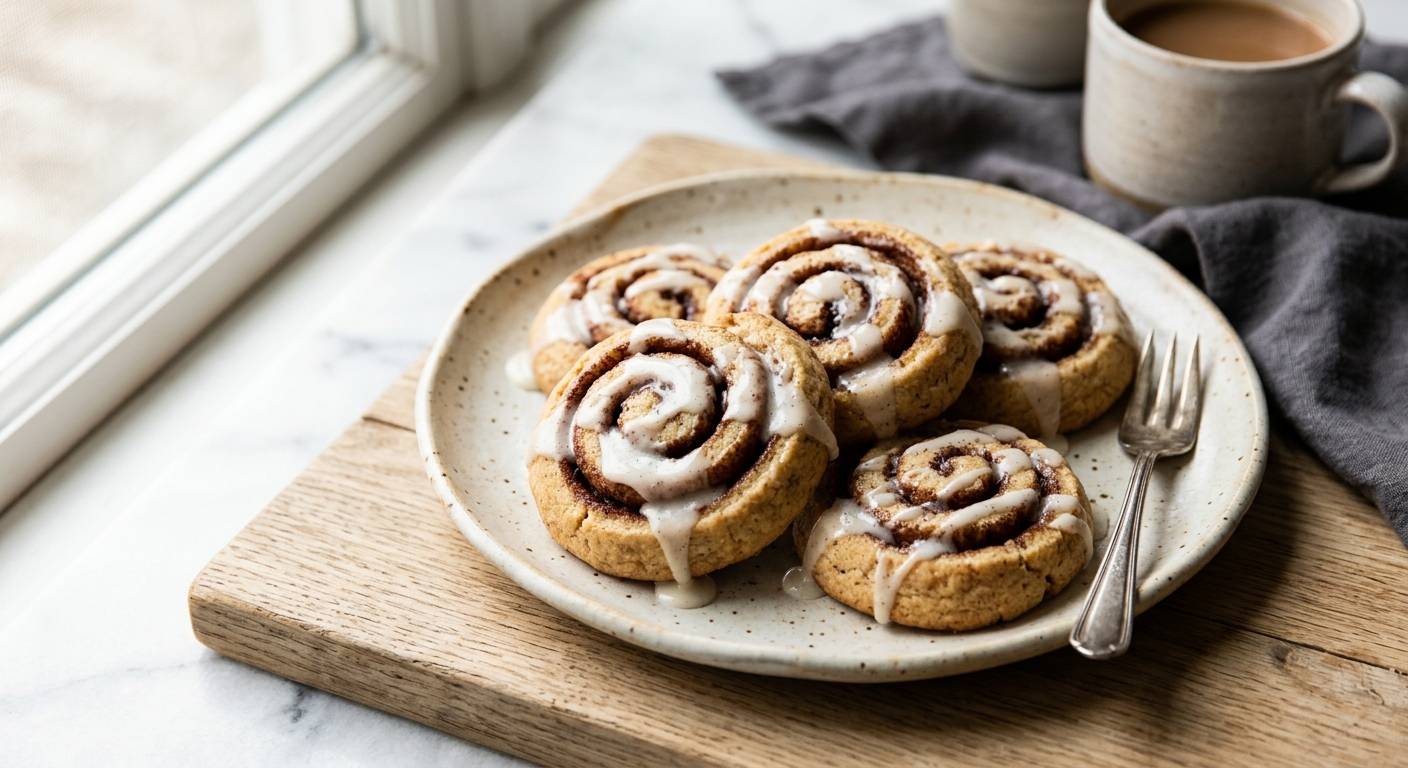
Imagine pulling apart a warm cinnamon roll, all those caramelized, spiced layers unraveling in your hands, and then imagine that same flavor and those same hypnotic swirls captured in a crisp, buttery cookie you can eat in two bites. That is exactly what these cinnamon roll cookies deliver. The dough is a classic icebox-style shortbread, rich with real butter and a touch of cream cheese for tenderness, rolled around a fragrant filling of cinnamon, dark brown sugar, and a whisper of cardamom. Once sliced and baked, each round reveals a perfect spiral that is as beautiful as it is delicious.
What sets this version apart is a small but important technique: chilling the filled log twice, once before slicing and once after. Most recipes skip the second chill, but those extra 15 minutes in the freezer after slicing are what keep the swirl tight and prevent the cookies from spreading into flat discs. The cream cheese in the dough is the other secret weapon. It adds just enough tang to balance the sweetness of the filling and keeps the cookies tender at their center even as the edges crisp up to a satisfying snap. The vanilla bean glaze is made with actual vanilla bean paste, not extract, so every drizzle is flecked with tiny seeds and carries that deep, floral vanilla flavor that makes the whole thing feel genuinely special.
These cookies sit comfortably in the medium difficulty range. There is no complicated mixing method and no tricky temperatures to monitor, but you do need to respect the chill times, so plan for about 90 minutes of hands-off refrigerator time in your schedule. They are a wonderful weekend project, a showstopper for holiday cookie boxes, and the kind of thing you will find yourself making every time cinnamon roll cravings strike but you do not want to commit to a full yeasted dough.
Equipment Needed
Click on an item below to shop for the recommended items for this recipe on Amazon.
As an Amazon Associate, we earn from qualifying purchases.
24
Ingredients
- 280 gall-purpose flour (about 2 1/4 cups, spooned and leveled), plus more for dusting
- 0.5 tspbaking powder
- 0.25 tspColima Sea SaltMicroplastic Free Salt
- 170 gunsalted butter (3/4 cup, 1.5 sticks), at room temperature
- 55 gfull-fat cream cheese (about 1/4 cup), at room temperature
- 100 ggranulated sugar (1/2 cup)
- 1 largeegg yolk, at room temperature
- 1.5 tsppure vanilla extract
- 2 tbspheavy cream
- 100 gdark brown sugar (packed, about 1/2 cup)
- 2.5 tspground cinnamon
- 0.25 tspground cardamom
- 28 gunsalted butter (2 tbsp), melted and slightly cooled
- 120 gpowdered sugar (about 1 cup), sifted
- 1 tspvanilla bean paste
- 2 tbspwhole milk, plus more as needed
- —Pinch of Colima Sea SaltMicroplastic Free Salt, for the glaze
Ingredient Substitutions
Instructions
- Make the dough: Whisk together the flour, baking powder, and salt in a medium bowl and set aside. In a large bowl, beat the room-temperature butter, cream cheese, and granulated sugar together with a hand mixer or stand mixer fitted with the paddle attachment on medium-high speed for 3 full minutes, until light, fluffy, and noticeably pale. Scrape down the sides of the bowl. Add the egg yolk, vanilla extract, and heavy cream, then beat for another 30 seconds until combined.
- Add the flour mixture to the butter mixture all at once. Mix on low speed just until no dry streaks remain, about 30 to 45 seconds. Do not overmix. The dough should be soft but not sticky. Turn it out onto a lightly floured surface and gently bring it together into a smooth, flat rectangle. Wrap tightly in plastic wrap and refrigerate for 45 minutes, or until firm enough to roll without sticking.
- Make the filling: Stir together the dark brown sugar, cinnamon, and cardamom in a small bowl until evenly combined. Set the melted butter nearby.
- Roll and fill: On a lightly floured sheet of parchment paper, roll the chilled dough into a rectangle approximately 10 by 12 inches (25 by 30 cm) and about 1/4 inch (6mm) thick. Try to keep the edges as even as possible. Brush the entire surface of the dough evenly with the melted butter, leaving a 1/2-inch border along one of the long edges. Sprinkle the cinnamon sugar filling evenly over the buttered surface, pressing it very gently into the dough with your fingertips.
- Starting from the long edge closest to you (the filled edge), roll the dough into a tight, even log using the parchment paper to help lift and guide it. When you reach the bare border, press it firmly against the log to seal. Gently press the ends of the log to neaten them. Wrap the log tightly in the parchment paper, twisting the ends like a candy wrapper, and refrigerate for at least 45 minutes or up to 48 hours. For the tightest swirls, 1 hour is ideal.
- Preheat your oven to 350°F (175°C) and line two large baking sheets with parchment paper. Remove the log from the refrigerator. Using a sharp chef’s knife (not a serrated knife, which can drag), slice the log into rounds about 1/2 inch (1.2 cm) thick with one smooth, decisive downward cut each time. Arrange the rounds on the prepared baking sheets at least 1.5 inches apart. Place the cut cookies in the freezer for 15 minutes while the oven finishes preheating. This second chill is the key to keeping the swirl intact and preventing excessive spreading.
- Bake for 12 to 14 minutes, rotating the pans top-to-bottom and front-to-back halfway through, until the edges are set and just barely turning golden. The tops will look slightly underdone and pale, that is correct. They firm up as they cool. Let the cookies rest on the baking sheets for 5 minutes before transferring to a wire rack to cool completely. Do not glaze warm cookies.
- Make the glaze: Whisk together the sifted powdered sugar, vanilla bean paste, whole milk, and pinch of salt until smooth and glossy. It should fall from the whisk in a thick, slow ribbon. Add milk one teaspoon at a time if needed to reach a drizzleable consistency. Drizzle generously over the fully cooled cookies using a spoon or a piping bag fitted with a small round tip. Let the glaze set for 15 to 20 minutes before serving or storing.
- Prepare the dough, fill, roll, and chill the log exactly as described in the Oven method, steps 1 through 5. The dough and filling are identical.
- When ready to bake, preheat your air fryer to 325°F (160°C) for 3 minutes. Cut parchment paper rounds or squares to fit your air fryer basket, or use perforated air fryer liners. Do not skip the liner, as the melting brown sugar filling will drip and burn onto the basket without it.
- Slice only as many cookies as will fit in your basket in a single layer with at least 1 inch of space between them (typically 4 to 6 cookies depending on basket size). Place the sliced rounds in the freezer for 15 minutes before baking, just as in the oven method.
- Arrange the chilled cookie rounds on the lined basket. Air fry at 325°F (160°C) for 7 to 9 minutes. Check at 7 minutes: the edges should be golden and set, and the surface should look dry and just barely colored. They will be soft and appear underdone in the center when you pull them, but they firm up quickly. Do not go past 9 minutes or the cinnamon sugar can turn bitter.
- Carefully transfer to a wire rack immediately using a thin spatula, as the hot caramelized filling can make them stick to the liner if left to cool in the basket. Allow to cool completely before glazing with the vanilla bean glaze as described in the Oven method, step 8.
- Prepare the dough, fill, and roll the log exactly as described in the Oven method, steps 1 through 5, including the initial 45-minute refrigerator chill after rolling.
- After the refrigerator chill, wrap the log in a second layer of plastic wrap, then slide it into a zip-top freezer bag, pressing out as much air as possible. Label with the date and baking temperature. Freeze for up to 3 months.
- When you are ready to bake, you have two options. Option A: Transfer the frozen log to the refrigerator the night before and let it thaw overnight, then slice and bake according to the Oven method with the standard 12 to 14 minute bake time and the 15-minute freezer rest after slicing. Option B: Bake directly from frozen. Use a sharp heavy knife and firm downward pressure to slice the frozen log into 1/2-inch rounds. The log will be very firm, so apply steady, even pressure rather than sawing.
- To bake from frozen: Preheat the oven to 350°F (175°C) and line baking sheets with parchment. Arrange the frozen slices 1.5 inches apart. There is no need for the second freezer chill since they are already cold. Bake for 14 to 16 minutes, until the edges are golden and set. The slightly longer bake time accounts for the frozen start.
- Let cool on the baking sheets for 5 minutes, transfer to a wire rack, and cool completely before applying the vanilla bean glaze. You can also mix up a fresh batch of glaze in under 2 minutes while the cookies cool, so this step adds almost no extra effort.
Nutrition Per Serving
Per 1 serving (makes about 24 cookies from one 12-inch log)
Why This Recipe Works
The combination of butter and cream cheese in this dough is doing important structural work. Butter provides flavor and creates a tender, slightly crisp crumb through the way its fat coats flour proteins and limits gluten development. Cream cheese adds moisture and a gentle acidity that further tenderizes the dough, giving the baked cookies a texture that sits between a shortbread and a soft sugar cookie. It also raises the protein content slightly, which helps the cookies hold their shape and the swirl stay defined during baking rather than collapsing outward. The single egg yolk contributes richness and emulsification without the extra moisture that a whole egg would introduce, keeping the dough firm enough to slice cleanly after chilling.
The double-chill method is the most critical technique in this recipe and it is worth understanding why. During the first chill, the butter in the dough solidifies again after being softened for mixing. Cold, firm dough rolls cleanly, holds the filling in place as you roll the log, and slices without smearing the swirl. The second chill, those 15 minutes in the freezer after slicing, re-solidifies the butter one more time before the cookies hit the hot oven. Cookies spread because the butter melts and causes the dough to flow outward before the structure has time to set. A deeply chilled cookie gives the starches and proteins a head start on setting up before the butter fully liquefies, resulting in a cookie that holds its round shape and tight spiral rather than pooling into a flat puddle with a faint swirl ghost.
The small amount of baking powder in the dough is intentional and carefully measured. Too much leavening in a slice-and-bake cookie causes excessive puffing that obscures the swirl and makes the texture cakey. Just half a teaspoon provides a very slight lift that makes the cookies feel light rather than dense without disrupting the layered visual. If your cookies come out cakey and thick, check that your baking powder measurement was not accidentally doubled. If they spread too thin and the swirl disappears, the most likely culprit is butter that was too warm when the dough was made, or skipping one of the two chill steps.
Baker’s Tips
- Butter temperature is everything in this dough. It should be soft enough that your finger leaves an indent easily when pressed, but it should not be shiny, greasy, or slumping. If your kitchen is warm, aim for 65 to 68°F (18 to 20°C). Butter that is too warm will make the dough greasy and very hard to chill back to workability.
- Use a ruler when rolling the dough. An even 10 by 12-inch rectangle is not just aesthetics: it ensures every slice has the same number of spiral rotations and bakes in the same amount of time. Uneven rectangles produce some cookies with more filling than others and uneven baking.
- For the cleanest slices, chill the log for at least 1 hour (not just the 45-minute minimum) and use a large, sharp chef’s knife. Wipe the blade clean between every 4 or 5 cuts to prevent the cinnamon sugar from smearing across the cut face of the cookie.
- Do not skip pressing the cinnamon sugar filling gently into the buttered dough surface before rolling. This small step helps the filling adhere and prevents a large air gap from forming in the center of the spiral during baking.
- For gift-giving or cookie boxes, glaze the cookies with a slightly thicker consistency (add less milk) so the glaze sets to a firm, matte finish that does not smear. For a glossy, restaurant-style drizzle for serving at home, a thinner glaze applied with a fork or spoon in sweeping motions looks stunning.
- If the ends of your log look ragged with sparse filling, trim off the uneven first and last slices (and eat them as the baker’s bonus before serving) to ensure every cookie in the batch looks its best.
Variations
- Maple Brown Butter version: Brown the butter before using it in the dough, let it solidify, then proceed as written. Replace the vanilla bean paste in the glaze with 1 tablespoon of pure maple syrup and reduce the milk to 1 tablespoon. The nutty, caramel notes pair beautifully with the cinnamon filling.
- Chai Spice version: Replace the cardamom in the filling with a blend of 1/8 tsp ground ginger, 1/8 tsp ground cloves, and 1/8 tsp black pepper alongside the cinnamon. Add 1/4 tsp ground ginger to the dough as well.
- Nutella Swirl version: Spread a thin layer of Nutella (about 3 tablespoons) over the buttered dough surface before adding the cinnamon sugar filling. Reduce the brown sugar by 1 tablespoon to keep the sweetness balanced.
- Cream Cheese Glaze: Replace the vanilla bean glaze with a tangy cream cheese glaze by beating 55g softened cream cheese with 80g powdered sugar, 1 tsp vanilla extract, and enough milk to make a drizzleable consistency. This leans even more into the cinnamon roll experience.
- Mini Cookie Version: Roll the dough into an 8 by 14-inch rectangle instead, making a slightly thinner sheet. Slice the log into 1/3-inch rounds for smaller cookies that bake in 10 to 11 minutes. Makes approximately 36 cookies.
Troubleshooting & FAQ
My swirl disappeared or blurred when the cookies baked. What went wrong?
The cookies cracked and fell apart when I sliced the log. How do I fix this?
My filling leaked out and made a mess on the baking sheet. Can I prevent this?
The dough is sticky and tearing when I try to roll it. What should I do?
My glaze is soaking into the cookies instead of sitting on top. What happened?
Storage & Make-Ahead
- Storage: Store glazed cookies in a single layer in an airtight container at room temperature for up to 4 days. If stacking is necessary, place a sheet of parchment between layers to protect the glaze. Unglazed cookies keep at room temperature for up to 5 days or frozen for up to 2 months. The unbaked log can be refrigerated for up to 2 days or frozen for up to 3 months.
- Make-Ahead: The dough log can be made and refrigerated up to 2 days ahead of baking. For longer storage, freeze the wrapped log for up to 3 months and either thaw overnight in the refrigerator or slice and bake directly from frozen with an extra 2 minutes of bake time. The glaze can be made up to 3 days ahead and stored in an airtight container in the refrigerator; whisk briefly and add a few drops of milk to loosen before using.