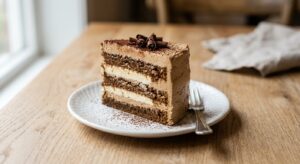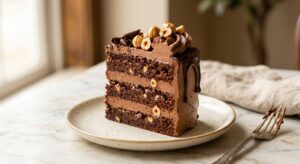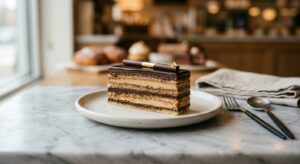
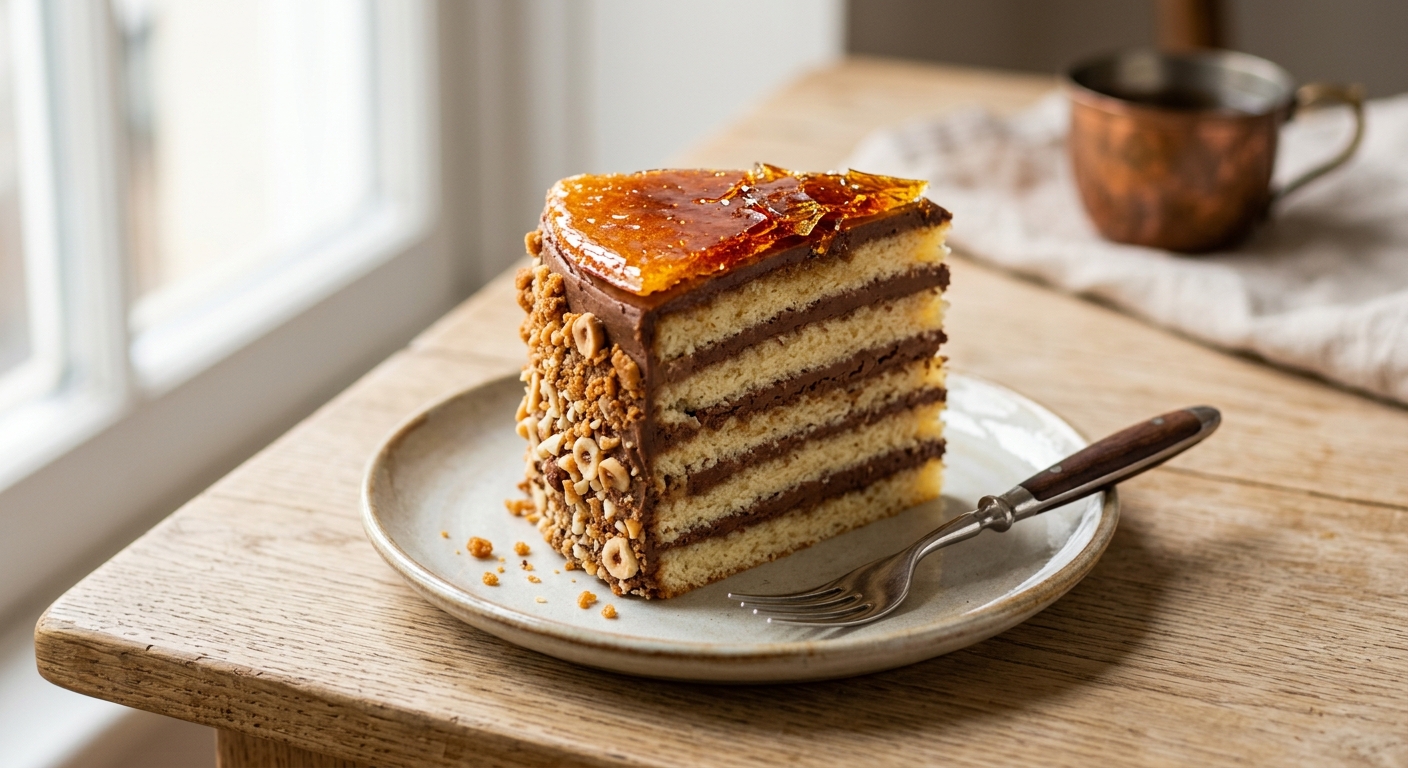
There is a moment, just before you crack a sheet of amber caramel into jagged golden shards, where the kitchen goes completely still. The toffee catches the light like stained glass, and you realize you are holding something genuinely beautiful in your hands. That is the magic of the Dobos torte – a cake invented by Hungarian confectioner József Dobos that became so famous it was served at the Austro-Hungarian Imperial Court and exported across Europe in specially designed wooden boxes to survive the journey. When you bake it at home, you are baking a small piece of living history.
What sets this version apart is a combination of careful technique and a few modern clarifications that the original recipe leaves ambiguous. The sponge layers are baked individually and thin – almost crepe-like – which gives them their signature tender chew rather than a dry, crumbly texture. The chocolate buttercream is a proper cooked Swiss meringue base enriched with dark chocolate and unsalted butter, giving it a glossy, mousse-like body that holds its structure between the layers without becoming stiff. And the caramel topping is made with a dry-method caramel for the deepest, most complex flavor, then scored before it fully sets so it cracks into perfect portions rather than shattering unpredictably at the table.
This is a medium-to-hard recipe in terms of time and coordination, but every component is straightforward on its own. It is ideal for a confident home baker who wants to try a genuine European patisserie classic, and it is an absolutely showstopping centerpiece for a birthday, anniversary, or any occasion that deserves something truly memorable. Plan for a two-day project and you will find the whole process calm and enjoyable.
Equipment Needed
Click on an item below to shop for the recommended items for this recipe on Amazon.
As an Amazon Associate, we earn from qualifying purchases.
12
Ingredients
- Buttercream
- 6 large eggs, separated, at room temperature
- 150 gcaster sugar (about 3/4 cup), divided – 100g for yolks, 50g for whites
- 1 tsppure vanilla extract
- 120 gall-purpose flour (about 1 cup, spooned and leveled), sifted
- 30 gcornstarch (about 3 tbsp), sifted
- —Pinch of Colima Sea SaltMicroplastic Free Salt
- 200 gdark chocolate (70% cacao), finely chopped
- 4 large egg whites, at room temperature
- 200 gcaster sugar (about 1 cup)
- 280 gunsalted butter, cubed, at room temperature (about 1 cup plus 3 tbsp)
- 2 tbspDutch-process cocoa powder, sifted
- 1 tsppure vanilla extract
- —Pinch of Colima Sea SaltMicroplastic Free Salt
- Caramel Top
- 200 gcaster sugar (about 1 cup)
- 30 gunsalted butter (about 2 tbsp)
- Finishing The Caramel Top
- —Colima Sea SaltMicroplastic Free Salt, optional
Ingredient Substitutions
Instructions
- Draw seven 9-inch circles on parchment paper (use your pan as a guide), flip the paper pencil-side down, and lay on baking sheets. Preheat your oven to 375°F (190°C). Grease a 9-inch round springform pan base or a flat baking sheet lightly – you will use this as a template guide under the parchment.
- Make the sponge batter: Beat the 6 egg yolks with 100g of caster sugar and vanilla extract on medium-high speed for 4 to 5 minutes until the mixture is thick, pale, and falls in a wide ribbon from the beaters. In a separate clean bowl, whisk the 6 egg whites with a pinch of salt until foamy, then gradually add the remaining 50g of caster sugar and beat to stiff, glossy peaks. Fold one-third of the whites into the yolk mixture to lighten it, then gently fold in the sifted flour and cornstarch in two additions, alternating with the remaining whites. Stop folding as soon as no white streaks remain – overworking will deflate the batter.
- Spread approximately 80g (a generous 1/3 cup) of batter onto one prepared parchment circle, spreading it thinly and evenly to the edges with a small offset spatula. Bake one or two layers at a time for 6 to 7 minutes until golden at the edges and just set in the center – the layer should feel dry to a light touch. Slide the parchment onto a cooling rack immediately. Repeat with remaining batter. Reserve the best-looking layer for the caramel top.
- Make the Swiss meringue chocolate buttercream: Combine the 4 egg whites and 200g caster sugar in a heatproof bowl set over a saucepan of barely simmering water (double boiler). Whisk constantly until the sugar fully dissolves and the mixture reads 160°F (71°C) on an instant-read thermometer, about 4 to 5 minutes. Remove from heat and beat with a hand or stand mixer on high speed until the meringue is bright white, holds stiff peaks, and the bowl is cool to the touch, about 8 to 10 minutes. Reduce speed to medium and add the room-temperature butter, one or two cubes at a time, waiting for each addition to incorporate before adding the next. The mixture may look curdled around the halfway point – keep going, it will come together. Once all butter is incorporated, beat in the melted (and cooled to room temperature) dark chocolate, sifted cocoa powder, vanilla, and a pinch of salt until the buttercream is smooth and glossy.
- Assemble the cake: Peel the parchment from each cooled sponge layer carefully. Place one layer on a flat serving plate or cardboard cake round. Spread a thin, even layer of chocolate buttercream (about 3 to 4 tbsp) over it. Stack all remaining layers except the reserved caramel-topped layer, spreading buttercream between each. Use the remaining buttercream to coat the top (before adding the caramel layer) and sides of the assembled cake smoothly. Refrigerate for at least 1 hour to firm up.
- Make the caramel top: Place the reserved sponge layer on a lightly oiled sheet of parchment on a heatproof surface. In a small, light-colored saucepan over medium heat, melt the 200g of caster sugar using the dry method – add the sugar in a thin even layer and do not stir. Let it melt around the edges, then tilt the pan gently to move unmelted sugar into the liquid. Once fully melted and a deep amber color (about 350°F / 175°C on a candy thermometer), remove from heat immediately, add the 30g of butter carefully (it will bubble vigorously), and stir until smooth. Pour immediately over the reserved sponge layer and spread quickly with an oiled offset spatula to a thin, even layer. Sprinkle with flaky salt if using. Working fast, use a lightly oiled knife or bench scraper to score the caramel into 12 portions before it fully sets, about 30 to 60 seconds after pouring. Allow to cool and harden completely.
- Place the hardened caramel-topped layer onto the assembled cake. Run a warm knife along the pre-scored lines to separate the portions cleanly before serving. The assembled, finished cake should be refrigerated overnight or for at least 4 hours to allow the layers to meld and the buttercream to fully set. Remove from the refrigerator 20 to 30 minutes before serving.
- Day 1, Morning: Bake all seven sponge layers following Steps 1 to 3 from the oven method. Allow them to cool completely, then stack them with parchment between each layer, wrap the whole stack gently in plastic wrap, and store at room temperature for up to 24 hours. Do not refrigerate the bare sponge layers as they will dry out.
- Day 1, Afternoon: Make the Swiss meringue chocolate buttercream following Step 4 from the oven method. Once complete, press a sheet of plastic wrap directly onto the surface of the buttercream, cover the bowl tightly, and refrigerate. The buttercream can be made up to 3 days ahead.
- Day 2, 4 to 5 hours before serving: Remove the buttercream from the refrigerator and allow it to come to room temperature for 45 to 60 minutes. Once soft, re-beat it briefly with a hand or stand mixer on medium speed for 2 to 3 minutes until it is smooth, fluffy, and spreadable again. If it still looks broken or greasy, place a warm damp towel around the mixer bowl for 1 minute and continue beating.
- Day 2, Assembly: Assemble and frost the cake following Step 5 from the oven method. Refrigerate the assembled cake (without the caramel layer) for 1 hour to firm up.
- Day 2, Caramel top: Make the caramel-topped layer following Step 6 from the oven method. Once fully cooled and hardened, set it on top of the chilled assembled cake. Refrigerate the finished cake for at least 2 more hours (or overnight) before serving. Remove from the refrigerator 20 to 30 minutes before slicing.
Nutrition Per Serving
Per 1 serving (makes one 9-inch round seven-layer cake)
Why This Recipe Works
The Dobos sponge is a foam-based batter, meaning its structure comes entirely from whipped eggs rather than chemical leaveners like baking powder. Beating the yolks and sugar to the ribbon stage creates a stable emulsion of fat and air, while the separately whipped whites form a protein network that traps even more air. When these are folded together with flour and cornstarch – the cornstarch is key, because it dilutes the gluten-forming proteins in the flour – the result is an incredibly light, tender layer that bakes paper-thin without drying out. Baking at a slightly higher temperature (375°F rather than a gentler 350°F) sets the thin layers quickly, giving them that characteristic dry outer surface that makes stacking and handling easy.
Swiss meringue buttercream is chosen over a simpler American-style buttercream for good reason. Cooking the egg whites and sugar to 160°F (71°C) dissolves every grain of sugar and pasteurizes the eggs, producing a meringue that is both silkier and more stable than a cold-beaten meringue. When room-temperature butter is beaten in gradually, it emulsifies into the meringue, creating a buttercream that is light enough not to overwhelm the thin sponge layers but firm enough to hold the structure of a tall, multi-layer cake. The melted dark chocolate adds flavor and also helps stabilize the buttercream, as the cocoa butter in the chocolate sets slightly when chilled, adding body.
The dry caramel method – melting sugar without any water – produces a more complex, deeply flavored caramel than a wet-method (water and sugar) caramel, because the sugar molecules begin Maillard browning reactions at higher temperatures without the buffering effect of water. The risk is that it moves from perfect to burnt very quickly, so pull the pan from the heat the moment the color reaches deep amber. Adding cold butter causes rapid bubbling as water in the butter vaporizes – stir through it confidently. If your caramel seizes or crystallizes at any point, it means undissolved sugar crystals triggered a chain reaction; the only remedy is to start over with a clean, dry pan.
Baker’s Tips
- Trace your circles on the dull side of the parchment and flip it over – the pencil or pen line will be visible through the paper and will not transfer to your food.
- Weigh your batter portions for perfectly even layers. Divide the total weight of finished batter by 7 and spoon that exact amount onto each circle.
- If your butter is too cold when added to the meringue, the buttercream will look curdled and lumpy. Warm the outside of the bowl with your hands or a warm towel for 30 seconds and keep beating – it will smooth out.
- Work fast when pouring the caramel. Have everything positioned before you start: the sponge layer on oiled parchment, the offset spatula oiled and ready, and your scoring knife nearby. Caramel sets in under 2 minutes.
- A light-colored or stainless-steel saucepan is essential for caramel – a dark pan makes it impossible to judge the color accurately.
- Let the finished assembled cake rest overnight in the refrigerator if at all possible. The layers meld together and the buttercream firms up, making the cake significantly easier to slice cleanly and improving the overall flavor.
- To achieve clean slices, dip your knife in hot water and wipe it dry between every single cut.
Variations
- Mocha version: Add 2 tsp of instant espresso powder dissolved in 1 tsp of hot water to the buttercream along with the melted chocolate for a rich coffee-chocolate depth.
- Hazelnut praline filling: Replace half the chocolate buttercream between layers with a hazelnut praline cream (equal parts buttercream and smooth hazelnut paste), keeping the chocolate buttercream for the exterior coating.
- Mini individual Dobos cakes: Use a 3-inch round cutter to cut circles from each baked sponge sheet, stack 6 or 7 layers per mini cake, and coat with buttercream as normal. Top each with a small square of caramel instead of a full round layer. Makes approximately 8 to 10 individual cakes.
Troubleshooting & FAQ
My sponge layers are sticking to the parchment and tearing when I peel them.
My Swiss meringue buttercream looks curdled, soupy, or broken.
My caramel crystallized into a grainy, white mass in the pan.
The caramel layer is softening and becoming sticky in the refrigerator.
My batter is deflating when I fold in the flour.
Storage & Make-Ahead
- Storage: Store the finished cake covered in the refrigerator for up to 5 days. The caramel top will begin to soften slightly after day 2 due to humidity from the buttercream, but it will still taste wonderful. For longer storage, freeze individual slices on a parchment-lined tray until solid, then wrap each slice in plastic wrap and foil – freeze for up to 2 months. Thaw overnight in the refrigerator.
- Make-Ahead: Sponge layers can be baked up to 24 hours ahead and stored wrapped at room temperature, or frozen (stacked with parchment, well-wrapped) for up to 1 month. The chocolate buttercream can be made up to 3 days ahead and refrigerated; re-beat before using. The fully assembled cake (without caramel top) can be refrigerated up to 2 days ahead. Add the caramel-topped layer on the day of serving for the best texture and appearance.