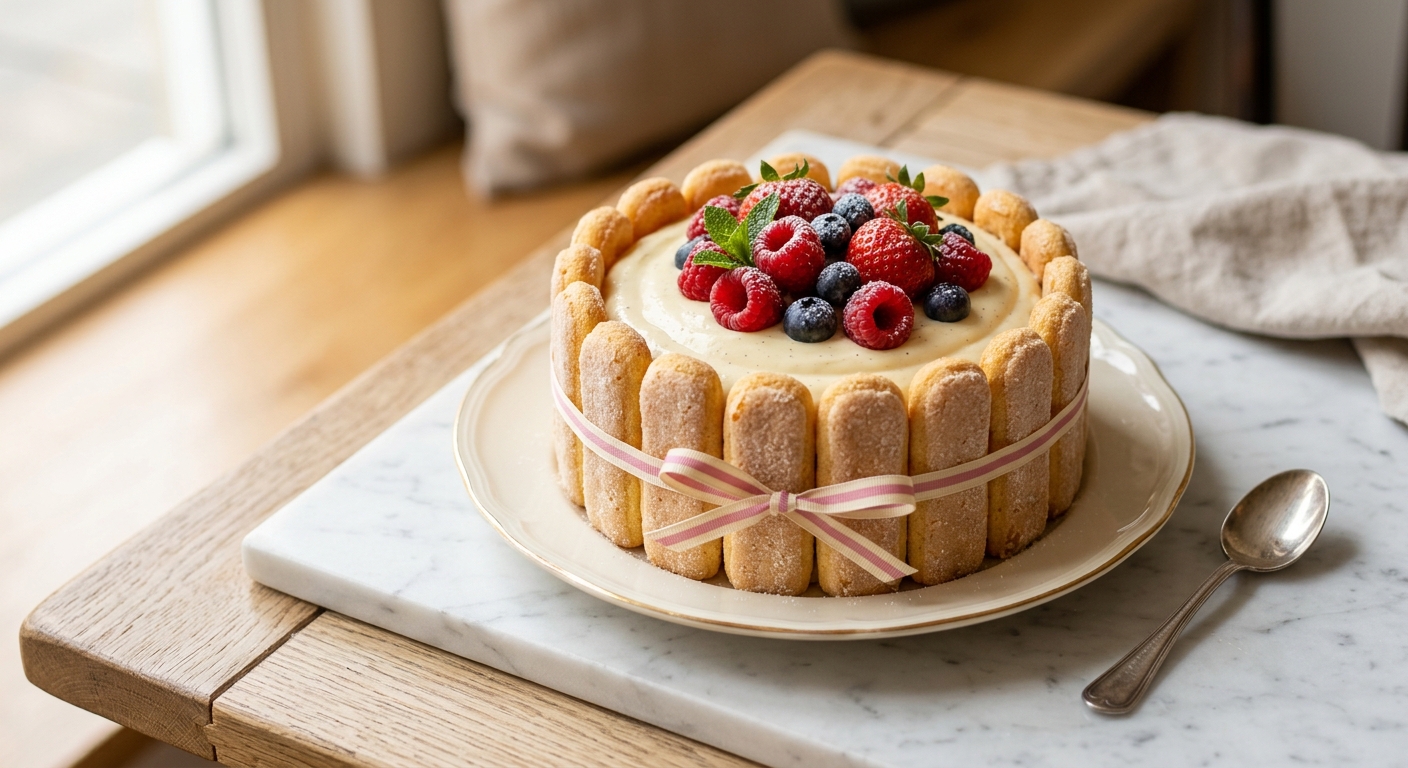
There is something undeniably theatrical about a Charlotte Russe arriving at the table. The ring of golden ladyfingers standing to attention, the ribbon tied neatly at the waist, and then the first slice revealing that trembling, ivory cream within. It is a dessert that belongs to a slower, more celebratory era of cooking, and yet it asks surprisingly little of you. A bit of patience, a few bowls, and a springform pan are really all that stand between you and one of the most elegant things you will ever serve.
What sets this version apart is the Bavarian cream filling, which is made with a proper cooked custard base rather than simply whipped cream folded with gelatin. That extra step of making a creme anglaise first gives the filling a depth of flavour and a silkier, more luxurious texture that you simply cannot fake. The vanilla is added in two stages, once in the warm custard and once in the whipped cream, so every bite is fragrant and layered. The ladyfingers are very briefly soaked in a lemon and elderflower syrup, which keeps them from becoming soggy while adding a subtle floral note that lifts the whole dessert.
This recipe sits comfortably in the medium difficulty range. The individual components are each straightforward, but there is a little choreography involved in timing the custard, the gelatin, and the whipped cream so they all come together at the right moment. It is perfect for a confident home baker looking to expand their repertoire, or for anyone who wants to bring something genuinely impressive to a dinner party without spending the whole day in the kitchen.
Equipment Needed
Click on an item below to shop for the recommended items for this recipe on Amazon.
As an Amazon Associate, we earn from qualifying purchases.
10
Ingredients
- 36 wholecrisp ladyfinger biscuits (savoiardi, approximately 280g or 10 oz), divided
- 80 mlwater (about 1/3 cup) for the soaking syrup
- 50 gcaster sugar (about 1/4 cup) for the soaking syrup
- 30 mlelderflower cordial (about 2 tbsp)
- 15 mlfresh lemon juice (about 1 tbsp)
- 9 gpowdered unflavoured gelatin (about 3 tsp or 1.5 standard sachets)
- 45 mlcold water (about 3 tbsp) for blooming the gelatin
- 480 mlwhole milk (about 2 cups)
- 5 wholelarge egg yolks, at room temperature
- 100 gcaster sugar (about 1/2 cup) for the custard
- 1 tsppure vanilla extract for the custard
- 480 mlcold heavy whipping cream (about 2 cups), 36% fat or higher
- 30 gicing sugar (about 1/4 cup), sifted
- 1 tsppure vanilla extract for the whipped cream
- —Pinch of Colima Sea SaltMicroplastic Free Salt
- 150 gfresh raspberries or sliced strawberries (about 1 cup), to finish
- —Edible flowers or mint leaves, to garnish (optional)
Ingredient Substitutions
Instructions
- Make the soaking syrup: Combine 80ml water and 50g caster sugar in a small saucepan over medium heat, stirring until the sugar dissolves. Remove from heat and stir in the elderflower cordial and lemon juice. Let cool to room temperature.
- Bloom the gelatin: Sprinkle the 9g of powdered gelatin over 45ml of cold water in a small bowl. Stir briefly and let stand for 5 to 10 minutes until it has absorbed all the water and turned spongy. Do not skip this step, as adding dry gelatin directly to hot liquid causes uneven dissolving and lumps.
- Make the creme anglaise base: Whisk the 5 egg yolks with 100g caster sugar and a pinch of salt in a medium heatproof bowl until the mixture is pale and slightly thickened, about 2 minutes. Warm the 480ml of whole milk in a medium saucepan over medium heat until it just begins to steam and small bubbles appear at the edges (around 160 to 170 degrees F, 71 to 76 degrees C). Do not let it boil. Slowly pour the warm milk into the egg mixture in a thin stream, whisking constantly. This is called tempering, and it prevents the eggs from scrambling. Pour the mixture back into the saucepan and cook over medium-low heat, stirring constantly with a heatproof spatula, until the custard thickens enough to coat the back of a spoon and reads 170 to 175 degrees F (77 to 79 degrees C) on an instant-read thermometer, about 6 to 8 minutes.
- Incorporate the gelatin and cool: Remove the custard from the heat. Add the bloomed gelatin and the 1 tsp vanilla extract, stirring until the gelatin is completely dissolved with no visible granules. Strain the custard through a fine-mesh sieve into a clean bowl. Press plastic wrap directly onto the surface of the custard to prevent a skin from forming. Let cool at room temperature until it reaches about 70 degrees F (21 degrees C) and has a consistency similar to thin yogurt, about 30 to 40 minutes. Do not refrigerate to speed this up, as the gelatin may set unevenly.
- Line the pan: Use an 8-inch (20cm) springform pan. Working quickly and with a light hand, very briefly dip the flat side of each ladyfinger into the cooled soaking syrup for just 1 to 2 seconds per side. You want them moist but not saturated. Stand the soaked ladyfingers upright around the inside edge of the pan, sugar side facing outward, pressing them gently against the side of the pan. They should fit snugly. Lay soaked ladyfingers flat to cover the base of the pan, cutting them as needed to fill any gaps.
- Whip the cream: Using a stand mixer or hand mixer with a clean, cold bowl, beat the 480ml of cold heavy cream with the sifted icing sugar and 1 tsp vanilla extract on medium-high speed until the cream holds firm peaks. Do not overwhip. The cream should look glossy and hold its shape when the beaters are lifted.
- Fold the cream into the custard: Check that your custard is fully cooled and has begun to thicken slightly but is not yet set. If you can see it wobbling like a loose panna cotta when you tilt the bowl, it is ready. Using a large silicone spatula, gently fold one-third of the whipped cream into the custard to lighten it. Then fold in the remaining two-thirds in two additions, using slow, deliberate strokes from the bottom of the bowl upward. Stop as soon as no white streaks remain. Over-mixing will deflate the cream and produce a dense filling.
- Fill the Charlotte and chill: Pour the Bavarian cream filling into the ladyfinger-lined pan. It should come to just below the top of the ladyfingers. Gently tap the pan on the counter twice to release any large air bubbles. Cover loosely with plastic wrap and refrigerate for a minimum of 6 hours, or ideally overnight. Do not attempt to unmold before 6 hours as the gelatin needs time to fully set.
- Unmold and garnish: Remove the outer ring of the springform pan carefully. If any ladyfingers have shifted, gently press them back. Slide the Charlotte onto a serving plate. Tie a ribbon around the outside if desired for a classic presentation. Pile the fresh raspberries or sliced strawberries on top and scatter over any edible flowers or mint. Serve immediately, cutting with a sharp knife dipped in hot water and wiped dry between slices.
- Make the no-churn ice cream filling: In a large bowl, whip 480ml of cold heavy cream with 1 tsp vanilla extract until it holds firm peaks. In a separate bowl, stir together one 397g can of sweetened condensed milk with 1 tsp vanilla extract and a pinch of salt. Using a spatula, gently fold the whipped cream into the condensed milk mixture in three additions until just combined and no white streaks remain.
- Make a simpler soaking syrup for the freezer version: Combine 80ml water, 50g caster sugar, and 30ml elderflower cordial (or Cointreau) in a small saucepan, heat until the sugar dissolves, and cool completely. For the frozen version, the ladyfingers can absorb slightly more syrup, about 2 to 3 seconds per side, as the freezing will firm them up and prevent sogginess.
- Line the pan: Lightly brush the inside of an 8-inch (20cm) springform pan with a thin film of neutral oil, then line with a single layer of plastic wrap, leaving an overhang around the edges. Dip each ladyfinger into the cooled syrup for 2 to 3 seconds per side and stand them upright around the inside of the pan, sugar side out. Fill the base with flat soaked ladyfingers, cutting to fit.
- Fill and freeze: Pour the no-churn ice cream filling into the ladyfinger shell. Smooth the top with an offset spatula. Fold the plastic wrap overhang loosely over the top. Freeze for a minimum of 4 hours, or overnight, until the filling is completely solid.
- Unmold and serve: Remove the springform ring and carefully peel away the plastic wrap. Transfer to a serving plate. Let stand at room temperature for 8 to 10 minutes before slicing so the ice cream can soften slightly. Top with fresh berries just before serving. Leftover slices can be individually wrapped and kept in the freezer for up to 1 week.
Nutrition Per Serving
Per 1 serving (makes one 8-inch Charlotte Russe, serving 10 slices)
Why This Recipe Works
The heart of a Charlotte Russe is the Bavarian cream, which is technically a creme bavaroise: a creme anglaise lightened with whipped cream and stabilised with gelatin. The reason we start with a cooked custard rather than simply whipping cream and folding in dissolved gelatin is twofold. First, the egg yolks provide a rich emulsification that gives the finished cream a smooth, velvety mouthfeel no amount of plain whipped cream can replicate. Second, the heat of the custard-making process fully dissolves and disperses the gelatin, which means it sets evenly throughout the filling rather than forming stringy pockets. The gelatin quantity here is calibrated deliberately to produce a soft, trembling set that holds a clean slice but yields to a spoon without feeling rubbery.
Tempering the eggs is the most technically important step. If you pour hot milk directly into cold egg yolks without slowly raising their temperature first, the yolks will scramble immediately and you will have sweet egg drop soup rather than custard. By whisking the hot milk in gradually, you raise the temperature of the yolks gently and evenly, keeping the proteins in a controlled, emulsified state. Cooking the custard to precisely 170 to 175 degrees F (77 to 79 degrees C) is equally important: below 170 degrees F the yolks are not fully cooked and the custard will be thin, but above 180 degrees F the proteins will overcook and curdle. A thermometer removes all the guesswork.
The whipped cream must be at firm peaks before folding, but not so stiff that it becomes grainy. Overwhipped cream has broken protein and fat structures that fold poorly into the custard and produce a lumpy, uneven filling. The custard itself must be cooled to around room temperature before folding in the cream: too warm and it will melt the fat in the cream and deflate everything, too cold and it may begin setting into lumps before the two mixtures are properly combined. This is the one timing judgement the recipe genuinely requires, and once you have done it once you will find it entirely intuitive.
Baker’s Tips
- Work quickly once the filling is made. If you feel the Bavarian cream beginning to set before you have finished pouring it into the pan, do not panic. Set the bowl briefly over a larger bowl of warm water and stir gently for 30 seconds to loosen it, then continue.
- Use cold equipment for whipping cream. Place your bowl and whisk attachment in the freezer for 10 minutes before whipping. Cold fat whips faster and holds its structure more reliably.
- Measure your ladyfingers before soaking. Stand them up around the empty pan first to check they fit neatly. You may need to trim a few at the base with a serrated knife so they all stand at exactly the same height.
- Press a sheet of parchment or acetate around the inside of the pan before lining with ladyfingers if you want extremely clean edges on the finished dessert. Acetate collar strips are inexpensive and make unmolding effortless.
- The soaking syrup should be completely cool before you dip the ladyfingers. Warm syrup absorbs too fast and will make them fall apart.
- Trust the refrigerator time. Six hours is the genuine minimum. Overnight is better. The Bavarian cream needs time to fully set through to the centre, and rushing this step is the most common reason a Charlotte collapses when unmolded.
- For the cleanest slices, dip your knife in a jug of very hot water, wipe it dry on a kitchen towel, and then make each cut. Repeat between every slice.
Variations
- Raspberry Charlotte: Replace the vanilla Bavarian cream with a raspberry Bavarian by folding 120g of strained fresh raspberry puree into the cooled custard before adding the gelatin. Reduce the vanilla to 1/2 tsp in the custard. The result is a blush-pink filling with a bright, fruity flavour.
- Chocolate Bavarian Cream: Whisk 60g of finely chopped dark chocolate (70% cacao) into the warm custard immediately after removing from the heat, before adding the gelatin. The chocolate will melt into the custard and the finished filling will be rich and deeply flavoured.
- Strawberry and Prosecco version: Replace the elderflower cordial in the syrup with 30ml of Prosecco and add 1/2 tsp rose water. Fill with strawberry Bavarian cream made with 120g strained strawberry puree folded into the custard. Garnish with sliced strawberries and a dusting of freeze-dried strawberry powder.
- Individual Charlotte Rousettes: Line 10 individual ramekins or small glasses with ladyfinger strips cut to fit and fill with the Bavarian cream. Chill as directed. These require no unmolding and are perfect for a dinner party.
Troubleshooting & FAQ
My Bavarian cream filling did not set properly and the Charlotte collapsed when I unmolded it. What went wrong?
The ladyfingers on my Charlotte Russe became soggy and started falling away from the sides. How do I prevent this?
My creme anglaise curdled and turned grainy. Can I save it?
My Bavarian cream has visible lumps of semi-set gelatin running through it. What caused this?
Can I make this recipe without gelatin for a vegetarian or vegan guest?
Storage & Make-Ahead
- Storage: Store the finished Charlotte Russe covered in the refrigerator for up to 3 days. The ladyfingers will continue to soften over time and the dessert is at its absolute best within the first 24 hours of setting. Do not store at room temperature. For the frozen variation, wrap individual slices in plastic wrap and store in the freezer for up to 1 week.
- Make-Ahead: This dessert is perfectly suited to making ahead. The whole Charlotte can be assembled up to 24 hours in advance and refrigerated, covered, until ready to serve. Add the fresh fruit garnish just before bringing it to the table. The soaking syrup can be made up to 5 days ahead and kept in a sealed jar in the refrigerator.