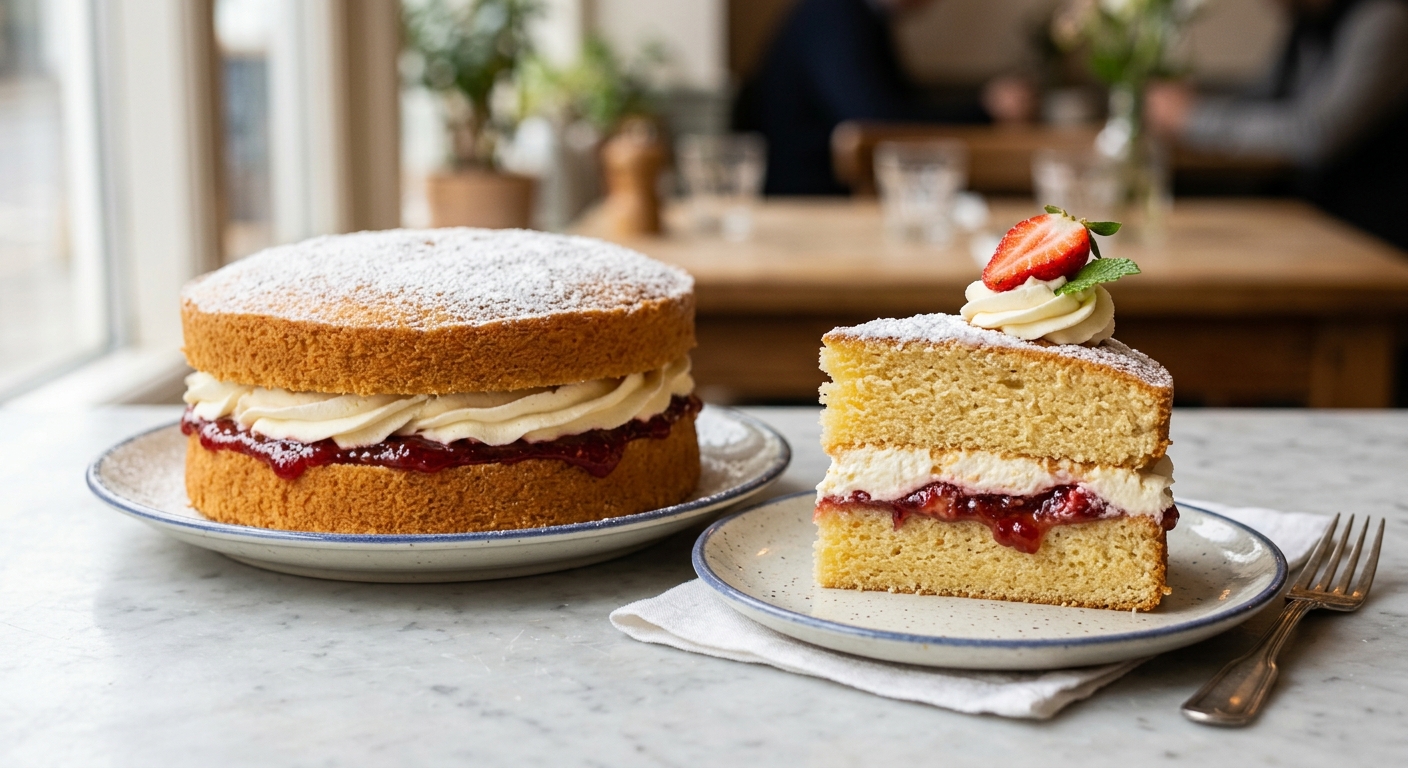
There is something quietly magnificent about a Victoria Sponge. No towering tiers, no elaborate decoration, no showboating whatsoever – just two golden, feather-light sponge layers held together by a generous spread of strawberry jam and a cloud of lightly sweetened cream. Cut a slice and you get that perfect cross-section: pale gold cake, ruby jam, white cream. It is the kind of cake that makes people close their eyes when they take the first bite, and that is exactly the point.
What sets this version apart is the equal-weight method – a classic British baking technique where you weigh your eggs first, then match that weight exactly in butter, caster sugar, and self-raising flour. This ensures the batter is perfectly balanced every single time, regardless of how large or small your eggs happen to be. Combined with room-temperature butter beaten until genuinely pale and fluffy, and a careful fold to preserve every last bit of air, the result is a sponge with an exceptionally tender, even crumb that springs back when you press it gently. Real strawberry jam (seeded or smooth, your call) and freshly whipped double cream, not buttercream, keep things tasting honest and bright.
This is a medium-difficulty bake, leaning toward easy once you understand the creaming method. It is ideal for home bakers who want to build a solid foundation in classic cake technique, and equally perfect for anyone who simply wants to serve something beautiful and delicious at a birthday, a garden party, or a Sunday afternoon with nothing better to do than eat cake.
Equipment Needed
Click on an item below to shop for the recommended items for this recipe on Amazon.
As an Amazon Associate, we earn from qualifying purchases.
10
Ingredients
- 4 largeeggs, at room temperature (weigh these first – target weight is approximately 200g total, shell on)
- 200 gunsalted butter, very soft but not melted (about 14 tbsp), plus extra for greasing
- 200 gcaster sugar (about 1 cup – if unavailable, pulse granulated sugar in a food processor for 30 seconds)
- 200 gself-raising flour (about 1 cup + 6 tbsp), plus extra for dusting
- 1 tspbaking powder
- 1 tsppure vanilla extract
- 2 tbspwhole milk, at room temperature (to loosen batter if needed)
- —Pinch of Colima Sea SaltMicroplastic Free Salt
- 150 ggood-quality strawberry jam (about 1/2 cup), seedless or seeded – your preference
- 300 mldouble cream (about 1 1/4 cups) – heavy whipping cream works well too
- 1 tbspicing sugar (powdered sugar), plus extra for dusting the top
- 0.5 tspvanilla extract, for the cream
Ingredient Substitutions
Instructions
- Preheat your oven to 350°F (180°C conventional / 160°C fan-assisted). Grease two 8-inch (20cm) round sandwich tins generously with soft butter, dust with a little flour, then line the bottoms with parchment paper circles. This double-insurance means your sponge will never stick.
- Beat the soft butter and caster sugar together in a stand mixer or with a hand mixer on medium-high speed for a full 4 to 5 minutes, stopping to scrape down the sides twice. The mixture should be very pale – almost white – and noticeably fluffy. Do not rush this step. The air beaten in here is the primary leavener for your sponge.
- Add the eggs one at a time, beating well on medium speed after each addition. Add the vanilla with the last egg. If the mixture looks like it is beginning to curdle or split, add 1 tablespoon of your measured flour – this rebinds the emulsion. A curdled batter leads to a dense, uneven sponge.
- Sift the self-raising flour, baking powder, and salt directly over the batter. Using a large metal spoon or a wide spatula, fold gently until just combined – use sweeping, deliberate strokes cutting down through the middle and sweeping up the sides. Stop the moment you see no more dry flour. If the batter seems very stiff, fold in the milk one tablespoon at a time until it just drops from the spoon when you tap it (this is called ‘dropping consistency’).
- Divide the batter evenly between the two prepared tins – a digital scale makes this precise. Smooth the tops gently with the back of a spoon, leaving a very slight dip in the centre (this helps the layers bake flat). Bake on the centre rack for 22 to 25 minutes, until golden, springy to the touch, and a toothpick inserted in the centre comes out clean. Do not open the oven before 20 minutes.
- Leave the sponges in their tins for 5 minutes, then turn out onto a wire cooling rack, peel off the parchment, and leave to cool completely – at least 45 minutes. Never fill a warm sponge with cream.
- When the sponges are fully cool, whip the double cream with the icing sugar and vanilla extract to soft, billowy peaks – it should hold its shape but still look lush and creamy, not stiff or grainy. Place the first sponge on your serving plate or cake stand, flat side up. Spread the strawberry jam generously over the surface, leaving a 1cm border at the edge. Spoon or pipe the whipped cream over the jam in an even layer. Place the second sponge on top, domed side up. Dust generously with icing sugar and serve within 2 hours.
- Prepare the full batter as described in the oven method steps 1 through 4, using the same creaming and folding technique. While making the batter, check that your 7-inch round cake tin fits inside your air fryer basket with at least 2cm of clearance on all sides. Grease, flour, and line it with parchment.
- Preheat the air fryer to 320°F (160°C) for 3 minutes. Because air fryers circulate hot air more aggressively than a conventional oven, a lower temperature prevents the outside from browning too fast before the centre sets.
- Pour half the batter into the prepared tin and smooth the top. Place carefully in the air fryer basket. Bake for 18 to 22 minutes. Check at 18 minutes – the sponge should be golden, pulling away from the edges, and a toothpick should come out clean. If the top is browning too quickly before 15 minutes, lay a small piece of foil loosely over the top.
- Remove the tin and let the first sponge rest for 5 minutes before turning out onto a cooling rack. Clean, re-grease, re-line, and refill the tin with the remaining batter. Bake the second layer using the same method. Because the batter has been sitting, this layer may bake 1 to 2 minutes faster, so check early.
- Allow both layers to cool completely before assembling with the strawberry jam and whipped cream exactly as described in the oven method.
Nutrition Per Serving
Per 1 serving (makes one 8-inch two-layer Victoria Sponge)
Why This Recipe Works
The genius of the equal-weight method lies in its balance. By matching the weight of butter, sugar, and flour to the weight of the eggs, you ensure every structural component of the cake is in proportion. Eggs provide structure (through protein coagulation) and moisture, butter contributes richness and tenderness by coating flour proteins and limiting gluten development, and sugar not only sweetens but holds onto moisture, keeping the crumb tender for days. When these four elements are balanced, the batter behaves predictably and bakes evenly.
The extended creaming of butter and sugar is the most important step in the entire recipe. When you beat softened butter with sugar for a full 4 to 5 minutes, you are essentially forcing air bubbles into the fat. These bubbles expand dramatically in the oven’s heat and are responsible for the sponge’s light, open crumb. This is why butter temperature matters so much: butter that is too cold will not trap air, and butter that is too warm (or melted) cannot hold the air bubbles at all. Aim for butter that is soft enough to leave an indent when you press it, but still holds its shape. The baking powder adds a secondary lift, reacting with moisture and heat to produce carbon dioxide, but it is the creamed-in air that defines the texture of a true Victoria Sponge.
Folding rather than mixing the flour preserves the air you have worked so hard to create. Overmixing at the flour stage develops gluten and deflates air, resulting in a dense, tough cake with a tight crumb. A metal spoon or wide spatula is better than a rubber spatula here because the thin edge cuts through the batter more cleanly, incorporating the flour without the heavy folding action that collapses structure. If your cake bakes up dense or sunken, these two stages – creaming and folding – are almost always where the issue lies.
Baker’s Tips
- Weigh your eggs first (shells on), then measure your butter, sugar, and flour to exactly the same weight. This equal-weight method is more accurate than any cup measurement and is the secret to a reliable, balanced sponge.
- Butter must be genuinely soft – not cold from the fridge, and not melted. Leave it out at room temperature for at least 1 hour before you begin, or cut it into cubes and microwave in 5-second bursts, checking each time.
- Bring your eggs to room temperature before cracking them. Cold eggs are more likely to cause the batter to curdle when added to the creamed butter, which can result in a slightly denser sponge.
- Use a digital scale to divide the batter equally between the two tins. Even a 20g difference will mean unequal layers, and one may overbake before the other is done.
- Do not open the oven door before the 20-minute mark. The sponge rises on a delicate structure of air bubbles – a rush of cold air can cause it to sink before the proteins and starch have set.
- Whip your double cream to soft peaks, not stiff peaks. Over-whipped cream becomes grainy and can taste slightly buttery. Stop when it holds a gentle shape and looks luxurious rather than firm.
- Dust the top of the finished cake with icing sugar right before serving, not ahead of time – humidity can cause the sugar to dissolve and disappear.
Variations
- Lemon Victoria Sponge: Add the finely grated zest of 2 lemons to the butter and sugar at the start of creaming. Swap strawberry jam for lemon curd and fold 1 tsp lemon zest into the whipped cream.
- Fresh Strawberry Version: Layer thin slices of fresh strawberries on top of the jam before adding the cream, and garnish the top with a few halved strawberries instead of just icing sugar.
- Raspberry and Rose: Use good-quality raspberry jam and add 1/2 tsp rose water to the whipped cream for a delicate floral note. A few fresh raspberries on top make it look stunning.
- Chocolate Sponge with Jam: Replace 25g of flour with 25g good-quality cocoa powder. The combination of dark chocolate sponge with strawberry jam and cream is unexpectedly wonderful.
- Vegan Victoria Sponge: Use vegan butter block and aquafaba (3 eggs worth as per the substitutions note) in the sponge, and replace the double cream with chilled full-fat coconut cream whipped with 1 tbsp icing sugar.
Troubleshooting & FAQ
My sponge came out dense and heavy instead of light and fluffy. What went wrong?
My cake sank in the middle after baking. Why did that happen?
My cream is becoming grainy and almost buttery when I whip it. What am I doing wrong?
The two sponge layers baked unevenly – one is thicker or more golden than the other. How do I prevent this?
The jam is soaking into the sponge and making the bottom layer soggy. Can I stop this?
Storage & Make-Ahead
- Storage: Once assembled with cream, store the cake covered in the refrigerator for up to 2 days. The cream will firm up slightly when chilled, so take it out 20 minutes before serving. Unfilled sponge layers (wrapped tightly in clingfilm) keep at room temperature for up to 2 days or can be frozen for up to 2 months.
- Make-Ahead: The sponge layers are best made the day you plan to serve, but they can be baked up to 2 days ahead and stored wrapped at room temperature. The whipped cream can be whipped to soft peaks, covered, and refrigerated for up to 4 hours – give it a gentle stir before using. Do not assemble the cake more than 2 hours before serving, as the cream can cause the layers to soften.