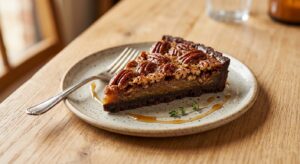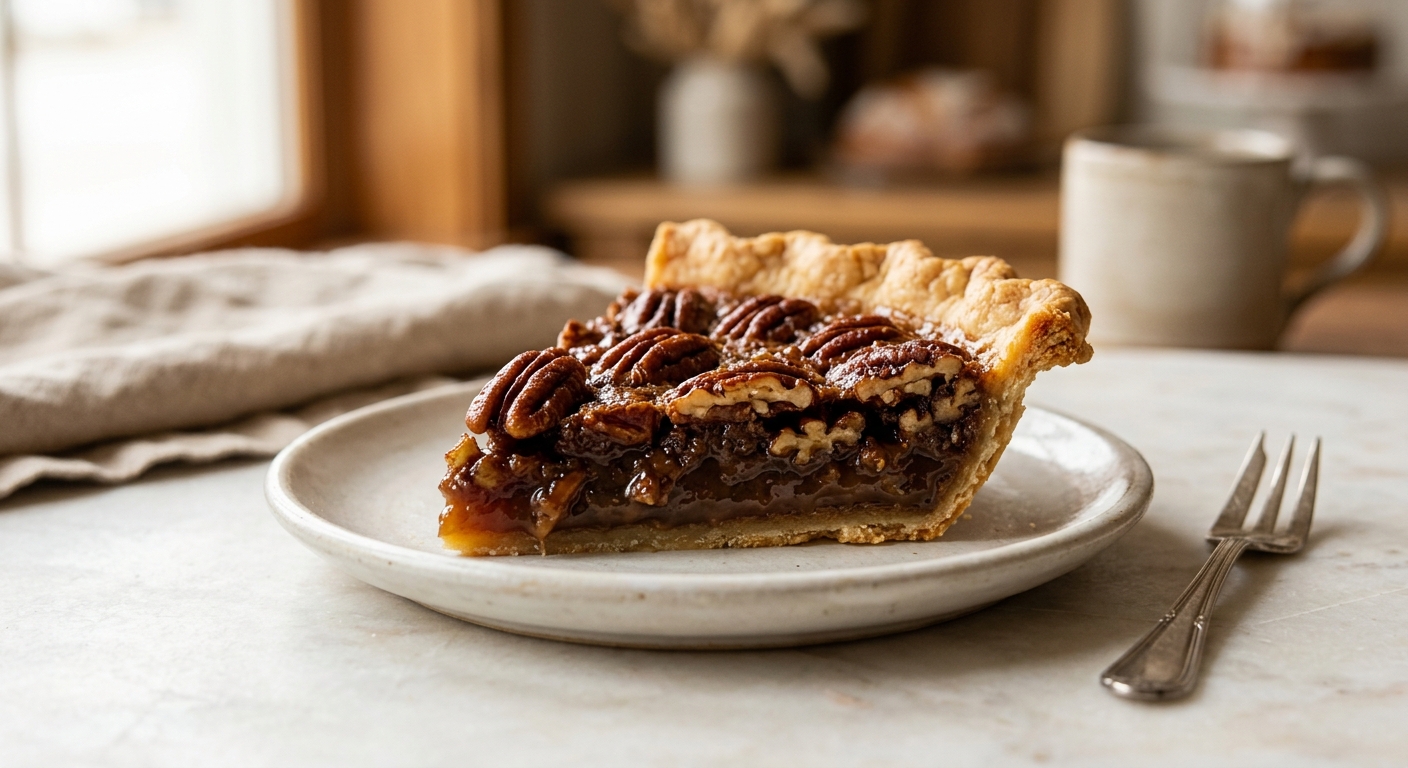
There is a moment, just after a pecan pie comes out of the oven, when the kitchen smells like toasted nuts and warm caramel and something almost smoky and sweet all at once. The filling is still trembling slightly in the center, the pecans are arranged in a burnished, lacquered crown, and you already know you are going to have to talk yourself out of slicing into it before it has properly set. This is that pie. The one your grandmother may have made, or the one you wish she had.
What sets this recipe apart is the choice of dark corn syrup over light. Dark corn syrup has a deeper, more molasses-forward flavor that gives the filling a genuine caramel complexity, rather than a one-note sweetness. Combined with dark brown sugar, real vanilla extract, and a full tablespoon of melted butter stirred into the filling, the result is a pie that tastes grown-up and substantial, not cloyingly sweet. The pecans are toasted before they go in, which is a small step that makes a remarkable difference in flavor and texture.
This recipe sits comfortably at a medium difficulty level. The filling itself is genuinely simple to put together, and if you use a store-bought crust on a time-pressed weeknight, nobody will judge you. But the homemade all-butter crust included here is worth every minute if you have the time, and the detailed instructions will walk you through it clearly. This pie is ideal for Thanksgiving, Christmas, or any occasion where you want to bring something truly impressive to the table.
Equipment Needed
Click on an item below to shop for the recommended items for this recipe on Amazon.
As an Amazon Associate, we earn from qualifying purchases.
10
Ingredients
- Crust
- 180 gall-purpose flour (about 1.5 cups, spooned and leveled)
- 1 tbspgranulated sugar
- 0.5 tspColima Sea SaltMicroplastic Free Salt
- 115 gunsalted butter, very cold and cubed (about 1/2 cup or 1 stick)
- 3 tbspice water, plus more if needed
- 300 gpecan halves (about 3 cups), lightly toasted
- 240 mldark corn syrup (about 3/4 cup plus 1 tablespoon)
- 150 gdark brown sugar, packed (about 3/4 cup)
- 3 largeeggs, at room temperature
- 56 gunsalted butter, melted and slightly cooled (about 4 tablespoons)
- 2 tsppure vanilla extract
- Filling (helps Stabilize The Custard)
- 1 tbspall-purpose flour
- Filling
- 0.5 tspColima Sea SaltMicroplastic Free Salt
- 1 tspapple cider vinegar (brightens the filling and balances the sweetness)
Ingredient Substitutions
Instructions
- Make the crust: Whisk together 180g flour, 1 tablespoon sugar, and 0.5 teaspoon salt in a large bowl. Add the cold cubed butter and toss to coat. Using your fingertips or a pastry cutter, work the butter into the flour until the mixture resembles coarse crumbs with some pea-sized pieces of butter remaining. Those chunks are what create flakiness, so do not overwork. Drizzle in 3 tablespoons of ice water and stir with a fork until the dough just comes together when pressed. Add an extra teaspoon of water at a time if needed, but stop as soon as it holds. Turn out onto a lightly floured surface, gently shape into a disc, wrap in plastic wrap, and refrigerate for at least 1 hour or up to 2 days.
- Toast the pecans: Spread the pecan halves in a single layer on a dry baking sheet. Toast in a 350°F (175°C) oven for 7 to 9 minutes, until fragrant and slightly deepened in color. Watch carefully as they can go from toasted to burnt quickly. Set aside to cool completely.
- Roll and blind bake the crust: On a lightly floured surface, roll the chilled dough into a 12-inch circle, about 3mm thick. Carefully transfer to a 9-inch deep-dish pie pan, gently pressing it into the corners without stretching. Trim the overhang to about 1 inch, fold it under itself, and crimp the edges as desired. Prick the bottom a few times with a fork. Line the shell with parchment paper, fill with pie weights or dried beans, and refrigerate for 15 minutes. Bake at 350°F (175°C) for 15 minutes. Remove the weights and parchment and bake for another 5 minutes until the base looks dry and just barely starting to color. Remove from the oven. Keep the oven at 350°F.
- Make the filling: In a large bowl, whisk together the dark corn syrup, dark brown sugar, melted butter, vanilla extract, apple cider vinegar, 1 tablespoon flour, and 0.5 teaspoon salt until smooth and well combined. Add the eggs one at a time, whisking after each addition. Do not over-whisk the eggs once added, as too much air can cause the filling to puff up and crack. Stir in two-thirds of the toasted pecans.
- Assemble and bake: Pour the filling into the warm blind-baked crust. Arrange the remaining pecan halves in concentric circles on top for a classic presentation. Place the pie on a rimmed baking sheet to catch any drips. Bake at 350°F (175°C) for 55 to 60 minutes. The edges should be set and puffed, but the center should still have a gentle wobble about the size of a quarter when you nudge the pan. It will firm up as it cools.
- Cool completely: Transfer the pie to a wire rack and allow it to cool for at least 2 hours before slicing. The filling needs this time to fully set. Cutting too early will result in a runny interior. The pie can be served at room temperature or very slightly warm, with a scoop of vanilla ice cream or a dollop of lightly sweetened whipped cream.
- Prepare the crust: Make a half-batch of the homemade crust dough as described in the oven method, or use one sheet of store-bought rolled pie dough. Roll and fit into a 7-inch pie dish or six 4-inch tartlet pans. Crimp edges and refrigerate for 20 minutes. There is no need to blind bake for the air fryer method as the direct circulating heat cooks the base through effectively.
- Prepare the filling: Make the full filling exactly as described in the oven method, using all the same ingredients and proportions. For individual tartlets, distribute the toasted pecans evenly. Pour the filling into the chilled crust, leaving at least 1cm of space at the top as it will puff slightly. Arrange reserved pecan halves on top.
- Air fry the pie: Place the filled pie dish into the air fryer basket. If your air fryer runs hot, tent a small square of foil loosely over the top for the first 15 minutes to prevent the pecans from over-browning. Air fry at 325°F (160°C) for 28 to 32 minutes for a 7-inch pie (20 to 22 minutes for individual tartlets), until the edges are set and the center has only a very slight jiggle. Check at the 22-minute mark and loosely foil the top if the surface is browning too fast.
- Cool before serving: Remove carefully using oven mitts, as the dish will be very hot. Place on a wire rack and cool for at least 1.5 hours before slicing. The smaller size means it sets slightly faster than the full-sized oven version. Serve with whipped cream or ice cream.
- Make the press-in crust: Combine 200g (about 2 cups) of finely crushed graham crackers or digestive biscuits with 85g (6 tablespoons) of melted unsalted butter and 2 tablespoons of granulated sugar. Stir until the mixture resembles wet sand. Press firmly and evenly into the bottom and up the sides of a 9-inch pie dish using the flat bottom of a measuring cup. Refrigerate while you make the filling.
- Toast the pecans: In a dry skillet over medium heat, toast the pecan halves for 4 to 5 minutes, stirring frequently, until fragrant and lightly browned. Remove from heat immediately and set aside to cool. Roughly chop two-thirds of them and leave the rest as halves for topping.
- Cook the filling: In a medium heavy-bottomed saucepan, combine the dark corn syrup, dark brown sugar, and melted butter over medium heat. Stir until the sugar is dissolved, then bring to a gentle boil and cook without stirring for 4 minutes. Remove from heat and allow to cool for 5 minutes (this is important, as adding eggs to a too-hot mixture will scramble them). In a separate bowl, whisk the 3 eggs with the vanilla, salt, apple cider vinegar, and 1 tablespoon flour until smooth. Gradually stream the warm syrup into the egg mixture while whisking constantly. Return everything to the saucepan and cook over medium-low heat, stirring constantly with a silicone spatula, for 6 to 8 minutes until the mixture has thickened noticeably and coats the back of a spoon. It should register around 175°F to 180°F (80°C to 82°C) on an instant-read thermometer.
- Assemble and set: Stir the chopped toasted pecans into the warm filling. Pour into the chilled crust and smooth the top. Arrange the reserved pecan halves on top in a decorative pattern. Press them gently into the surface so they adhere as the filling sets.
- Refrigerate until firm: Cover loosely with plastic wrap (do not let the wrap touch the surface) and refrigerate for at least 3 hours, or overnight for the cleanest slices. Slice with a sharp knife dipped in hot water and wiped dry between cuts. Serve cold or allow to sit at room temperature for 20 minutes before serving.
Nutrition Per Serving
Per 1 serving (makes one 9-inch deep-dish pecan pie)
Why This Recipe Works
The filling of a pecan pie is essentially a baked egg custard sweetened with syrup. The eggs provide the protein network that, when heated, coagulates and transforms the liquid filling into a sliceable, set texture. This is why over-whisking the eggs matters: too much incorporated air causes the proteins to set unevenly, resulting in a puffed, cracked surface. Gentle whisking keeps the custard smooth and glossy. The tablespoon of flour is a small but effective stabilizer, giving the egg proteins a little extra support and reducing the risk of a weepy or overly soft filling.
Dark corn syrup is the star ingredient here for good reason. Unlike light corn syrup, which is essentially pure glucose with a neutral sweetness, dark corn syrup contains refiners’ syrup, a byproduct of sugar refining that is rich in minerals and has a flavor profile similar to light molasses. This is what gives the filling its characteristic depth, a hint of bitterness that balances the sweetness and creates complexity. The addition of dark brown sugar, which contains more molasses than light brown sugar, reinforces this effect. The apple cider vinegar is a chef’s trick: a small amount of acid brightens the overall flavor and cuts through what could otherwise be cloying sweetness, without adding any detectable vinegar flavor.
Blind baking the crust is non-negotiable for a pie with a wet filling like this one. Pouring a liquid custard directly onto raw pastry creates what bakers call a ‘soggy bottom,’ because the steam from the filling is absorbed by the unbaked dough rather than escaping through the hot pan. The brief blind bake dries out the interior of the crust, creating a moisture barrier so the base bakes through properly. If your crust edges begin to brown too quickly during the final bake, simply shield them with a strip of foil or a pie crust shield, pressing it gently around the perimeter.
Baker’s Tips
- Keep the butter very cold for the crust. If your kitchen is warm, chill the flour and mixing bowl in the freezer for 10 minutes before you start. Visible butter flakes in the dough mean steam pockets during baking, which translates directly to flakiness.
- Toast the pecans even if you are short on time. It takes under 10 minutes and the difference in flavor between raw and toasted pecans is significant. Raw pecans can taste bland and slightly waxy inside a baked pie.
- Let the melted butter cool before adding it to the filling. If it is too hot when it meets the eggs, it can begin to cook them and create an unpleasant texture.
- Place the pie on a rimmed baking sheet before it goes in the oven. Pecan pie filling can bubble over the edges, especially if the filling is very full, and a baking sheet saves you from a smoky oven and a cleaning nightmare.
- The jiggle test is your best guide for doneness. The filling should jiggle like set Jell-O at the very center (about a 2-inch circle), not slosh like liquid. If the whole pie is moving fluidly, it needs more time. An instant-read thermometer inserted in the center should read between 195°F and 200°F (91°C to 93°C) when done.
- Resist slicing for at least 2 hours. We know it is hard. But the filling continues to set as it cools, and cutting too early will give you a runny pie. The wait is genuinely worth it.
Variations
- Bourbon Pecan Pie: Replace the apple cider vinegar with 2 tablespoons of good-quality bourbon. The whiskey adds a warm, oaky depth that is especially welcome during the holiday season.
- Chocolate Pecan Pie: Melt 85g (3 oz) of good-quality dark chocolate and whisk it into the filling along with the butter for a deeply fudgy, brownie-like interior.
- Salted Caramel Pecan Pie: Increase the salt in the filling to 1 teaspoon and finish the baked pie with a light sprinkle of flaky sea salt (such as Maldon) over the top while still warm.
- Spiced Pecan Pie: Add 0.5 teaspoon cinnamon, 0.25 teaspoon ground ginger, and a small pinch of cloves to the filling for a warmly spiced version that pairs beautifully with the dark syrup.
Troubleshooting & FAQ
My pecan pie filling is still runny after baking and cooling. What went wrong?
The top of my pie cracked or the filling puffed up and then collapsed. Did I do something wrong?
My crust is soggy on the bottom. How do I prevent this?
My crust shrank and slid down the sides of the pan during blind baking. How do I stop this?
The pecans on top burned before the filling was set. What should I do?
Storage & Make-Ahead
- Storage: Store loosely covered at room temperature for up to 2 days, or refrigerate for up to 5 days. To prevent the crust from softening, place a paper towel under the pie dish in the fridge to absorb condensation. The pie can be frozen whole or in slices, well wrapped, for up to 2 months. Thaw overnight in the refrigerator and bring to room temperature before serving.
- Make-Ahead: The pie crust dough can be made up to 3 days ahead and refrigerated, or frozen for up to 3 months. The fully baked pie actually improves overnight as the filling firms and the flavors deepen, making it ideal to bake the day before serving. If baking ahead, cool completely, cover, and store at room temperature or in the refrigerator.